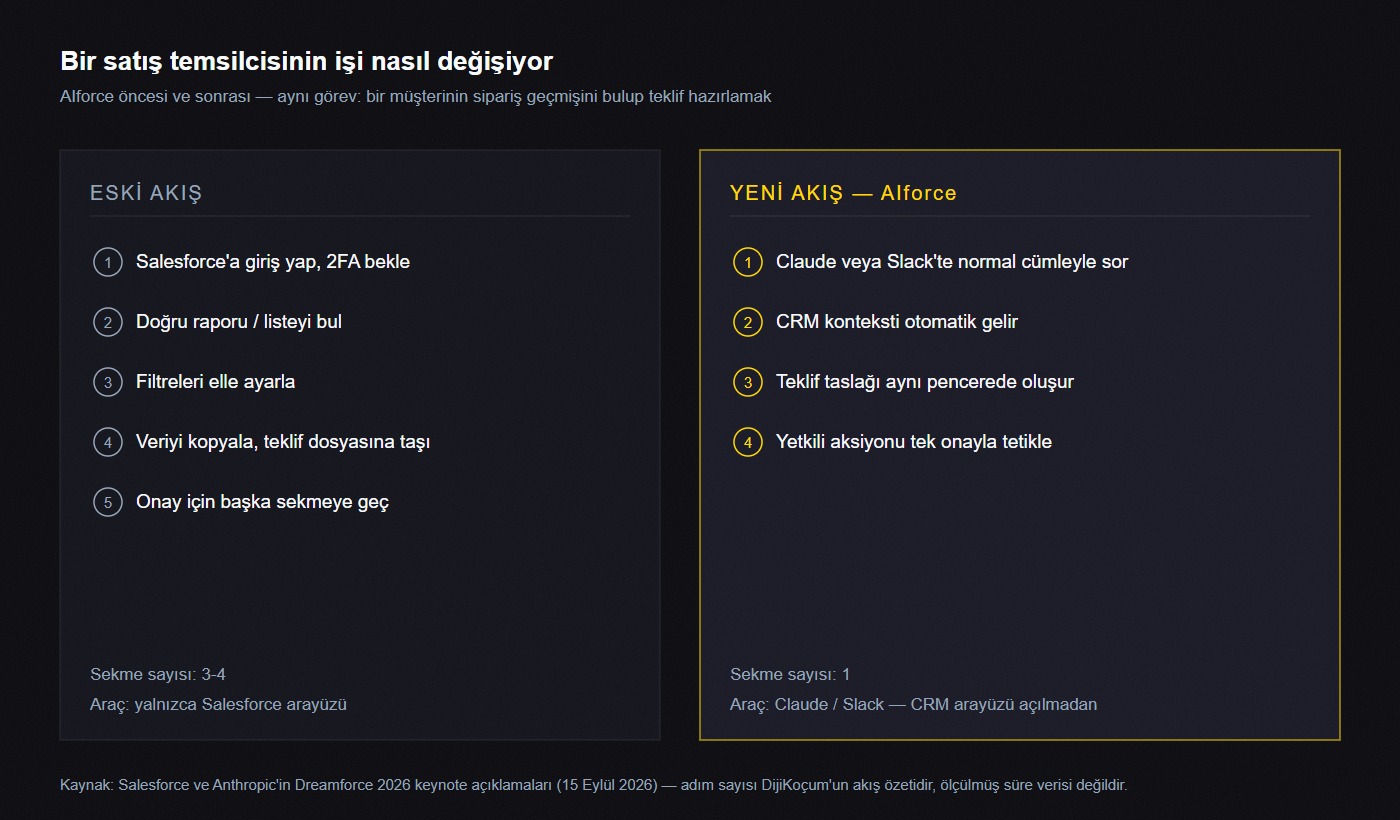
When your sales team starts work in the morning, which window do they open first? At most companies, the answer has been the same for years: the CRM. To check a customer's history, to prepare a quote, to see which lead has gone cold, the day starts by logging in there.
On September 15, Salesforce, the biggest player in the CRM world, took the stage and said that may no longer be the case. Co-founder Parker Harris's line was exactly this: "You may never log in to Salesforce again." [A] Introducing your own product's interface that way at a trade show isn't an ordinary marketing line; it's the announcement of a strategy shift.
Quick answer: At Dreamforce 2026, Salesforce announced "AIforce," an umbrella strategy that takes CRM data out of its own interface and into tools employees already use, such as Claude and Slack. [A] This directly concerns Salesforce customers and, indirectly, anyone working with competing CRMs (HubSpot, Zoho, Pipedrive). The one thing to do today: for a single day, have your team note how many times they log into the CRM and what they go there to find.
What happened?
In its Dreamforce 2026 keynote, Salesforce laid out an umbrella strategy it calls "AIforce": the CRM is being repositioned not as an application you go to, but as a layer that the data and business rules sit behind. [A] In concrete terms, that comes in three parts:
ClaudeForce connects Anthropic's Claude Enterprise to Salesforce data. When an employee asks Claude a customer question in plain language, CRM context (account history, the suggested next step) comes in automatically, and authorized actions can be triggered without opening the Salesforce interface. [A] The foundation of this integration isn't actually new: the partnership between Salesforce and Anthropic was first announced under the name "Claudeforce" on August 26, and what was shown at Dreamforce was an expanded version, demoed live on stage. [A]
Slackforce brings CRM context into Slack; "Slackforce Surfaces" turns a prompt into a live dashboard.
Koa is a reasoning model built specifically for CRM, trained on NVIDIA's Nemotron technology. According to Salesforce's own claim, the model matches or exceeds leading models on CRM-specific actions with three times fewer errors. [A] This is the company's own measurement, not an independent benchmark, and it's worth keeping that in mind as you read.
Anthropic CEO Dario Amodei was also on stage. Marc Benioff's line was less dramatic than Harris's but pointed the same way: "AIforce is here to unlock trapped value from anywhere." [A] At least two separate sources confirm the news: CX Today's Dreamforce recap, the Tech Times article published on September 16, and Anthropic's own announcement page all describe the same three parts (AIforce, Slackforce, Koa). [A]
Why does it matter?
This isn't Salesforce's only AI move this year. On September 11, the company introduced seven named Agentforce agents (Casey, Paige, Carter, Hunter, Marshall, Piper, Fin), each focused on a single function such as sales, service, or commerce. [C] Four days later came AIforce. In other words, the company is making announcements back to back, at an accelerating cadence. That alone doesn't mean "hurry up," but it shows how tight the competition has become.
Why is it so tight? Because CRM competitors are all racing in the same direction at the same time. Microsoft is adding agent-based automation to Dynamics 365; HubSpot and smaller players have also announced their own AI layers. [C] Salesforce's real worry probably isn't a rival CRM. It's that employees already live in Slack, email, and ChatGPT, and are starting to see the CRM as "an extra tab." If people stop opening an application, it no longer matters how smart that application is.
I think the real question here isn't technical, it's cultural. The line "You may never log in to Salesforce again" sounds liberating, but in practice it means this: the cleaner your data hygiene, permission rules, and workflows are, the more useful this new layer becomes. If you connect Claude to a messy CRM, the answers you get will be messy too. They'll just be messy faster.
In Turkey: It would be a mistake to apply this to everyone right away. The general observation is this: at many small businesses (SMBs), leads still sit in Excel and customer notes still sit in WhatsApp, so there isn't even a single body of "CRM data" to bring together. In a setup like that, the "ask Claude and take action without opening the CRM" scenario remains theoretical for now. I won't predict when it will become practical; it depends on how quickly the data gets organized, and even on the enterprise AI consulting side, it's hard to give a universal timeline for that.
What changes for your brand?
Enterprise companies already using Salesforce: AIforce is opening up to large customers for now, and when it will reach smaller plans is unclear. Mapping out now what your team logs into the CRM to ask every day will help you be ready when the integration arrives.
HubSpot, Zoho, or Pipedrive users: This news doesn't affect you directly, but you'll feel the pressure. Competing CRMs may announce a similar "manage it from a chat interface" layer in the coming months; this is turning into a standard expectation.
Businesses that haven't built proper CRM discipline yet: This isn't your priority. First you need to bring your lead and customer data together in one place; an AI layer won't fix anything if the data underneath is scattered. That cleanup is actually the first step of CRM consulting work; I explained what a CRM is and how it's set up, step by step, in the what is a CRM and what does it do guide.
Agencies and integrators: If a client asks "can we connect it to Claude too?", the first question to ask is "to which data, with which permissions?" This is more a permissions and process job than a technical setup.
Affected
Not affected
Salesforce's enterprise/large-plan customers, teams using Claude Enterprise
Small-plan Salesforce users (for now)
Sales teams that want to manage CRM data through Slack
Teams that don't use Slack and run all communication over email
Competing CRM vendors (they'll feel pressure to build a similar layer)
Businesses that haven't set up a CRM yet and run on Excel/WhatsApp
The one thing to do today
Ask someone on your team to jot down a note today every time they log into the CRM (or whatever customer record system you have): the time, what they were looking for, and how many minutes it took. The list you have by evening will answer the question "could this really have been handled from a chat window?" far more clearly than your CRM vendor ever will. You can do it without buying anything.
Today's Radar
News
Why people are talking about it
Who it concerns
Instagram opened its "Your Algorithm" feature to all English-language users; users can see and adjust what shapes their Reels recommendations
A direct answer to demands for algorithm transparency; the logic behind how brand content gets recommended is now partly visible
OpenAI passed Anthropic in enterprise revenue for the first time in 2.5 years (the claim is tied to GPT-6 Astra); the story goes that a year ago it was 10 points behind Anthropic among the Global 2000 and is now 25 points ahead
The figures come from a single source and are unverified, but they show how fast competition in the enterprise AI market is moving
Meta opened the AI business assistant in Ads Manager to all advertisers and agencies; it suggests campaign setup step by step
It partly takes on the "media planner" role for small-budget advertisers
Small businesses that run their own Meta ads → Meta Ads
FAQ
Does AIforce mean Claude is replacing Salesforce?
No. Claude, Slack, and other tools connect to CRM data as an "access layer"; the data still lives in Salesforce, and the permission rules are still defined there. What changes is where the data is viewed and managed from.
Can this feature be used today?
Partly. The integration behind ClaudeForce had been in testing with certain customers since August; what was shown at Dreamforce was an expanded version. Which plan tiers it will reach, and when, isn't clear; you'll need to follow Salesforce's own announcements for that.
As a small business, should I be thinking about this now?
If you don't use Salesforce, no, this news doesn't directly concern you. But the question "can I manage my CRM data from a chat interface?" is one that will reach everyone in the next year or two, regardless of size; getting your CRM discipline in place now will make sure you're ready when that day comes.
If you want to clean up the mess on the CRM side or automate your sales process, take a look at our CRM & Sales Automation service. To talk about how to connect AI to your workflows, our AI Automations page can be a starting point too.
October 7, 2026: a WhatsApp button started appearing on Google's local business card. In Turkey, 90% of internet users use WhatsApp, according to the national statistics office; what should businesses do?
I explain what a CRM actually does, how to set one up, and how to tell which software fits you. I also take an honest look at free plans, Excel and WhatsApp CRM.
AI & automation10 minOpen guide
We use cookies to improve the site and measure advertising performance. Analytics and advertising cookies run only if you accept them. Details are in our Privacy Policy and Data Protection Notice.