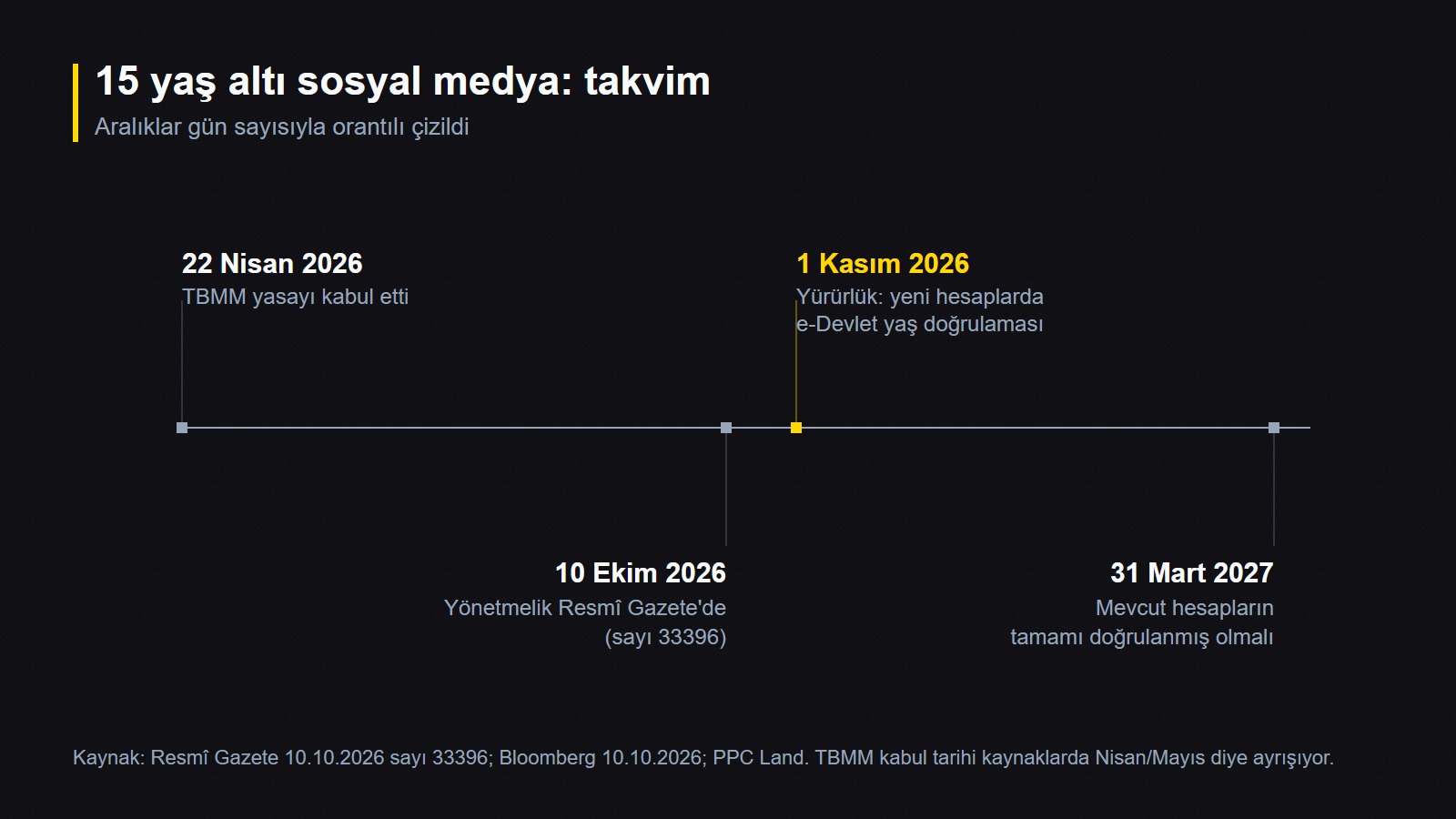
Anyone who opened the October 10 issue (No. 33396) of the Official Gazette of Turkey on Saturday morning would have found a long title in fifteenth place on the list of regulations: "Regulation on the Provision of Separate Child-Specific Services by Social Network Providers and on Age Verification" (in Turkish: Sosyal Ağ Sağlayıcı Tarafından Çocuklara Özgü Ayrıştırılmış Hizmet Sunulmasına ve Yaş Doğrulamaya İlişkin Yönetmelik) [A]. The title is dull; the content isn't. It bans providing services to children under 15 in Turkey, and it takes effect on November 1, 2026.
For anyone managing social media for brands in Turkey, the real question isn't "what happens to the kids." The real question is what the "separate service" for 15- to 17-year-olds does to your account's reach, your ads, and your partnerships. This post tries to sort that out.
Quick answer: From November 1, 2026, every social network provider accessible in Turkey will be barred from serving users under 15; users aged 15-17 will be moved to a separate, restricted version through age verification via e-Devlet (Turkey's e-government portal). Every brand that speaks to young people or families should factor in that part of its audience will shrink or become invisible. The first thing to do: export the last 90 days of follower and reach data with an age breakdown.
What happened?
Turkey's parliament (TBMM) passed the law in April this year; sources differ on the adoption date, giving either April 22 or May, and I've gone with April 22 [C]. The regulation published on Saturday was prepared by Turkey's Cybersecurity Directorate. The 14-article text covers every social network provider accessible from Turkey, domestic or foreign; there's no threshold based on user numbers [B][C]. So there's no visible "small platforms are exempt" loophole.
Here's how the mechanism works. The user logs into e-Devlet, gets a token, and uploads it to the platform. The token carries only two pieces of information: whether the person is 15 or older, and whether they are 18 or older. It reportedly carries no other personal data, and the platform may use it only for the age check [B]. For temporary visitors who don't live in Turkey, there's an exceptional token obtained with a passport.
The timeline has two stages:
November 1, 2026: verification becomes mandatory for new accounts; the regulation takes effect.
March 31, 2027: all existing accounts must have been verified at least once. Accounts found to belong to under-15s are closed with a notice; those 15 and older move to the restricted service [B][C].
The regulation doesn't specify penalty amounts for platforms; it refers to the sanctions framework in Law No. 5651 (Turkey's internet law). In case of a violation, a reasonable correction period is granted first, and the severity criteria include the number of children affected and good-faith compliance efforts [B]. The technical guide (the token format, the platform's process) hasn't been published yet, and no date has been given.
Why does it matter?
The list of rules for 15- to 17-year-olds is long, and some of them hit marketing directly [B][C]:
Accounts are private by default; there's no public option.
Only the account owner can see the follower and following lists.
Only followed accounts can send messages.
No live streaming.
No behavior-based personalization, profiling, or personalized advertising. Not even with parental consent.
Interfaces that serve visual content back to back through scrolling, tapping, or autoplay are banned. The text doesn't explicitly name this as "feed" or "Reels"; my interpretation: short-video feeds will either not exist at all for this group or will look completely different.
No contact or phone syncing, no account suggestions.
Then there are the under-15s. For them, it's not a restriction; accounts simply can't be opened. In a survey by EDAM, a think tank in Turkey, 53% of respondents oppose a full start on November 1, while 45% favor starting as planned [C]. I think the chance of the date slipping isn't low. But for a brand that waits because "it might slip," the loss is a week or two if it slips; if it doesn't, it's all of November. I'm not making a prediction; I'm only saying the risk is asymmetric.
What changes for your brand?
Not all of it applies to everyone. Break it down by your audience's age.
Brands that sell to teens (stationery, games, clothing, cosmetics, education): personalized advertising is shutting off for the 15-17 group. How well your Meta or TikTok campaigns targeting this age band will keep working is something I can't give a clear answer to either; we'll see how the platforms implement the regulation.
Brands doing influencer partnerships: Private accounts and hidden follower lists change how a teen will see a product post. At the same time, if you've signed with a creator whose audience is mostly under 15, part of that audience may not be able to open accounts in November. Read the reach commitment in your contract now.
Brands that sell to families: There's an indirect but real effect. Parental control tools (approval for paid transactions, spending limits, usage time) become mandatory [B]. For a brand selling in-app purchases or subscriptions, the payment flow may have to go through parental approval.
Brands that sell to a general audience: You'll probably be the least affected, but I'm stressing the word "probably." If you see a small drop in your follower count, this may be the reason; knowing that keeps you from blaming the wrong campaign.
Under 15
Ages 15-17
18 and over
Opening an account
Banned
Restricted version
Normal
Personalized ads
None
None
Per platform rules
Live streaming
None
None
Normal
Account visibility
None
Private by default
Normal
Deadline for existing accounts
March 31, 2027
March 31, 2027
One-time verification
The one thing to do today: From your Instagram, TikTok, and YouTube dashboards, export the last 90 days of follower and reach data with an age breakdown, and write the share of 13- to 17-year-olds in a cell. You don't need to buy anything. After November 1, that number will be the only honest answer to the question "how much of our audience did we lose?"
Today's Radar
News
Why people are talking about it
Who it concerns
Meta banned ByteDance and TikTok ads on Facebook and Instagram (October 8); it applies in the US, Canada, Egypt, Indonesia, Japan, Thailand, and Vietnam, and Turkey isn't on the list [C]
Third-party ads promoting the rival app are blocked too
An EU Council draft cuts the interval at which sites can ask for cookie consent again to four months (PPC Land, October 10); it's a draft, not in force [C]
It doesn't directly bind Turkey, but sites selling to the EU will be watching
ChatGPT shows interactive elements such as comparison tables and calculators inside the chat (OpenAI release notes, October 7); the model names are not confirmed by a second source [C]
All domestic and foreign social network providers accessible from Turkey. The text has no threshold based on user numbers [B][C]. The text doesn't make clear which services count as a "social network," though; there's uncertainty around gaming and messaging apps.
Is a brand's account also subject to age verification?
Verification is described for individual users. No separate provision on business accounts appears in the text, but it wouldn't be right to speak definitively before the technical guide is published.
Will ads be shown to the 15-17 age group?
Behavior-based personalization and profiling are banned; the status of contextual ads isn't explicitly stated in the text [B]. So it's too early to say either "it's completely shut off" or "nothing will change."
September 19, 2026: Meta One launched worldwide on September 15, with business plans in Turkey at TRY 259-8,699 a month. Professional Facebook accounts without a subscription are limited to two link posts a month; who is affected, and what should you do?
I explain how a business account is managed month to month, why your Instagram profile comes before ads, and what to look for in a social media package. There's also a checklist you can use on your own account or on a proposal you've received.
Social media & video9 minOpen guide
We use cookies to improve the site and measure advertising performance. Analytics and advertising cookies run only if you accept them. Details are in our Privacy Policy and Data Protection Notice.