"The fastest way to grow on Shorts is to find a video that took off and post it again on your own channel." I've heard this so often over the past year that I'd stopped bothering to argue. Compilation channels, "10 funniest moments" accounts, pages that slap subtitles on someone else's footage and upload it. And it worked, I won't deny that.
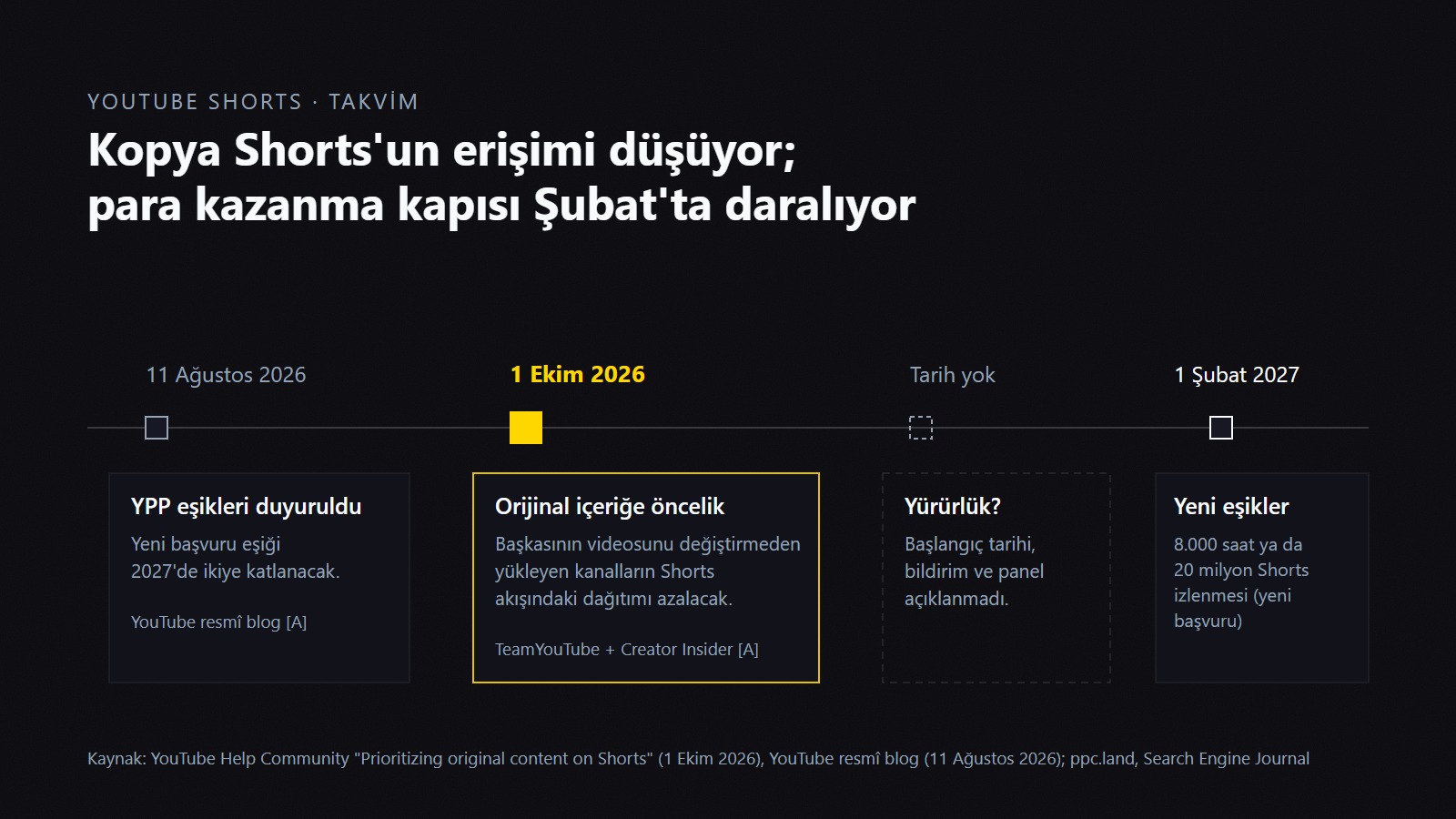
On October 1, YouTube officially put up a sign on that road. The "Prioritizing original content on Shorts" note TeamYouTube posted in the Help Community and Rene Ritchie's explanation on Creator Insider the same day say the same thing: channels that upload other people's videos without adding anything of their own will see their reach in the Shorts feed drop. Channels that shoot and edit their own content will be pushed forward.
Quick answer: On October 1, 2026, YouTube announced it has updated the Shorts recommendation system to reduce distribution for channels that reupload other creators' videos without meaningful changes. This affects compilation accounts and brands that share other people's content on their own channel. Feed your Shorts with your own footage, your own commentary, and your own editing; if you want to show someone else's video, point people to the original.
What happened?
In YouTube's words, its recommendation systems will "give more priority" to original content and reduce the reach of content reuploaded from other creators "without adding something of your own" [A]. Channels found to mainly aggregate or reupload content are expected to get less distribution in the Shorts feed [A].
The line Ritchie drew is, in my view, the most useful part of the announcement. He listed exactly what isn't enough: a voiceover narrating what's on screen, minor technical edits, and batch changes made with templates don't count as "original" [A, via Search Engine Journal]. What's expected is that something of yours goes into the video. That could be commentary, or a story you have to tell. If you want to show someone else's video to your audience, YouTube's suggestion is to share it in your channel's Posts tab, which sends viewers to the original.
One more detail: this is a distribution rule, not a monetization rule. Reused content already couldn't make money under the "reused content" policy [A]. According to ppc.land's breakdown, reupload views also weren't counted toward the Shorts revenue pool [C]. The third layer is what's new: now you get pushed to the back in the feed as well.
Search Engine Journal, Social Media Today, ppc.land, and Music Ally each covered the announcement. The gap they all highlight is the same. There's no start date.
Why does it matter?
Because this was the easy growth path on Shorts, and YouTube is closing it without giving any indicators. It hasn't said when it starts, where a channel whose reach has been cut can see that, or how long it takes for a channel that fixes itself to be "re-evaluated" [A]. Ritchie says there will be re-evaluation, but gives no timeline. It's unclear when this will become clear, and I'm not going to speculate.
The second reason is the timing. On August 11, YouTube announced that it would double the entry thresholds for the YouTube Partner Program (YPP) starting February 1, 2027: for new applications, 1,000 subscribers plus either 8,000 watch hours in 365 days or 20 million Shorts views in 90 days [A]. Today the threshold is 4,000 hours or 10 million. There's also a new gate for channels already in the program: to keep receiving a share of Shorts ad revenue, they'll need at least 10 million qualified Shorts views in the last 90 days [A].
So the two moves point in the same direction. Racking up views on Shorts is getting harder, and views only count if they come from original content.
I also have a contrarian take. This announcement isn't as big a break as everyone says. Instagram rolled out a similar ranking rule earlier, and Adam Mosseri said afterward that reach for original creators went up [C, via Social Media Today]. Facebook takes the same approach. YouTube is really just doing what its rivals did long ago. The real news is that the latecomer has finally arrived.
What changes for your brand?
Most brands don't run compilation channels, so your first reaction might be "this doesn't affect me." But these situations are more common than you'd think:
If you publish influencer or customer videos on your own channel, be careful. The announcement doesn't explicitly address brands using licensed creator content [C]. Having permission doesn't mean the system won't read it as a "reupload from someone else." At the very least, add your own intro, your own commentary, or your own product footage.
If you cut your own long videos into Shorts, there doesn't seem to be a problem; the content is already yours. Uploading your own TikTok or Reels videos to YouTube as well isn't what this announcement is about. There's no new statement on how watermarked uploads are treated, so uploading clean files is still the smart move.
If your agency mass-produces Shorts for you from templates, meaning other accounts' clips get dropped into the same template, that's exactly what Ritchie called "not enough."
If you're a local business, you actually have the advantage. Your kitchen, your workshop, your team, the question your customer asked. You already have footage nobody can copy. A video shot on a phone but genuinely yours is becoming more valuable than a perfectly edited copy.
Until now
After the October 1, 2026 announcement
Shorts reuploaded without changes
Couldn't make money, but could still get reach in the feed
Can't make money, and feed distribution is reduced too
Voiceover narrating "what's happening on screen"
Gray area
According to Ritchie, doesn't count as original
Your own commentary, analysis, your own footage
Normal distribution
Prioritized
Showing someone else's video
Uploading it to your channel was common
Recommended route: share it in the Posts tab
Seeing that your reach has been cut
—
No dashboard or notification announced
YPP threshold for new applications
4,000 hours or 10 million Shorts views
8,000 hours or 20 million starting February 1, 2027
This is the perfect time to look at how you've set up your video production. If you don't have your own filming setup, our production and video service exists for exactly this gap.
The one thing to do today
Open the last 30 Shorts on your channel and write one word next to each: "ours" or "someone else's." For the "someone else's" ones, decide: can you re-edit them by adding your own intro and commentary? If you can't, turn that video into a Post that points to the original. It takes fifteen minutes, and you don't need to buy anything.
Today's Radar
News
Why people are talking about it
Who it concerns
ChatGPT added virtual try-on for clothing and accessories (October 1)
A "Try on" button on the product card generates an image on your selfie; shopping inside ChatGPT got one step shorter
E-commerce brands selling clothing and accessories, ChatGPT SEO / GEO
An st_source=ai_overview parameter spotted on AI Overviews links (October 2)
Shared by Tom Pool; Barry Schwartz couldn't reproduce it, and Google hasn't confirmed it. If it sticks, AI clicks could be measured separately for the first time
If I upload my own TikTok video to YouTube Shorts, will my reach drop?
This announcement targets other creators' videos; publishing your own content on another platform as well appears to be outside its scope. Still, uploading a clean file without a watermark is the safest route.
Is adding a voiceover to someone else's video enough?
No. According to Rene Ritchie, YouTube's Creator Liaison, a voiceover narrating what's on screen, minor technical edits, or batch changes made with templates don't count as original. Something of yours has to go into the video: your commentary, or a story you have to tell.
How can I tell if my reach has dropped?
YouTube hasn't announced a dashboard or notification for this. In practice, the only way is to track views from the Shorts feed week by week in YouTube Studio.
If you want to feed your Shorts with your own footage, talk to our production and video team; for the publishing plan side, take a look at the social media management page. If you'd like to see where you stand first:
What do you decide before you shoot a Reel, what do you watch for while filming, and why do some videos get scrolled past in the first second? I also give an honest take on brand films and AI video.
OpenAI is removing the Videos API and all Sora 2 models on September 24, 2026, and its documentation recommends no replacement model. Daily Radar, September 14, 2026.
Social media & video7 min
We use cookies to improve the site and measure advertising performance. Analytics and advertising cookies run only if you accept them. Details are in our Privacy Policy and Data Protection Notice.