On Thursday, Google introduced a new version of Gemini, and the first line sounds strange: this agent has a workplace account. Its own email address, its own calendar, its own Drive space. Someone assigns it a task, and it can pick up that task like an employee and hand it off to someone else.
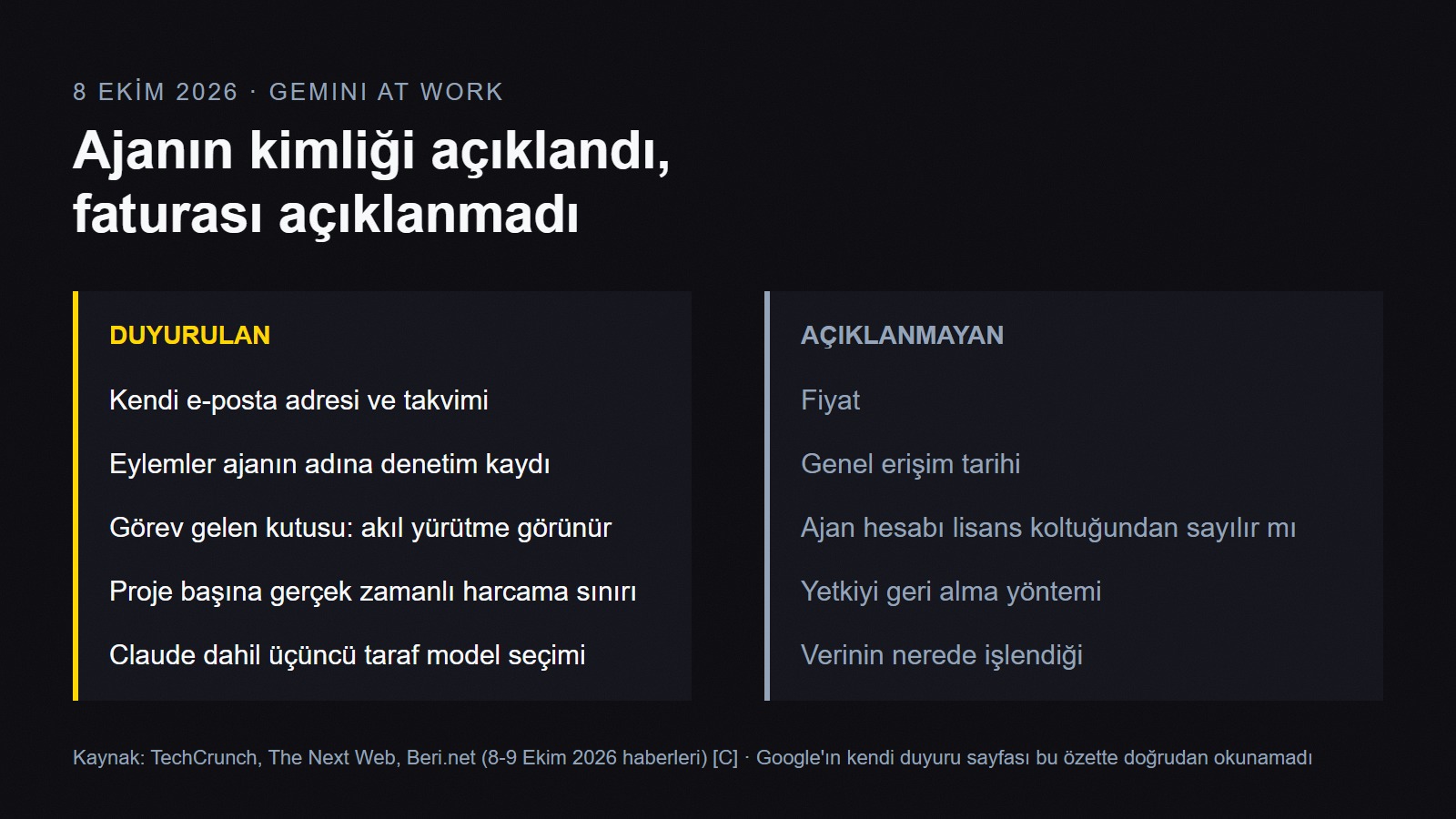
It's easy to read this as "a robot coworker," and I think that's misleading. The real news is that the agent has an identity: every action is logged under its name, its permissions are defined, and its spending is capped. In other words, AI is moving from being a "tool" to being a managed account. Pricing and a general availability date, however, are nowhere to be seen.
Quick answer: On October 8, 2026, at its Gemini at Work event, Google announced a unified Gemini agent for businesses; the agent takes a goal, plans the work, assigns tasks to sub-agents, and can operate with its own Workspace account. It's coming to enterprise customers first; pricing and a general availability date haven't been announced. If you're a small team, don't buy anything now; write down which job you'd want to give an agent, and with what permissions.
What happened?
The announcement came on Thursday, October 8, 2026. According to TechCrunch, Google Cloud CEO Thomas Kurian said, while describing the agent, that you give it "a goal, not instructions": the agent plans the work, uses specialized skills and tools, connects to the company's internal systems, and delegates work to sub-agents when needed. It can write code, schedule meetings, and arrange appointments and travel. [C]
The list of integrations is broad: Google Workspace, Microsoft 365, Slack, Jira, Confluence, Git, BigQuery, Databricks, Postgres, Snowflake, and any MCP server. Model choice is open too: by default, Gemini picks the most suitable model itself, and users can choose third-party models if they want, notably Anthropic's Claude models. [C]
Here's how the identity side is described. An administrator defines a role, and Gemini creates a "coworker agent" for that role with an email address, calendar, Drive space, and directory entry. Each agent has a credential-authenticated identity; every action it takes is written to the audit log under the agent's name, not an employee's. In the task inbox, you can follow the agent's reasoning, the skills it used, the code it wrote, and the work it delegated to sub-agents. [C]
Google is offering this to enterprise customers first; when it will reach consumers isn't known. On, Shopify, and PayPal are named among the first testers. [C]
The details here come from reports by TechCrunch, The Next Web, and Beri.net. All three describe the same framework, but check Google's blog for the exact wording.
Why does it matter?
Because until now, the security question around AI was "what is the employee pasting into this tool?" Now the question is changing: "on whose behalf, with what permissions, and with what record is this agent working?" The agent having its own account is a good thing, because the records don't get mixed up. Still, keeping a record doesn't mean the record points to someone accountable.
The criticisms reported by The Next Web converge on exactly this point. Google doesn't require a named human owner for the agent. The spending cap works at the project level; when the cap is reached, the agent in that project stops, which means one agent's runaway job can freeze another agent in the same project. What happens to email sent to a paused agent hasn't been explained. The method for revoking permissions isn't in the announcement either. [C]
A Gartner forecast is also widely quoted: 40% of organizations will pull back their autonomous agents by 2027 because of governance gaps. That's a prediction, not a certain outcome; I wouldn't rely on it alone. [B]
I have a contrarian take: I think the most important part of this announcement for small businesses isn't the agent itself but the concept of an "account." The moment you start treating software like a user, you start talking about licenses, permissions, and auditing. Do agent accounts count as license seats? That hasn't been said. Considering that Business editions have user limits, that's not a small question.
What changes for your brand?
Solo business or a team of 5-10 people: This product probably isn't for you, at least for now. No pricing, no general availability date, and the initial target is large organizations. Waiting costs you nothing.
Agency or company of 20-300 people on Google Workspace: Keep an eye on the admin console. If agent accounts become visible on your plan, that's where you'll notice first. Thinking ahead about which data it can access is easier than cleaning up afterward.
E-commerce: Shopify is among the first testers; you might expect the product to be connected to sales operations, but that's a guess, not an announced plan.
Service firms (advertising, SEO, content agencies): You'll need to write permission limits for an agent account that acts on behalf of clients. If you handle this by feel today, the same approach won't work with an agent.
When we connect this kind of work to clients' processes as automation, we first map out who approves what; we've described that framework on the AI automations page. If the in-house setup is larger, enterprise AI consulting comes into play.
Topic
Before
With the Gemini agent
Identity
The tool runs in the user's session
The agent has its own account, email, and calendar
Audit log
Actions appear under the user's name
Records are written under the agent's name
Spending
Per user or per organization
Real-time cap per project; the agent stops when it's reached
Model
Single provider
Gemini by default; third-party models, including Claude, can be selected
Pricing and access
Known
Not announced
The one thing to do today: On a piece of paper, write down the most tedious job you'd want to give an agent (for example, categorizing incoming invoices). Below it, add three lines: which emails it can read, what it must never access, and who catches its mistakes. You don't need to buy anything; those three lines will be useful no matter which tool you choose.
Today's Radar
News
Why people are talking about it
Who it concerns
Google Ads now shows copy in advance for AI Max (October 8-9)
When you enter a URL at setup, up to 10 sample headlines and descriptions are generated in about 30 seconds; the copy can be seen before it goes live, an answer to concerns about copy the brand hasn't approved
Automatic migration in Dynamic Search Ads, February 2027
This has been the timeline since the postponement in June; creating new DSA campaigns closes in January 2027
Search campaigns using DSA
FAQ
Is the Gemini agent available in Turkey or in Turkish?
That isn't stated. The announcement includes no country or language list, and pricing and a general availability date haven't been announced either. The product is launching for enterprise customers first; I won't speculate.
Is it a security risk for the agent to have its own email?
The risk and the convenience come from the same feature. Because records are kept under the agent's name, what the agent did and what a human did stay separate. But there's no requirement for an accountable human, and the method for revoking permissions hasn't been announced. So security depends on how strict the administrator doing the setup is.
Should a small agency try this agent right away?
The product isn't generally available anyway. Use the time you'd spend waiting to decide which job you'll give it and which permissions you'll define. For every agent that works with client data, draw up a permissions table first.
Where to start?
First, use a digital maturity analysis to see which tasks are repetitive and low-risk. If you want to connect customer communication or sales records to agents, clean up your CRM and sales automation setup first; an agent doesn't fix a messy record system, it amplifies it.
From a workflow that writes form responses to a spreadsheet to appointment reminders on WhatsApp, here are the ten workflows businesses most often build with n8n, each with its trigger, its steps and what to watch out for.
I explain which tasks are worth automating, how n8n works and whether it is really free. You'll also find how it compares with Zapier and Make, the rules of WhatsApp automation, and a checklist to run before you build your first workflow.
September 25, 2026: On September 24, Adobe opened Photoshop, Lightroom, Express and Firefly tools to all Gemini plans and added Acrobat to its Claude connector. What changes for small businesses, and where should you be careful?
AI & automation8 min
We use cookies to improve the site and measure advertising performance. Analytics and advertising cookies run only if you accept them. Details are in our Privacy Policy and Data Protection Notice.