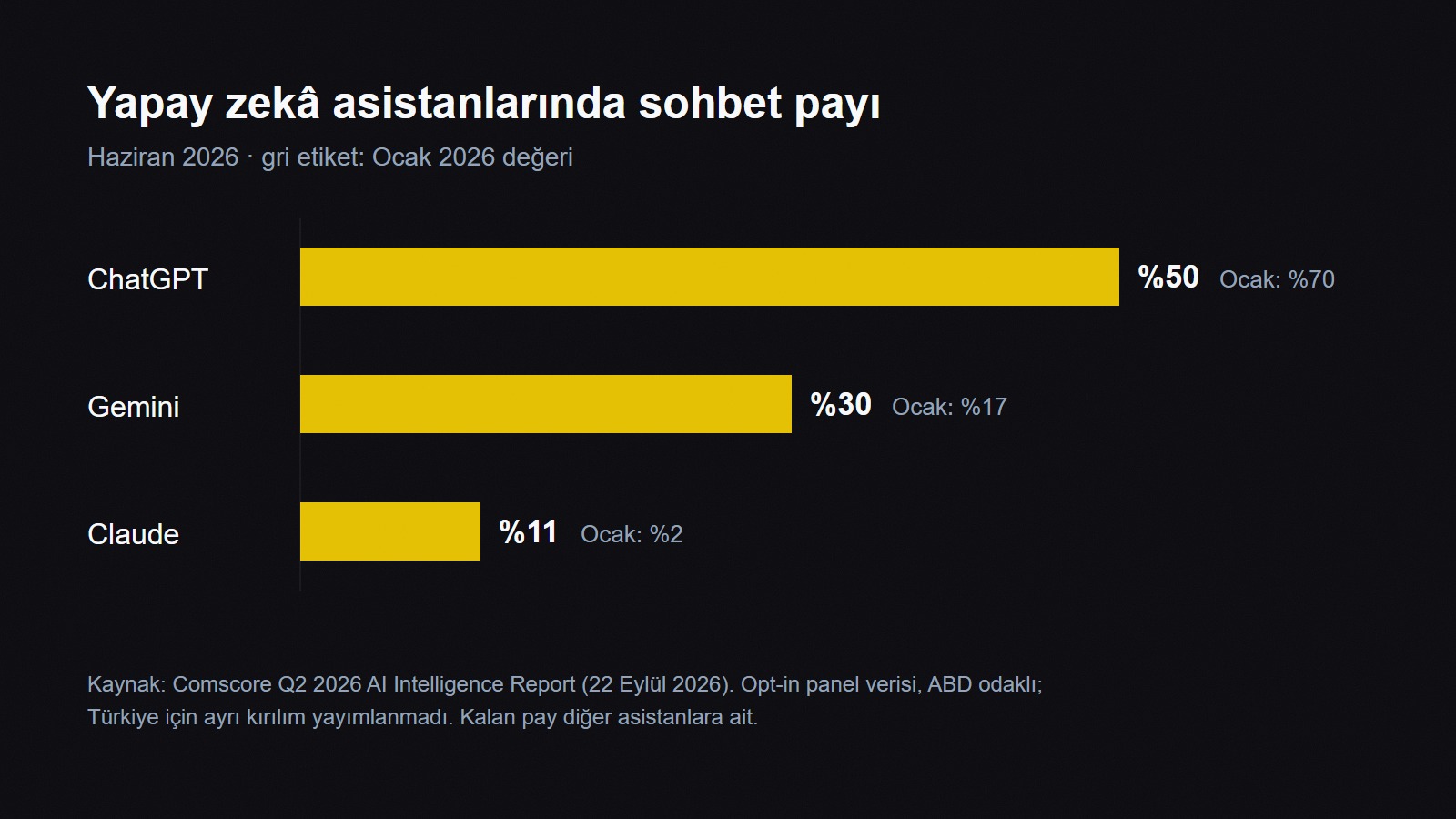
From seventy percent to fifty percent. In six months. According to Comscore's Q2 2026 AI report, published on September 22, that's how far ChatGPT's share of conversations among AI assistants fell between January and June [A]. Over the same period, Gemini rose from 17% to 30%, and Claude from 2% to 11%. The whole pie is growing while ChatGPT's slice shrinks; in other words, it isn't losing users, but it's no longer the only address.
The same day, a few hours apart, Anthropic announced its new flagship, Claude Opus 5.5, and cut the API price by 20% [A]. The two stories are unrelated, but put side by side, I think they tell companies one thing: at the end of 2026, "We use ChatGPT" isn't a strategy, it's a habit. In a company that hasn't decided which model to use for which job, this picture gets a little more expensive every month.
Quick answer: According to Comscore data, ChatGPT's share of conversations in the assistant market fell from 70% to 50% in the first half of 2026; Gemini and Claude grew fast, and on the same day Claude Opus 5.5 launched at a lower price. This matters to every company that has connected AI to its business processes or plans to — especially automations built around a single vendor. The task isn't to switch models; it's to list which job runs on which model and start making those jobs vendor-independent.
What happened?
There are two separate announcements, both dated September 22.
Comscore Q2 2026 AI Intelligence Report. Comscore measured AI assistant usage from its own opt-in panel (between 500,000 and 1 million participants, according to Digiday) [A][B]. The conversation share figures are above. In addition, on desktop in June 2026, 168 million conversations were counted on ChatGPT and 89 million on Gemini; on Claude, the number of conversations rose from 1.1 million in October 2025 to 22.3 million in June 2026 [B]. The rate at which AI Overviews appear in Google searches also rose from 25.8% in July 2025 to 39.4% [A].
Let me add a note: this data is US-focused. There's no separate breakdown for Turkey, and if there were, it would probably look different. I'm not carrying the percentages over one-to-one; I'm carrying over the direction.
Claude Opus 5.5. According to Anthropic's own announcement, the model costs $4 per million input tokens and $20 per million output tokens on the API; that's a 20% cut compared with Opus 5 [A]. The price of cache reads dropped 60%, to $0.20. The company says total cost falls by 40% on "typical workloads." The model is also available through AWS, Google Cloud and Microsoft Azure, and the five-hour usage limits for Pro, Max and Team subscribers were raised [A]. Sonnet 5.5 and Haiku 5.5 are said to be coming "in the coming weeks," with no date.
Why does it matter?
Because most companies adopted AI not as a tool but as a brand. The marketing team got used to ChatGPT, someone built an automation, that automation was connected directly to the OpenAI API, and that's where things stayed. Nobody asked "which model is best for this job," because a year ago the answer was already obvious.
It isn't obvious anymore.
A few numbers show why this is more than a technical detail:
Claude's share of conversations grew more than fivefold in six months, from 2% to 11% [A]. A tool growing that fast is probably a tool someone on your team is already using with a personal account.
Opus 5.5's 40% cost claim comes with a condition: according to Digital Applied's review, the calculation assumes moving from Opus 5's default "high" setting to Opus 5.5's "medium" setting [C]. The same review also notes that performance may regress on legal, healthcare and tax work [C]. So the discount is real, but reading it as "40% cheaper for every job" is wrong.
On the API side, there are four breaking changes: thinking mode can't be turned off, forced tool use can return errors, and the old computer-use tool is rejected [C]. If you have an automation tied to Opus 5, just changing the model name and moving on may not work.
The same report measured that sponsored ads appeared in 6% to 24% of AI answers containing source links for hotel searches, between March and May [A]. Assistants are quickly turning into an advertising channel.
In my view, the really interesting part isn't the measurement. In the words of Comscore executive Smriti Sharma, assistants are now "a layer of consumer behavior" [B]. If it's a layer, it's only natural that everything you build on top of it is affected by changes in that layer.
What changes for your brand?
A small business that uses AI only for internal team chat: Not much changes. It's enough for the team to try two different assistants on the same task; whichever gives better answers wins. Calling that a "strategy" would be an exaggeration.
A company with customer-facing automation (preparing quotes, support replies, generating product descriptions): There's risk here. A single vendor's price, limit or policy change hits your operations directly. If switching vendors has turned into a software project, the dependency is already in place.
A team building its own agent or long-running workflow: The 60% cut in Opus 5.5's cache pricing affects you most, because in long agent jobs most of the cost comes from cache reads [A]. But testing before switching is a must.
A marketing team tracking how its brand appears in AI: If you measure by looking only at ChatGPT, then according to US data you're missing half of the conversations. We cover the GEO side of this separately on our AI SEO service page.
Setup tied to a single vendor
Vendor-independent setup
When a price cut arrives
Taking advantage of it requires code changes
It's tried with a settings change
When the vendor changes limits or policy
Work stops or slows down
You switch to a backup model
When a new model comes out
The "should we switch?" debate drags on for weeks
It's compared in a day with the same test set
Setup cost
Low
Higher at first
Who it's for
A team in the trial phase
A company that has connected AI to customer processes
Don't skip the last row. Not every company needs an independent setup; if you're still in the trial phase, this table is more than you need, and that's fine.
I explained where to start with AI without getting locked into a single vendor in the AI transformation guide. I also covered the search visibility side of the same Comscore data in a separate post.
The one thing to do today
Write every job that AI touches in your company on a single list: the job name, which tool or model, who uses it, and whether it depends on an API key. It's a half-hour task. At the end of the list, you'll have the answer to "if this vendor doubles its price tomorrow, which job stops?" If the answer is "none," you're in good shape. If not, you now know where to start.
Today's Radar
News
Why people are talking about it
Who it affects
Claude Opus 5.5 launched, API price cut by 20% (September 22)
Cache cost in long agent jobs fell 60%, but there are four breaking API changes
I'm deliberately keeping the AI Overviews external link claim in the table, but I'm not giving it weight. It's single-source, the method is unclear, and the editor who covered the story openly disclosed having an investment in the source [C]. Until it's verified, I'm only watching it.
Frequently asked questions
Should we drop ChatGPT and switch to Claude or Gemini?
No, at least not based on this data. Comscore's figure is market share; it doesn't tell you which model is better for your work. The right approach is to try your three most-used tasks on two different models and compare the results side by side.
Is Opus 5.5 really 40% cheaper?
Partly. The list price dropped 20%, that's certain [A]. The 40% figure assumes running at a lower "effort" setting [C]; if your work keeps its quality at that setting, it holds, and if not, it doesn't. Without measuring on your own workload, it's hard to say anything.
What does this split look like in Turkey?
Unknown. The data Comscore published is US-focused and has no breakdown for Turkey. I'm not going to guess; separating AI-referred visits by assistant in your own site's analytics is the most reliable local data you have right now.
If you'd like to clarify together where AI stands in your company and which job should run on which model, take a look at our Enterprise AI Consulting page. For those who want to see the big picture first:
When you train employees on AI, giving everyone the same seminar doesn't work. We cover three role-based levels, the modules, a time plan, data rules and how to measure whether the training worked.
AI projects often either never get started or get stuck in the pilot. Here is a 90-day plan split into three phases, discovery, pilot and rollout, with the deliverables you should have in hand at the end of each one.
October 4, 2026: starting October 9, Google is limiting the Gemini app on free personal accounts to the Flash-Lite model only, and Pro is also going away on AI Plus.
AI & automation7 min
We use cookies to improve the site and measure advertising performance. Analytics and advertising cookies run only if you accept them. Details are in our Privacy Policy and Data Protection Notice.