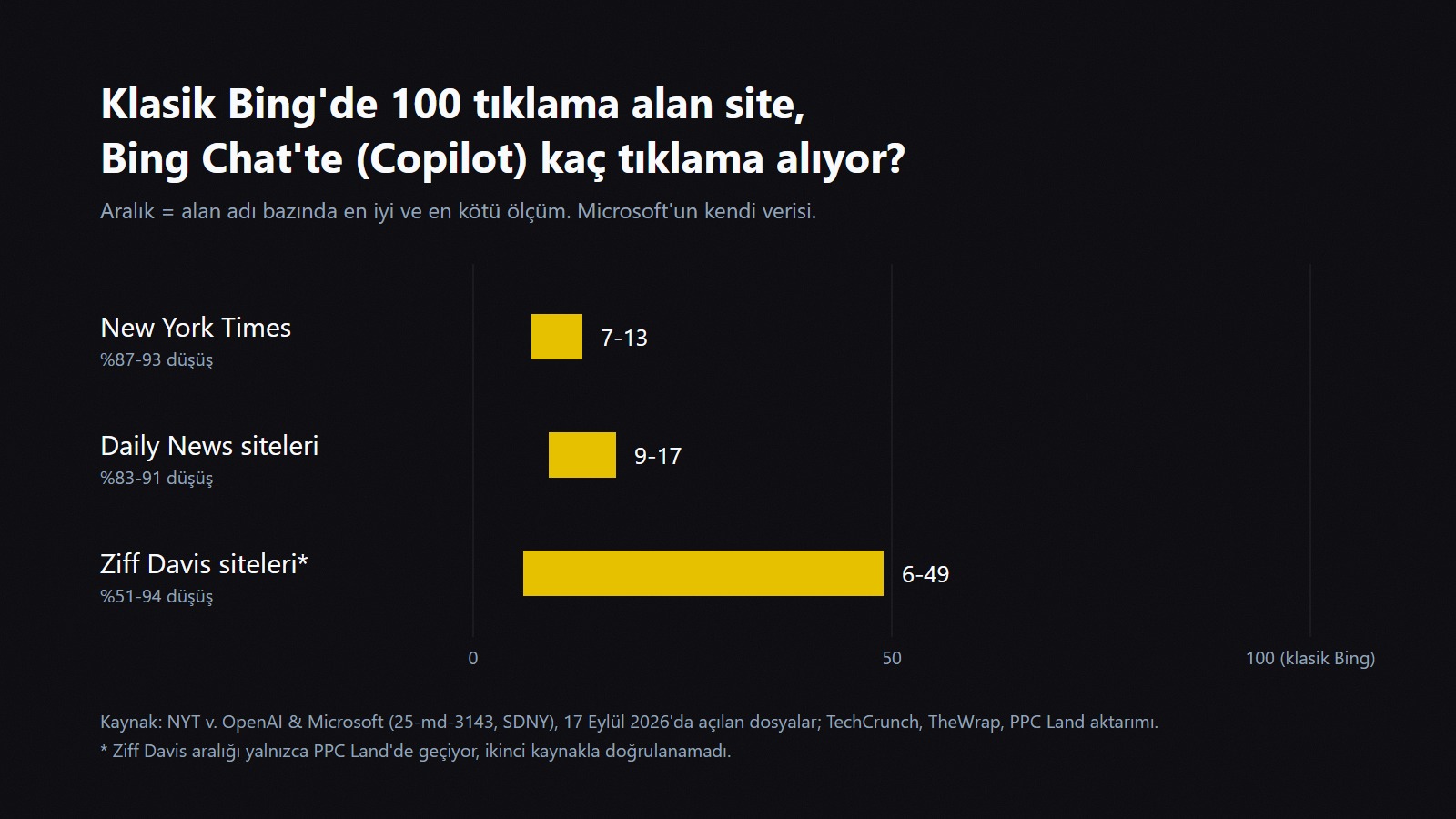
From a hundred clicks to seven. That's how much the traffic classic Bing search sends to The New York Times' sites melts away when the same query is asked in Bing Chat (now called Copilot). This number wasn't estimated by an SEO tool or an agency; Microsoft measured it in its own system, domain by domain. It came out on September 17 in documents unsealed in the lawsuit between The New York Times and OpenAI and Microsoft.
We've been hearing the "AI answers are eating clicks" debate for two years. Until now, all we ever had were studies looking in from the outside; their samples could be disputed and their methods criticized. This time, the data is the platform's own measurement. In my view, that's why it matters even more than the number itself.
Quick answer: According to court documents unsealed on September 17, 2026, Microsoft measured with its own data that Bing Chat reduced clicks to publisher sites by 83% to 93% compared with classic Bing search. This matters to every brand that expects traffic from informational content: blogs, guides, comparison pages. The job isn't to try to win the traffic back; it's to start measuring whether your brand name and your figures appear inside the AI answer.
What happened?
The New York Times, eight newspapers owned by Daily News, and several other publishers are pursuing a copyright lawsuit against OpenAI and Microsoft in the US (Southern District of New York, case 25-md-3143). A memorandum the publishers prepared for a partial summary judgment motion was partially unsealed on September 17, and Microsoft's internal measurements came out of it.
As reported by TechCrunch and TheWrap, the click-through rate from Bing Chat to the Times' sites is 87% to 93% lower than from classic Bing search [B]. For Daily News sites, the gap is 83% to 91% [B]. PPC Land also mentions a drop of 51% to 94% for Ziff Davis sites [C]; this range doesn't appear in a second publication, so it carries a lower label.
Alongside the numbers, there are sentences in the documents that are just as striking. Nick Turley, head of ChatGPT, is reported to have described the products in internal correspondence as "largely substitutive" for publishers [B]. Microsoft's Brent Hecht, in a note, described the data collection as one of the largest thefts of labor in history [B].
One note: the figures come from three separate publications that saw the filing (TechCrunch, TheWrap, PPC Land), not from the court record itself. Because the same ranges appear in two independent sources, I'm comfortable writing them, but they carry a [B] label, not [A].
Why does it matter?
Because the debate always got stuck at some point on "measurement method." Google's official position on AI Overviews has been the same for years: clicks are higher quality, users are more satisfied. And outside CTR studies always got the "sample's too small" or "different industry" pushback.
This data makes that pushback harder. The source is the very company that builds the chat interface. And the comparison is between two faces of the same platform: a classic Bing result versus a Bing Chat answer.
Still, we need to be honest; it has limits:
The sites measured are news publishers. News is the type of content a chat interface summarizes most easily; the answer to "what happened yesterday" fits into two sentences. For an e-commerce product page or a booking form, the drop wouldn't be the same, probably smaller. But how much smaller, I don't know; that data isn't in these documents.
The date of the measurement isn't clear in the reports. It may come from Bing Chat's early days. Copilot has been revamped several times since then; today's rate may be different.
PPC Land also reports that ChatGPT users didn't go to any external site in 87.78% of searches, compared with 26.91% on Google [C]. The study behind this figure isn't clear from the report. The direction is consistent, but I don't trust its precision.
So this data doesn't say "AI answers cut everyone's traffic by 90%." It says this: the drop for informational content is real and large, and now the platform itself knows it too.
What changes for your brand?
In Turkey, Copilot's share is small, I know. But the mechanism is the same for ChatGPT, Gemini, and Google's AI Mode: the answer is given on the page, and the source stays a small label.
Service businesses expecting traffic from their blog (clinics, law firms, consultancies): The click-driving power of "what is X, how do you do it" posts is dropping. These posts aren't dead, but their role has changed; they're now written not for traffic but to be the source AI quotes.
E-commerce: Product and category pages are better protected, because the user eventually has to go somewhere to buy. The real risk is in comparison and "top 10" content.
Sites that earn ad revenue from content: This is the group taking the hardest hit. The publishers in the documents are exactly this model.
Local businesses: This looks like the least affected group; "near me" searches still end with a map and a phone call. Of course, that's a guess.
Classic search result
Chat answer (Copilot, ChatGPT)
Where does the user read the answer?
On your site
In the chat window
How the brand appears
Title + link
A name in a sentence, or a source label
Measurement tool
Search Console, GA4
Mostly none; manual testing
Clicks to a news site (Microsoft data)
100
7-17
The success question
"How many people clicked?"
"Are we in the answer, and are we described correctly?"
I explained step by step how to prepare a page so it gets mentioned inside the answer while clicks decline in my guide to what GEO is and how to do it.
The one thing to do today
Write down five questions your customers ask before they reach you (like "What's the best … in Istanbul" or "How much does … cost"). Ask those same five questions in ChatGPT and Copilot today, and copy the answers into a table: does your brand come up, and if so, which source is it quoted from, and is the information correct? Ask the same questions again a month from now. It costs nothing, takes half an hour, and for the first time gives you a point of comparison.
Why am I keeping this so small? Because there's no reliable automated measurement tool in this space yet, and most of what's on sale actually runs this test for you and turns it into a table. See it by hand first, then decide.
Let me add a contrarian note, too. After this news, some people will conclude "let's stop writing blog posts." I think that's wrong. An AI answer needs a source to quote; if that source isn't your page, it'll be your competitor's. What's changed is the purpose of the writing, not the need for it.
Not directly. The documents are Microsoft's measurement of Bing and Bing Chat. Google hasn't shared similar internal data for AI Overviews and AI Mode. Since the mechanism is the same, I'd expect the direction to be similar, but the rate isn't known.
If clicks are dropping, should I keep producing content?
Yes, but with a different goal. The job of content now is to be cited as a source in AI answers, to describe your brand correctly, and to convert the minority who do click. Pages that carry clear figures, dates, and information from your own experience are the ones with a better chance of being quoted.
How do I measure whether my brand appears in AI answers?
For now, the most reliable method is manual testing: a fixed list of questions, regular intervals, and answers you keep on record. The AI report in Search Console shows impressions, but not the content of the answer.
If you'd like to see how your brand is described in ChatGPT and Copilot answers, take a look at our ChatGPT SEO / GEO service, or start with a free assessment first.
I explain step by step which pages ChatGPT reads when it answers a question, why it isn't recommending you, and what to fix on your site. I also separate what OpenAI's documentation actually says from what it doesn't.
When ChatGPT doesn't mention your brand, it rarely comes down to a single cause. We walk through six possible reasons in order, starting with the free checks you can do in a few hours.
Since GPT-6, ChatGPT links no longer carry the UTM tag or the referrer; as of October 15, 2026, ChatGPT visits are shifting to Direct in analytics.
AI search6 min
We use cookies to improve the site and measure advertising performance. Analytics and advertising cookies run only if you accept them. Details are in our Privacy Policy and Data Protection Notice.