In Google's example, a jeweler raises its bid by 20%, meaning it enters a 1.2 multiplier. The result: the bid gets more aggressive by the same proportion for a $500 cart and for a $50 cart. A flat "increase by this much" setting couldn't do that. This is the most concrete item in the customer lifecycle goals update announced this week.
The update has three parts, and all three let Smart Bidding give a finer answer to the question "who do I want, and how much do I want them?" It's expected to open sometime this month, but Google isn't giving a date. No date has been given for Turkey either; I'm not going to guess.
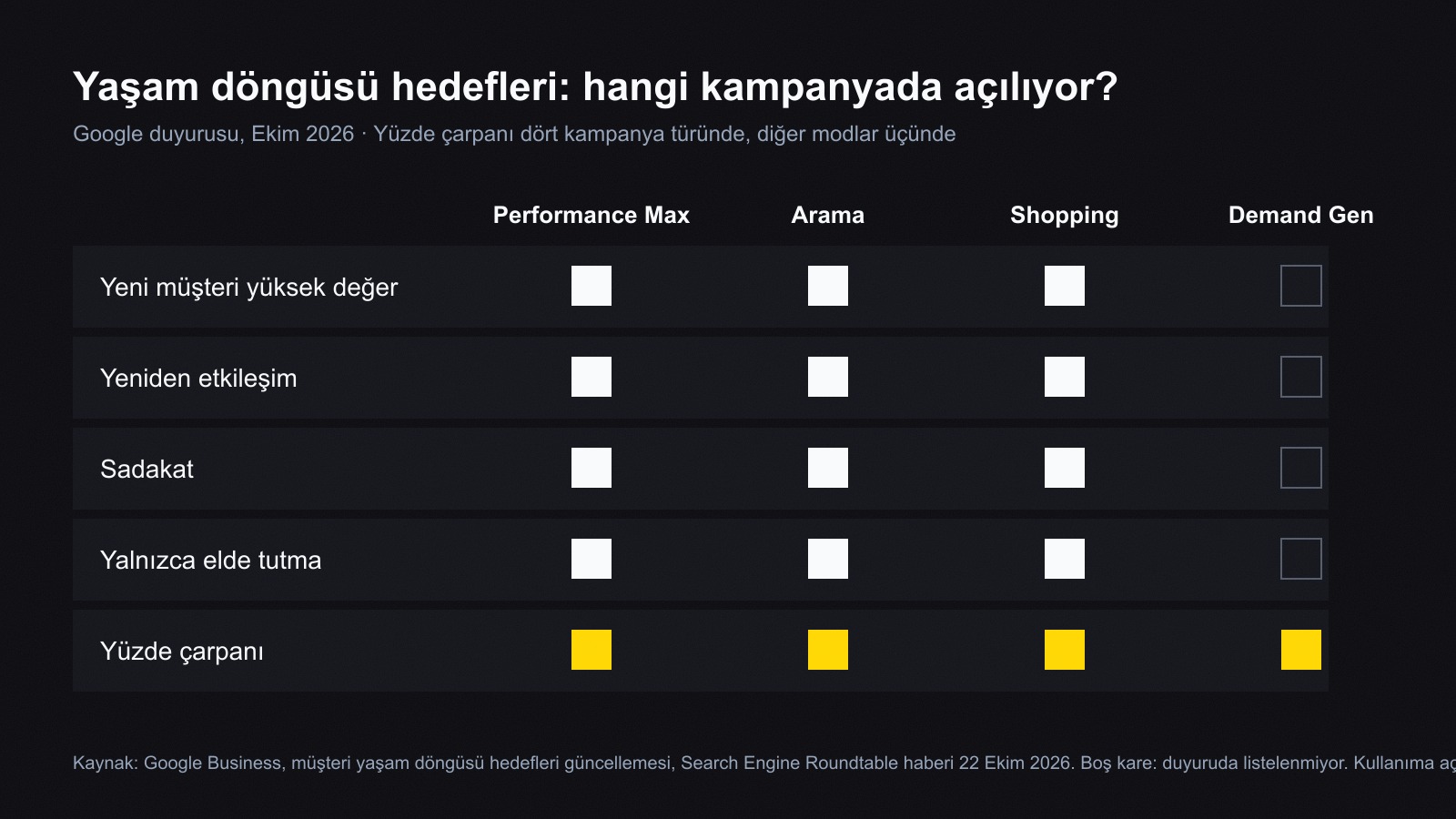
Quick answer: Google Ads expanded its customer lifecycle goals: the "high-value new customer" mode is coming to Shopping, retention goals (re-engagement, loyalty, retention only) are opening in Performance Max, Search and Shopping, and percentage multipliers are leaving beta and spreading to four campaign types, including Demand Gen. It concerns e-commerce and retail advertisers who have purchase conversions and customer lists in their accounts. The first thing to do isn't to turn on a new setting but to get clear on which customers count as "valuable" in your account.
What happened?
Google announced three changes in a post published on Google Business ("Three updates to customer lifecycle goals to help you win the holiday season"). Search Engine Roundtable reported the news on October 22, 2026. Google's post doesn't give a date; it describes the launch as "this month." [A][C]
Here are the three parts:
1. The new customer high-value mode is coming to Shopping. This mode was previously available in Search and Performance Max. The logic: when acquiring new customers, bid more for the people whose first order is likely to be high-value, without hurting normal reach. The Shopping side opens this month.
2. Retention goals are expanding. There are three modes. Re-engagement prioritizes customers who haven't ordered in a long time but keeps showing ads to the main audience too. The loyalty mode is for showing loyalty program members member-only prices or messages. Retention only is a campaign fully dedicated to retention that reaches only the customer segments you define. All of them open this month in Performance Max, Search and Shopping.
3. Percentage multipliers. The beta is ending. The bid grows in proportion to cart value. In Google Ads and SA360; for Search, Shopping, Performance Max and Demand Gen.
Why does it matter?
Because for years we always gave Google a crude answer to the question "new customer or existing customer?" Upload a customer list, say "new customers only," done. Now a structure is being built that can target the new high-value person, the lapsed customer and the loyalty member separately in the same account.
There's one detail you shouldn't skip. As practitioners like Govind Singh have pointed out on X, because of privacy limits, ads can leak outside the audience you selected even with a retention setting. Google's own text also says normal reach continues in every mode except "retention only." So this isn't a hard filter; it's a weighting setting. [C]
In my view, the real risk here is something else: the more settings there are, the more tempting the "I turned it on, Google will handle it" mindset becomes. But every one of these modes depends on the quality of the customer data you upload. If the list is old, or conversion values were entered wrong, the multiplier amplifies the wrong thing. Quickly and quietly.
What changes for your brand?
If you're a store with a low monthly order count (say, a few dozen orders a month), there may not be enough data to test the retention modes. Smart Bidding's learning period isn't short to begin with; narrow the segment on top of that and the campaign may get very few impressions.
If you're in a category where cart value swings a lot (jewelry, furniture, electronics), the percentage multiplier helps you the most. In a business where the cart swings between 200 and 20,000 Turkish lira (TRY), a flat bid increase either burns money on small carts or misses opportunities on big ones.
If you have a loyalty program but have never connected it to Google, how you connect membership data to Google will be decisive for the loyalty mode. How this will work in Turkey isn't clear.
If you're in a service business, meaning there's no cart, this package is largely not for you. All the modes rely on order data; in a business built on form fills, you first need to define for yourself what a "valuable customer" is. Google doesn't say anything specific for this business model.
Affected
Largely not affected
Campaign type
Performance Max, Search, Shopping, Demand Gen (multiplier)
Display, Video (not on the list)
Business model
E-commerce, retail, repeat-purchase products
One-time services, form-driven businesses
Data status
Customer list up to date, conversion values correct
No list, or values not entered
Timing
Expected to open this month, no date
No date for Turkey
The one thing to do today
Go to the Data Manager section of your Google Ads account and check when your customer lists were last updated. If they're older than three months, refresh them before touching the lifecycle settings. You don't need to buy anything; it takes ten minutes.
Today's Radar
News
Why people are talking about it
Who it concerns
Universal Cart is live in Google Search (SER, October 23). An "Add to cart" button appears in product listings and a cart icon in the top right; checkout with Google Pay. It was shown at Google I/O in May
The shopping decision can close inside Google. US only for now
The Translation tool is gradually rolling out in Google Ads (Tools > Translation). It translates text assets, keywords, text on images and landing pages
For a small business selling abroad, it shortens the work of building campaigns from scratch
Google Business Home beta: it brings Business Profile, Merchant Center, YouTube and Ads accounts together on one screen. Closed beta, US and UK, select categories
Google is trying to pull local management into a single panel
Multi-location businesses that depend on local visibility, SEO management
A test of a scrolling marquee-style ratings/reviews strip and an underlined domain on some sponsored results. Alex Greenland, who spotted the test, saw it in about 5% of his searches
If the ad's appearance changes, click-through rate shifts too
Anyone managing search ads
IAB Europe report: 86% of respondents use AI in marketing, and 48% have AI rules specific to advertising. The report came out on September 24, with a sample of 50 companies
Usage is growing faster than the rules; some questions rest on 21-29 people, so the percentages are volatile
Companies whose teams use AI and that are looking for corporate AI consulting
Frequently asked questions
What is a percentage multiplier, and how is it different from a flat bid adjustment?
A flat adjustment applies the same fixed increase to every cart. A percentage multiplier grows the bid in proportion to cart value. In Google's example, a 1.2 multiplier means an equally aggressive bid, proportionally, on a $500 cart and on a $50 cart. It opens this month in Google Ads and SA360 for Search, Shopping, Performance Max and Demand Gen. [A]
Can the loyalty mode be used in Turkey?
The official source isn't clear on this. Google's post doesn't distinguish between countries and doesn't say which markets it will open in. If it shows up in your account, you can try it; if it doesn't, there's nothing to do but wait.
Is it worth turning on these modes with a small budget?
In my view, most of the time it isn't. When the segment narrows, impressions drop, and Smart Bidding needs conversions to learn. Starting with settings that only weight the bid, like the percentage multiplier, is safer. This is a general opinion I'm giving without looking at your account; your data may turn out differently.
Next step
If you don't know whether the customer lists and conversion values in your account are ready, take a look at our Google Ads service. To see the big picture, you can use the free analysis.
October 5, 2026: starting October 12, Google Ads will automatically add the coupons and discounts on your website to Search and Performance Max ads with a location asset. Who is affected and how to turn the setting off.
On September 24, 2026, Google cut Demand Gen's Shorts and Gmail image ads down to a single tap and announced a Business Agent beta for YouTube. Why you should be cautious about the 40% Gmail figure, and what to do today.
October 14, 2026: Google Ads now lets you rank channels as High or Low priority and cap the low-priority channel's share of budget; in Search campaigns with Display turned on, the old spend distribution goes away in February 2027.
Advertising7 min
We use cookies to improve the site and measure advertising performance. Analytics and advertising cookies run only if you accept them. Details are in our Privacy Policy and Data Protection Notice.