It's very easy to brush this off with "it's a test in America, what's it got to do with us." That's what I did when I first read it. Then, once I got into the details, I realized the real story isn't America: it's what happens after someone clicks an ad.
On September 16, OpenAI launched a pilot called "Sponsored Agents" for ChatGPT ads. When a user taps an ad, they aren't sent off to a website; inside the conversation, a brand agent clearly labeled "sponsored" takes over, answers questions, and when things get serious, hands the user off to the brand's own page or lead form. The ad's final stop is no longer a page; it's a conversation.
Quick answer: On September 16, 2026, OpenAI launched the "Sponsored Agents" pilot in ChatGPT ads, where the brand's own agent takes over the conversation; for now it's US-only and limited to selected advertisers. You can't buy this format from Turkey today, but this is where customers' expectation of meeting a chat on your site is being shaped. What to do: write down the answers you give to the first questions people ask on your site.
What happened?
According to the coverage of the announcement (Unite.AI, Angi's press release), the mechanics work like this: an ad appears in ChatGPT, the user taps it, and a conversation starts "with a clearly labeled agent sponsored by the business." The agent answers follow-up questions in the same window, and when the user is ready, they move on to the business's website.
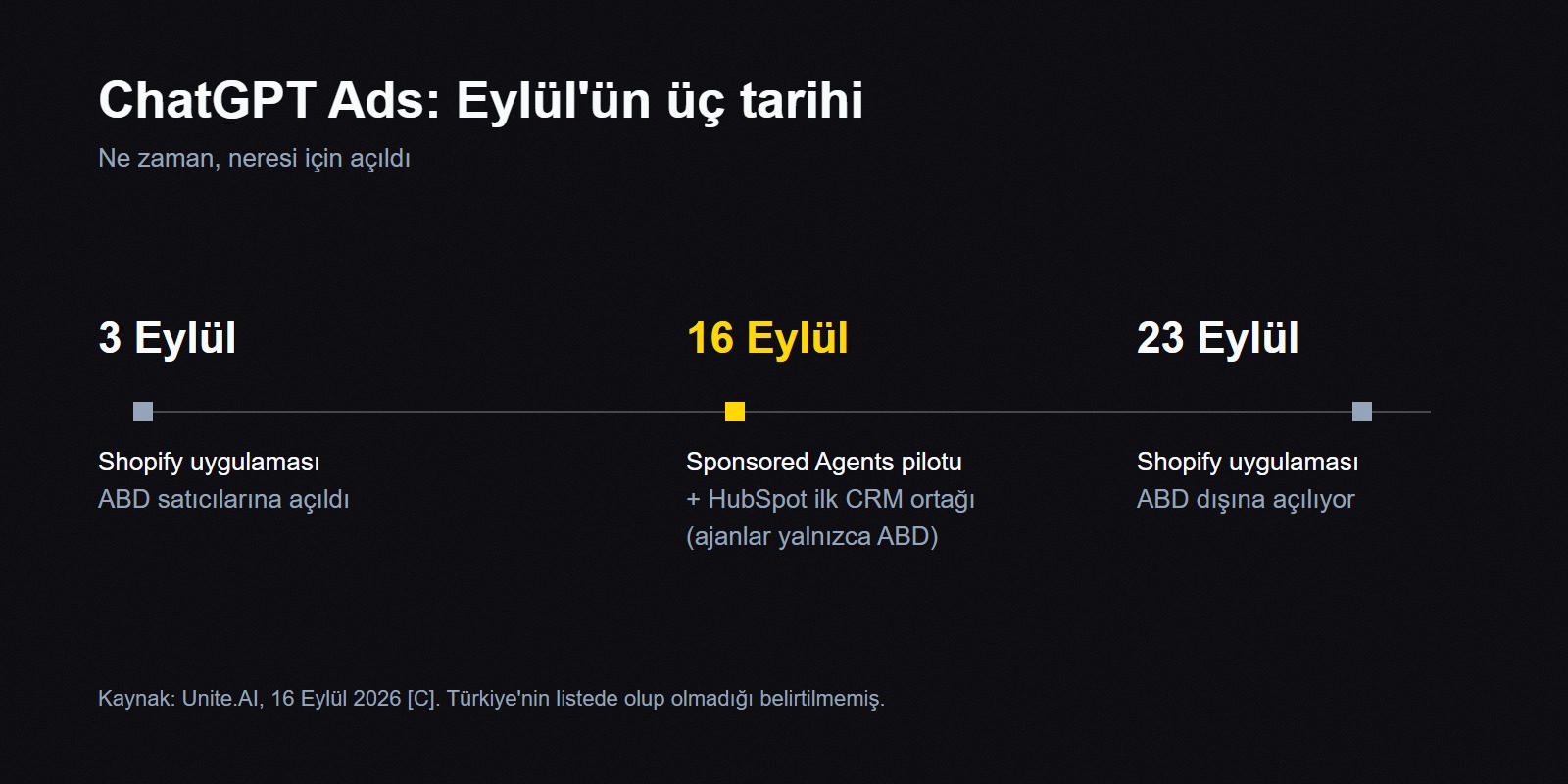
The known names: Angi (home services; its sponsored agent lets homeowners talk through project details and get connected with local pros), Wayfair (a small-scale test), Newegg, Best Buy, Lowe's and VistaPrint. The same day, HubSpot was announced as ChatGPT Ads' first CRM partner. There's an app on the Shopify side too: it launched in the US on September 3, with September 23 given as the date outside the US.
On the ad tool side, there are three more new features: building campaigns in natural language, ad copy and image suggestions from the landing page, and context-based headline adaptation with automatic translation (opt-in). There's also an incentive for new advertisers: "spend $500, get $500 in credit."
There are things we don't know, too, and quite a few of them. How conversation data will be used hasn't been disclosed. How often the agent will show up in a conversation, and in which conversations it will be triggered, isn't clear. Neither is how performance measurement will be reported. Nothing has been published about when Turkey will be added to the list, and I'm not going to guess.
Why does it matter?
Advertising has had a rote formula for a long time: the ad grabs attention, the landing page persuades. This format moves the second half into the conversation too. In other words, the thing doing the persuading is no longer your page; it's a model speaking on your behalf.
That has two consequences. First, the sentences coming out of the agent's mouth become brand sentences; a wrong price, wrong stock information or a wrong promise is your mistake. Second, the handoff moment (where the user moves to the site or the form) remains the only measurable point, and everything that drops off there disappears silently. In Angi's case, that handoff is a service request flow. "What's your handoff point?" is a question you need an answer to.
There's also this: it's a pilot. Wayfair said it's testing at a small scale, with guardrails around accuracy, transparency and handoff to service [C]. When I read that sentence, I think: even big brands aren't switching this on without controls. You shouldn't either.
And I think it's being overhyped a bit. Some of the coverage has a "ChatGPT is now an ad platform, brands are becoming the product" tone. But it's worth remembering that the format is being tested in a single country, with a few dozen advertisers. Whether the format will catch on, or whether users will get tired of talking to ad agents, isn't clear yet.
What changes for your brand?
There's no buying it from Turkey today. Sponsored Agents is US-only. There's no budget decision to make today; nobody can tell you "set aside a ChatGPT ad budget right now."
If you sell high-consideration services (clinics, law, construction, education, B2B software), this format shift concerns you the most. It's no coincidence that Angi was chosen: the "let me describe my project, then have someone get back to me" flow is exactly their business. Whoever can design that as a conversation wins.
If you're in e-commerce, the September 23 date on the Shopify side is closer. We'll find out what it brings on that day.
If you use a CRM, HubSpot being the first partner suggests the way is opening for people coming from the conversation to be recorded directly as leads. There are no details, which is why I'm saying "suggests," not "definitely."
Classic ad flow
Sponsored Agents flow
After the click
Landing page
Conversation with a sponsored agent
What does the persuading
Page copy and design
The agent's answers
Handoff point
Form / call / cart
Moving from the conversation to the site
Measurement
Page analytics
Not disclosed
Status in Turkey
In existing channels
None, US pilot
The "Not disclosed" cell in the table isn't a gap; it's the pilot itself. Growing your budget before the measurement rules are written is like getting into a taxi with no meter: maybe it'll be cheap, maybe not, you can't know. If I were you, I'd watch during the first few months. I'd see whether Angi or Wayfair share a results number; the sources so far don't include one.
In Turkey: One more note from Turkey's perspective. Here, customers already shop through chat; for most small businesses, the sales line is a WhatsApp or Instagram DM inbox. So the idea of "a conversation after the ad" doesn't feel foreign. What feels foreign is a model running that conversation, and who does the handoff and how. That's really the core question: at some point the conversation will pass to a person; do you know what that person will have in hand at that moment?
The one thing to do today: Write down the ten questions customers first send you or call you about, and note the correct answer to each in two sentences. You can do this without buying anything. The agent, the chatbot and your sales team will all work from these ten answers; without this list, none of them will work properly.
Today's Radar
News
Why people are talking about it
Who it concerns
Shopify's ChatGPT Ads app, September 23 outside the US
It launched in the US on September 3; an international date was given
People building video production workflows → our post
Frequently asked questions
Can Sponsored Agents in ChatGPT be used from Turkey?
No. Right now it's a pilot in the US with selected advertisers. No date or list has been announced for Turkey.
Is a sponsored agent the same as a regular chatbot?
No. A sponsored agent appears inside ChatGPT after an ad and is labeled "sponsored." The chatbot on your site runs on your page, under your control. Behind both is the same thing: the right answers to the questions.
What's the first step for a small business?
Writing down the answers to frequently asked questions. Setting up an agent, or waiting to see, is the decision after that.
I explain plainly what a chatbot can and can't do, how to set one up on WhatsApp, and when it might give wrong information. A short checklist helps you see whether your business is ready for a chatbot.
A chatbot and live support aren't rivals; they're a division of labor. Which questions should go to which, how to set handoff rules, and how WhatsApp's 24-hour window affects the decision.
A WhatsApp chatbot processes a customer's name, phone number, order, and sometimes health information. Under Turkey's data protection law (KVKK) and Meta's WhatsApp rules, we walk through privacy notices, legal basis, cross-border transfers, sensitive data, retention, and human handoff in order.
AI & automation8 minOpen guide
We use cookies to improve the site and measure advertising performance. Analytics and advertising cookies run only if you accept them. Details are in our Privacy Policy and Data Protection Notice.