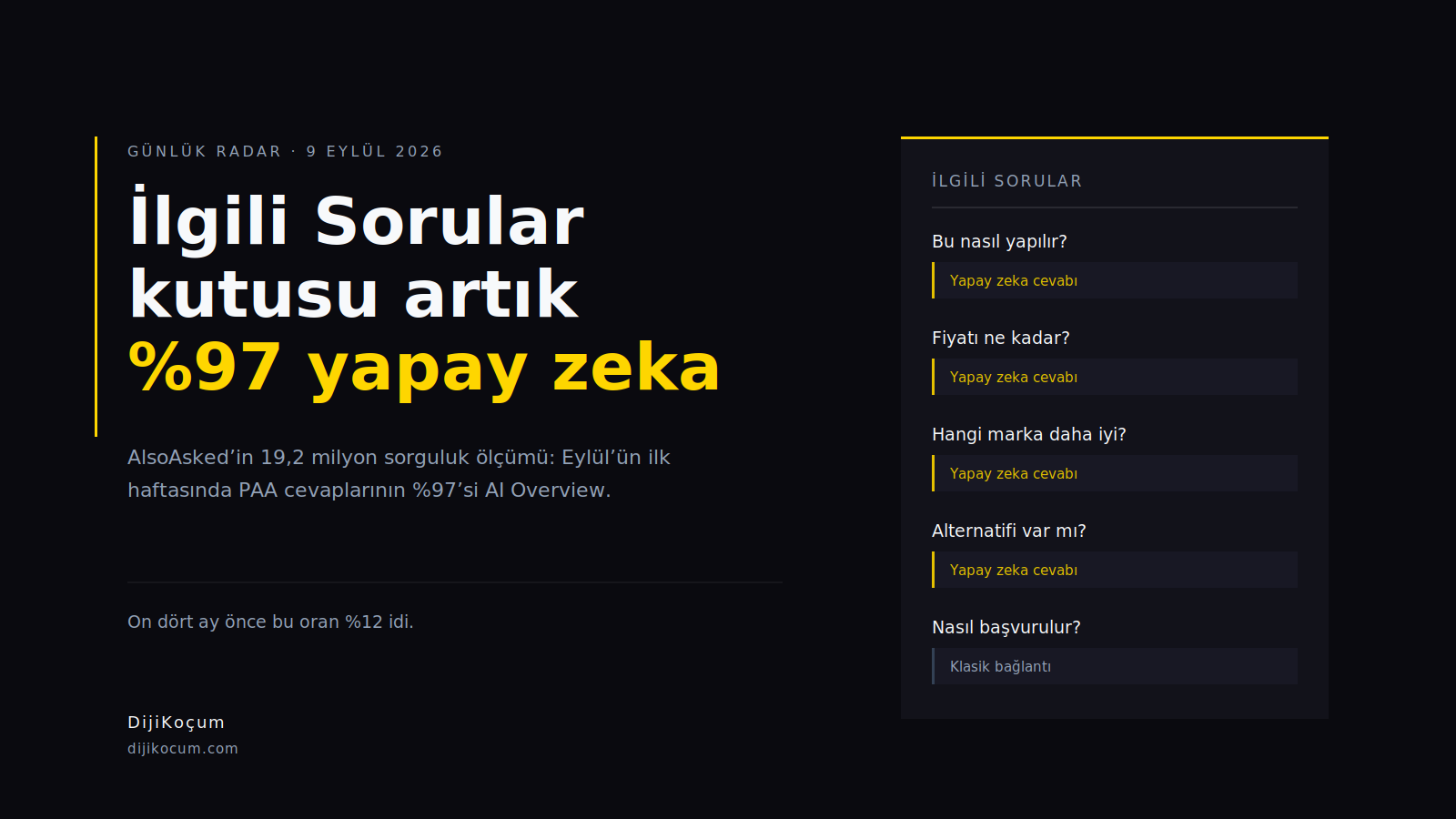
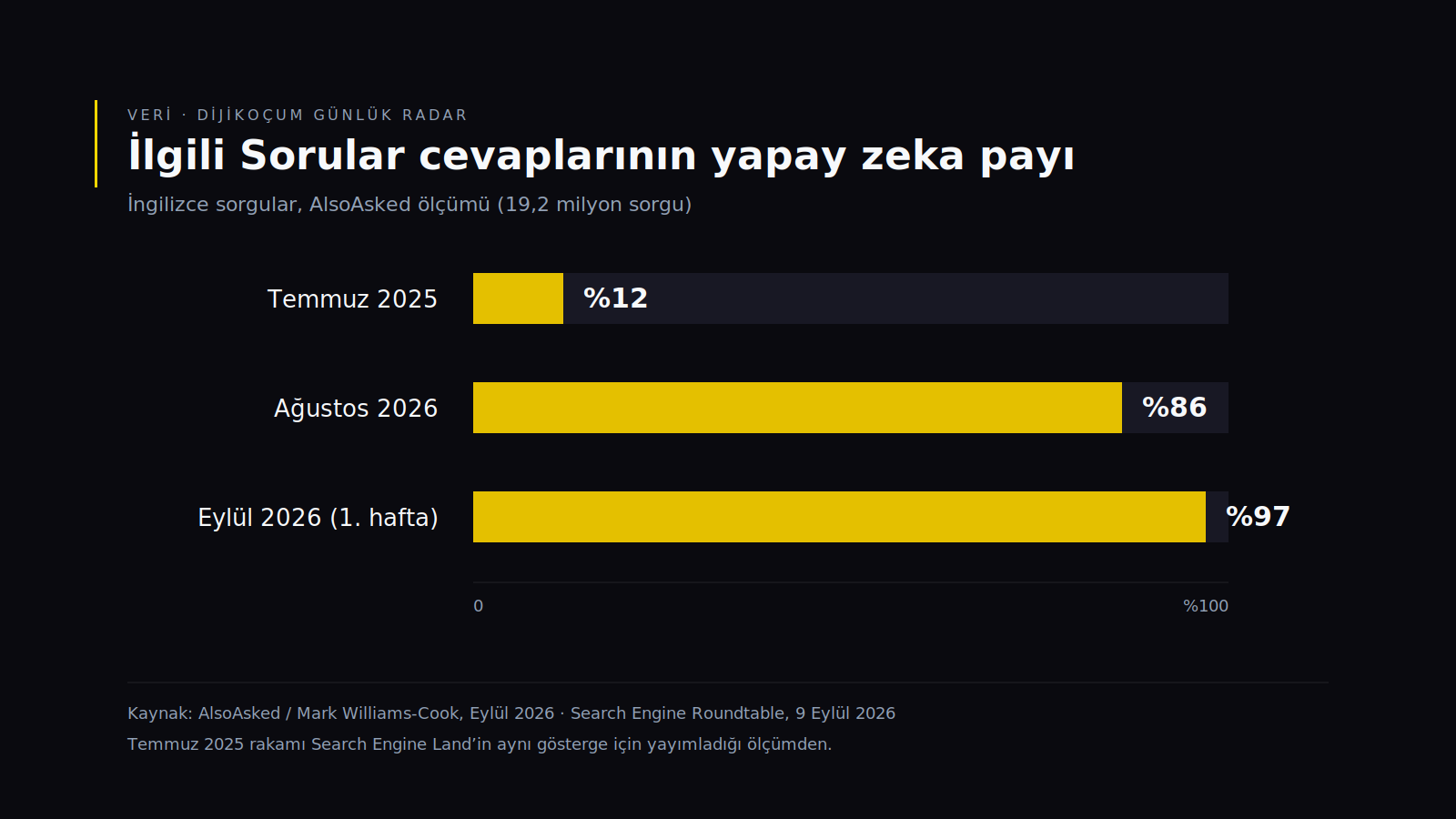
From 12% to 97%. The time in between: fourteen months. The "People Also Ask" box in Google's search results (the accordion that has gone by that name in English-language sources for years, and that sometimes shows up in the Turkish interface as "Kullanıcılar bunları da sordu") now writes its own answers. On the morning of September 9, when Search Engine Roundtable put two separate measurements side by side, the picture became clear.
For SEO teams in Turkey, this box was a cheap win for a long time. Add an FAQ block to the page, apply FAQ schema, make the question an H2, get into the box, get clicks from there. In other words, the tactic was simple and it worked. Right now, the ground under that mechanism has given way.
Quick answer: 97% of the answers in Google's People Also Ask box are now generated by AI Overviews; a year ago that figure was 12%. This directly affects every brand that collects organic clicks with Q&A-format content, especially e-commerce, health, finance, and service sites that lean on informational traffic. The job for today is to pull, one by one in Search Console, the questions your FAQ pages get clicks from, and manually check how many of those questions are now answered inside the box.
What happened?
AlsoAsked scanned about 19.2 million English-language queries from 2026 and classified the source of the answers in People Also Ask boxes. The result shared by founder Mark Williams-Cook: in the first week of September, 97% of the answers in the boxes were AI Overview output. In August, the figure was 86%. In Williams-Cook's own words, "It seems highly likely we are on track for 100% shortly."
The second measurement came from Allintitle. Saeed Khosravi says the figure has already been 100% in their own samples since August. Two independent tools, two different samples. Same direction.
What did it look like a year earlier? In the measurement Search Engine Land published for the same indicator, the figure was close to 13%. So the inside of the box changed hands completely in 14 months.
The box's behavior changed too. It used to be that when you clicked a question, two or three blue links opened underneath, and you had to go to a site to read the answer. Now, when the accordion opens, you get a written paragraph, and the links drop below that paragraph as small source badges. Naturally, more users stay on the same screen.
An important caveat: both measurements are based on English-language queries. I don't know exactly what the figure is in Turkish-language SERPs, and no one has shared a published number. I'm not going to guess. But we've seen Google roll out this kind of SERP change to other language markets a few months later more than enough times.
Why does it matter?
When the inside of the box changes, everything outside the box changes too.
In the US, in the first four months of 2026, 68.01% of Google searches ended without producing a single click. In 2024, the same figure was 60.45%. [C]: a compilation by SparkToro using Similarweb data. In searches that show an AI summary, the click-through rate of the first-ranked result fell 58% [C].
In Turkey: we have less data, but not none. Google's AI Overviews feature (AI Bakışı in the Turkish interface) launched in Turkey on February 18, 2026. According to Stradiji's measurement, clicks on informational searches dropped by roughly a third [C]. This figure is an industry analysis, not a metric Google has disclosed, so I'm giving it with the [C] label.
The People Also Ask share, on the other hand, is at the [B] level: data measured by two independent SEO tools with their own crawling infrastructure, not verified by Google.
What these numbers mean in practice: ranking first on a question-format query isn't worth what it used to be. You stay in the same position, your impressions hold, your clicks melt away. When you see a traffic drop in Analytics, your first reflex is "did our rankings drop?"; in most cases, they didn't. Looking for the problem in the wrong place leads you to spend three months on the wrong work.
There's also an invisible side. When AI Overview generates an answer, it picks sources, and that choice feeds brand awareness: the user sees your name under the answer even if they don't click. There's no standard metric to measure this right now. Google is expanding AI visibility reports in Search Console, but there's still no field that shows brand recall.
Now the contrarian part. Everyone is reading this as "FAQ content is dead"; I disagree. There's an answer inside the box now, true, but source links still sit below that answer, and AI Overview picks those sources from somewhere. What has changed is less the amount of traffic and more the selection criteria. It used to be that the page that best matched the question won. Now the page with the clearest paragraph that can be quoted while the answer is being generated wins. These are not the same job. This work of getting selected is called GEO today; I explained how to write a quotable paragraph in the what is GEO guide, and the whole job can also be handled with a GEO agency.
What changes for your brand?
For e-commerce and product-focused sites, the most concrete loss will be in guide content of the "how to choose," "which one is better," "what size should I buy" type. These pages weren't driving conversions anyway; they fed the top of the funnel. The top of the funnel is narrowing. On the other hand, the quality of your product pages' structured data becomes more useful, because the same week Google expanded AI search intent and terms reports in Merchant Center.
For service-based small businesses and local businesses, the picture is a bit better. The box shows up less often on local-intent queries, and the map pack is still standing. But on queries that sit between informational and commercial intent, like "dental implant prices in Istanbul," the loss has already started. On the SEO management side, this in-between band is the first place to look this month.
For corporate content teams, the real issue is reporting. Your impression count in Search Console won't drop, it may even rise; what drops is clicks. You need to measure this gap before you explain it to management. We covered this distinction in detail in yesterday's post on the Search Console AI report.
Publishers and blog-heavy sites are the ones taking the hardest hit. It's worth being honest here: I see no sign that archives of content produced in Q&A format, with no original data, will come back in the period ahead.
Area
Traffic from the box
What to do
Informational guide content
Serious loss
Write clear, quotable one-paragraph answers
Product and category pages
Limited impact
Complete your structured data and attributes
Local service queries
Holding up for now
Maintain the map pack and business profile
Queries containing the brand name
Not affected
No change needed
Comparison / "vs" content
Partial loss, high chance of being cited
Back it up with tables and dated numbers
The one thing to do today
Open the Performance report in Search Console, enter question words in the query filter (how, what is, which, how many, how much), and compare the last 3 months with the previous 3 months. Search the top 20 queries on the resulting list one by one in an incognito tab, and check whether the answer in the People Also Ask box was written by AI. It takes half an hour, needs no tools, and gives you your own site's real figure.
Today's Radar
News
Why people are talking about it
Who it concerns
Search intent, terms, and attribute suggestions added to Merchant Center AI performance reports
Google now tells you directly which conversational language you're being searched with
Exact and phrase match keywords being tested in AI Mode
AI Mode visibility may be possible without moving to AI Max
PPC teams that don't want to give up control
Google said the DMA changes in the EU led to the largest drop in quality in 29 years
The European SERP is diverging; it doesn't directly cover Turkey
Exporters selling into the EU market
Mueller: low-value programmatic pages can erode Google's trust in a site
Bulk-produced page archives hurt the site as a whole
Anyone producing pages from program output, GEO and AI SEO
72 ranking signals for Google Maps documented, 25 of them disabled
The most concrete signal list in local SEO in a long time
Multi-location businesses, local service providers
FAQ
Does getting into the People Also Ask box do no good at all anymore?
It still helps, but the shape of the gain has changed. Showing up in the box used to mean a click; now it mostly means a brand touchpoint. Having your name in the source link under the answer is still valuable, you just can't measure it as a click.
Should I remove FAQ schema from my pages?
No. Schema markup still makes it easier for Google to parse your content, and AI Overview benefits from that clarity when it picks sources. The sensible move isn't to remove it, but to shorten your answers and write them more precisely.
What's the figure for Turkish-language queries?
No one knows. There's no published Turkish-language measurement; both tools worked with English-language queries. For now, the most reliable way is to work out your own site's figure with the half-hour check above.
When who writes the answer in the search result changes, being the source of that answer becomes the new job description. If you'd like to talk about how to manage this transition on your own site, take a look at our SEO management service or the ChatGPT SEO / GEO side.
Google gave the spam update it launched on September 24, 2026 up to two weeks to roll out; the first hard wave came over the September 25–27 weekend. Who's at risk, and what should you do this week?
Google announced that the September 2026 spam update finished on October 8; the rollout took 13 days and 17 hours. Here's what to look at, and what not to touch, if your traffic dropped.
October 3, 2026: Google updated two of its guides on October 1; all AI-generated content should be manually reviewed before publishing, and fabricated author profiles are now explicitly treated as deception.
SEO8 min
We use cookies to improve the site and measure advertising performance. Analytics and advertising cookies run only if you accept them. Details are in our Privacy Policy and Data Protection Notice.