"Google doesn't penalize content written with AI; it looks at quality." We've heard this sentence in every SEO presentation for two years, and I've used it too. It's still true. But on October 1, Google added a word to its own documentation that leaves the sentence incomplete: critical.
Google Search Central wrote in its AI content guidance: "It is critical to manually factcheck and review all AI-generated content for accuracy and trustworthiness before publishing." Everyone talked about that. The same day, a second document that hardly anyone paid attention to got an even tougher sentence: AI-generated author photos, made-up names and fake job titles are now explicitly defined as "deception." In my view, that's the real news.
Quick answer: On October 1, 2026, Google updated two of its guides: all AI-generated content (including titles, meta descriptions, structured data and image alt text) should be manually reviewed before publishing, and author profiles fabricated with AI now count as deception. Every site that produces blog posts, product descriptions or category copy with AI is affected. The thing to do is list the pages written with AI and review the author boxes and any sentences containing numbers first.
What happened?
Two separate Google documents changed on the same day. I compared both, word for word, with their earlier versions; both footers say "Last updated 2026-10-01," and the previous copies on the Wayback Machine are dated December 10, 2025.
1. The "Using generative AI content" guide. The old text simply said "focus on accuracy, quality, and relevance" and moved on. Three sentences have been added to the new text: that generative models don't pull information from somewhere but predict a likely sequence of words based on their training data; that the output can therefore contain errors known as "hallucinations"; and that it's critical to manually review all AI content for accuracy and reliability before publishing. It also states separately that the review covers <title> elements, meta descriptions, structured data and image alt text. [A]
The reason given in Google's changelog is short: to get its documentation "in sync with our presentations we use at our developer events." No new penalty or ranking signal was announced; the scaled content abuse policy stays the same. [A] Search Engine Journal and PPC Land read it the same way. [B]
2. The "Creating helpful, reliable, people-first content" guide. This change isn't in the changelog; it went in quietly. There are two new sections. The first is a definition of "main content": everything that directly serves the page's purpose (text, images, tools like calculators, user reviews if they're the page's subject, information inside tabs, headings). The second is the four criteria quality raters look at in the main content: effort, originality, talent or skill, and accuracy. The description of effort includes this sentence: automatically generating pages from feeds, or mass-producing text with AI "without manual oversight," counts as "little to no effort." Citing sources doesn't replace original effort either. [A]
And that sentence. It was added to the "Who created it?" section: making content look as if an expert wrote it by using an AI-generated portrait, a made-up name or a fake job title is a form of deception; any kind of deception makes a page untrustworthy both to users and to automated quality systems, and it's a low-quality signal. [A] In the old version, this section only encouraged "adding accurate authorship information."
Why does it matter?
The timing doesn't look like a coincidence. Google's September 2026 spam update started on September 24; the rollout, which normally takes two days, was announced this time as "about two weeks," and the second sharp wave came on September 30–October 1. [A][C] The documents changed right between those two waves. Google hasn't said they're connected, and I'm not claiming it either. But they point in the same direction.
A note from Barry Schwartz of Search Engine Roundtable also stands out: Google rarely uses the word "critical" in its help documents. [C]
There's one more thing. The rater guidelines don't directly determine rankings; Google says so again in the same document. [A] So saying "raters look at effort" isn't the same as saying "the algorithm catches AI text." But rater scores are used to measure whether the systems are working correctly; that's where you'll find the clearest description of what Google wants to reward.
In Turkey: I don't have any data I've measured. What I do know is this: most "get blog posts written" and "SEO article" services are now built on AI drafts, and these articles are often signed with the name of an "editor" who doesn't exist. I don't know how many of them use fabricated profiles, and I won't guess.
What changes for your brand?
If you produce blog posts with AI: The real risk isn't that the post was written with AI; it's that it wasn't reviewed. The most errors turn up in numbers, dates and legal information. If a post has the wrong VAT rate or an incentive that's been discontinued, it now runs into the "accuracy" criterion in Google's own documentation.
If your site has a fictional "expert": An author box with a stock or AI-generated portrait, a made-up surname and "15 years of experience." I'd remove that today. If there's no real person, publishing under the company name is much safer than using someone made up.
If you mass-produce product descriptions in e-commerce: Product page titles, meta descriptions and image alt text are now covered by the manual review rule too. Reading a thousand products one by one isn't realistic, I know. But starting with the top hundred products by traffic is doable. Merchant Center's rule requiring AI-generated product data to be labeled separately still applies, too.
If you're a small business that writes less, but by hand: Not much changes for you. If anything, this works in your favor, not against you.
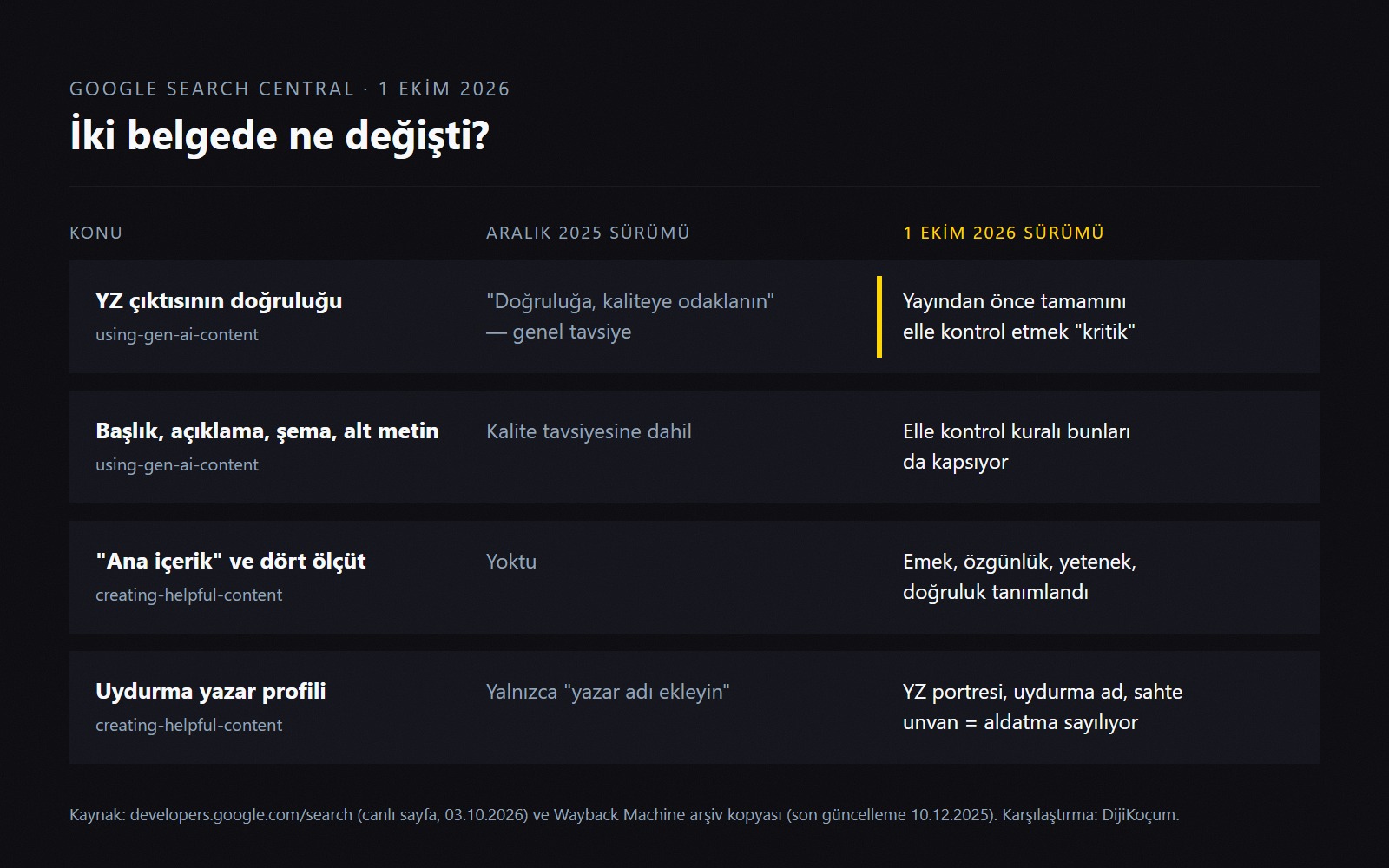
Topic
December 2025 version
October 1, 2026 version
Accuracy of AI output
"Focus on accuracy"
Manually reviewing all of it before publishing is "critical"
Title, meta, schema, alt text
Included in general quality advice
Explicitly covered by the manual review rule
Definition of main content
None
Added; four criteria: effort, originality, talent, accuracy
Unsupervised mass AI text
Under the scaled content policy
Also an example of "little to no effort"
Author information
"Adding accurate authorship information"
AI portrait, made-up name, fake title = deception
The one thing to do today
Open every page on your site that carries an author name and ask one question about each author: is this person real, and do they actually work in the field they write about? Remove every author box where the answer is "no," or switch it to the company name. It takes one afternoon, without buying any tools.
After that, the sentences with numbers are next. But author boxes first; that's the clearest, least debatable violation in Google's new text.
No, the October 1 update doesn't introduce a new penalty. What changed is this: Google defines manually reviewing AI output before publishing as "critical," and it describes unsupervised mass production as an example of "little effort." What triggers penalties is still the scaled content abuse policy.
Do I need to disclose on the page that I used AI?
It's not required. Google recommends adding a disclosure for content where readers might ask "how was this made?" The only place it's required is Merchant Center: AI-generated product images must carry IPTC metadata, and AI-generated titles and descriptions must be labeled separately.
Is using a pen name in an author box also deception?
The document's wording is "using AI-generated headshots, made-up names, or false credentials to make content appear as if it was written by human experts." The test is intent and impression: a real person's known pen name isn't the same as inventing an expert who doesn't exist. If you're not sure, publish under the company name.
If you'd like your content pipeline audited against Google's new guidance, you can start from the SEO management page. If you'd like to see where you stand first:
Google gave the spam update it launched on September 24, 2026 up to two weeks to roll out; the first hard wave came over the September 25–27 weekend. Who's at risk, and what should you do this week?
Google announced that the September 2026 spam update finished on October 8; the rollout took 13 days and 17 hours. Here's what to look at, and what not to touch, if your traffic dropped.
Since September 13, 2026, Google has been blocking rank tracking tools from collecting data, so the rankings in your dashboard may not reflect reality.
SEO8 min
We use cookies to improve the site and measure advertising performance. Analytics and advertising cookies run only if you accept them. Details are in our Privacy Policy and Data Protection Notice.