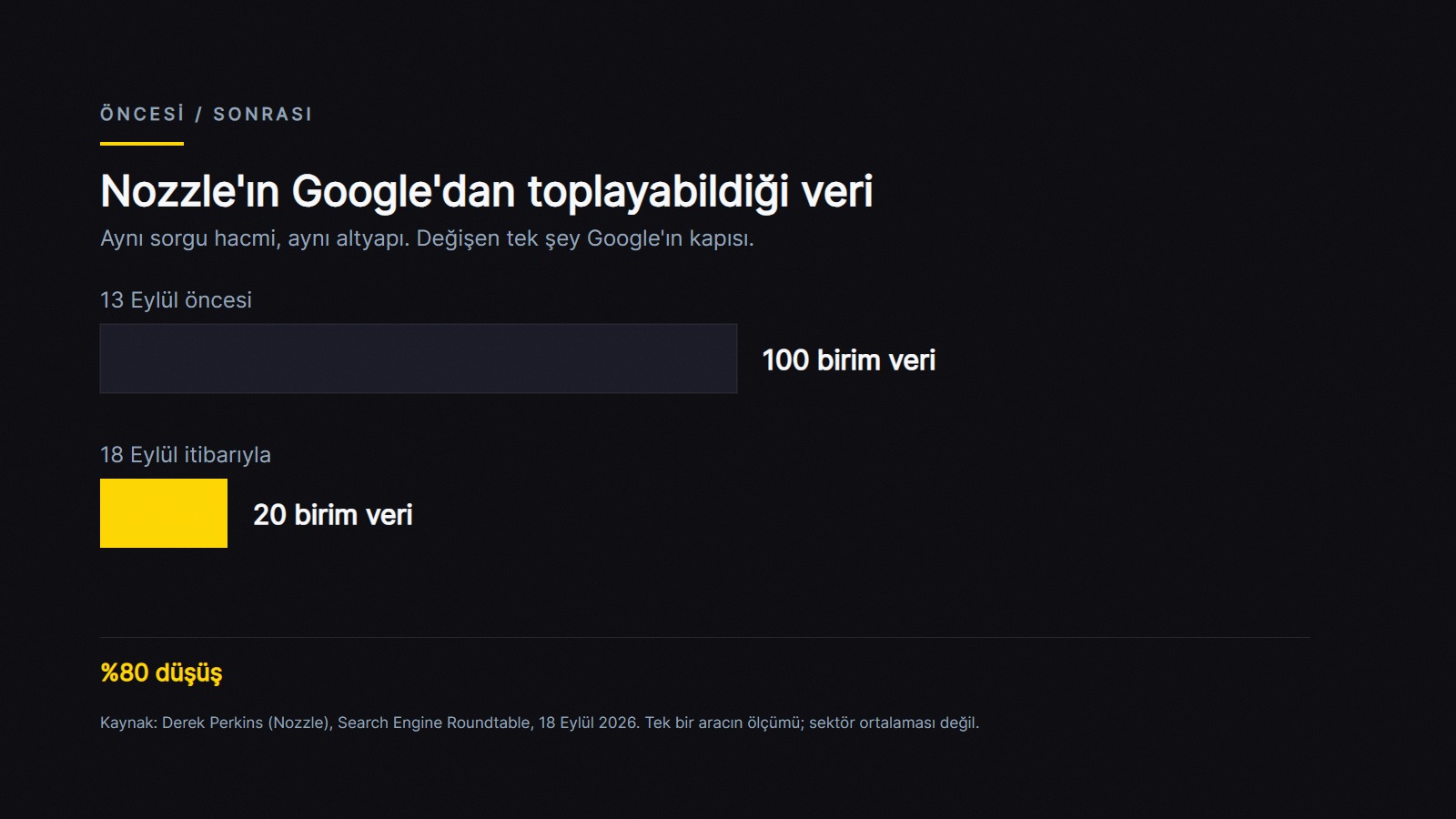
80%. Derek Perkins, the founder of Nozzle, says he measured a loss of that size in the data his tool can pull from Google. Same infrastructure, same query volume, same keywords — the only thing that changed is that Google no longer opens the door. According to the roundup Barry Schwartz put together on September 18, the problem isn't limited to one tool either: DataForSEO is seeing the same drop, SISTRIX posted a notice on September 16 saying "we're collecting at a reduced rate," and Glenn Gabe wrote that he saw rankings that didn't match across three different tools.
Here's what that means in practice: the numbers in the ranking report you send to your client or your management this week may not have been produced the same way as last month's numbers. When you see a falling chart, there are now two possibilities — your site really did drop, or your tool couldn't measure that query. In the dashboard, the two look exactly the same.
Around September 13, Google became noticeably more successful at blocking bots that collect search results, and the data flow to rank tracking tools narrowed. This affects everyone who tracks rankings on Google: agencies, in-house SEO teams, every brand with a tool subscription. The job for today is to cross-check the same period against Search Console data before you treat the drop in your dashboard as real and act on it.
What happened?
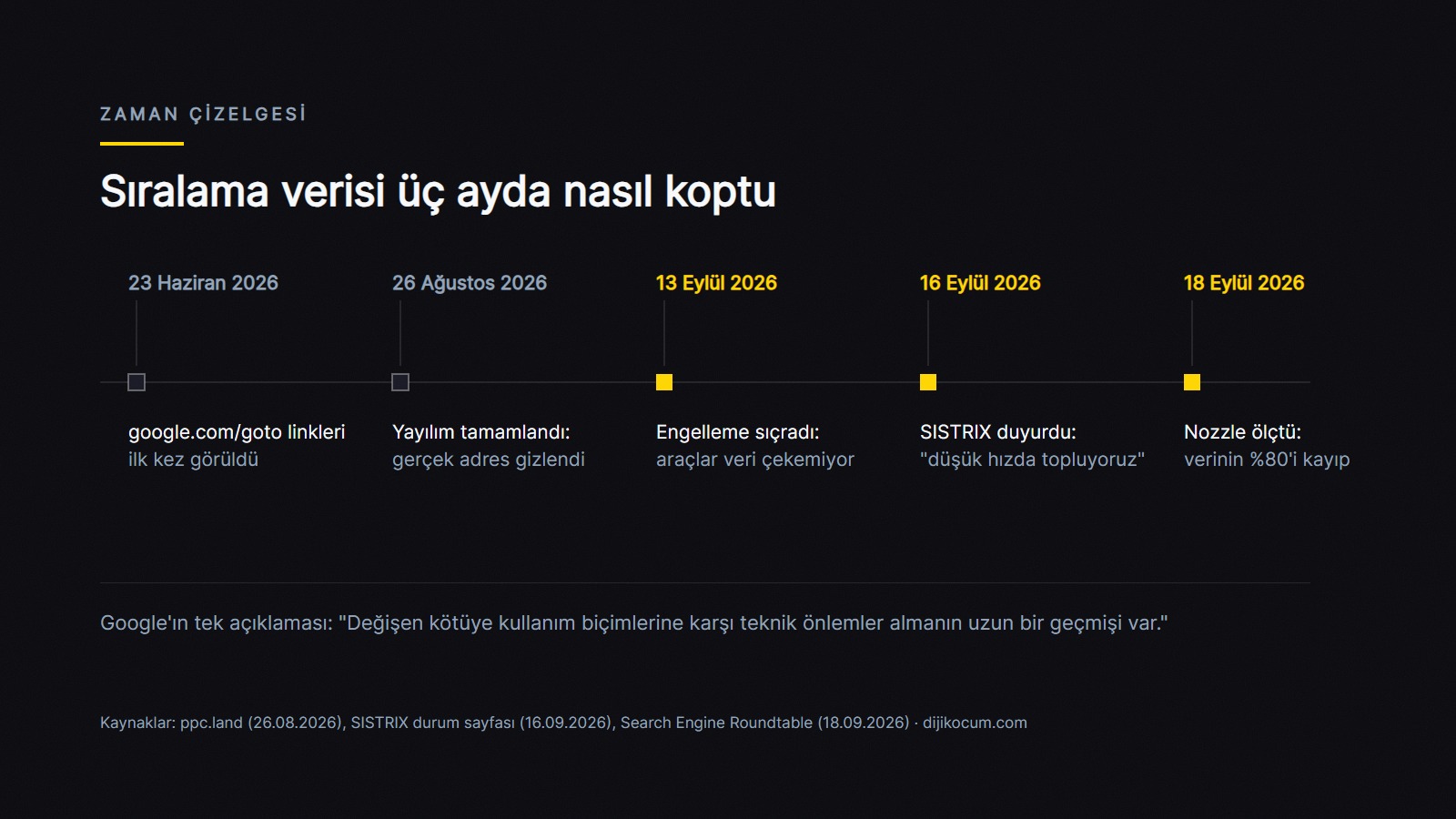
This didn't blow up in a single day; it had been building for three months.
The first link in the chain appeared on June 23, 2026: Google started wrapping the links in search results in an encrypted intermediate address of the form google.com/goto?url=. [A] On August 26, Perkins measured that this change had reached near-full rollout across several different residential IP providers. [C] The technical consequence: for a tool to read the real address on a results page, it now has to follow every link one by one. HEAD requests are rejected. Resolving a single five-page ranking query, as ppc.land reports, means 500 to 1,000 requests. [A]
The second link came on September 13. According to Search Engine Roundtable's roundup, around that date Google became visibly more successful at blocking AI crawlers, search scrapers and third-party tracking tools. [C] Steve Paine of SISTRIX says Google has been constantly changing the way results are served for about a year, but is now doing it at a very high rate. [C]
Google's only statement on this is old and short: "We have a long history of deploying technical measures against evolving forms of abuse." [A] There's no official announcement, no blog post, no transition timeline. And there won't be — Google's own terms already prohibit sending automated queries for the purpose of checking rankings. [A] In other words, what it's blocking was never permitted under its own rules in the first place.
Why does it matter?
Because the backbone of SEO reporting rested on a data collection method Google doesn't allow, and this isn't the first shake-up.
In September 2025, when Google removed the &num=100 parameter, tools could see only 10 results at a time instead of 100, which raised operating costs roughly tenfold. [C] The goto wrapper came on top of that. The jump in blocking on September 13 is the third layer. With three layers stacked up, the picture looks less like a single outage and more like a change of direction.
Here are the measured effects: an 80% loss in the data Nozzle can collect, a publicly announced slowdown at SISTRIX, and ranking readings that don't match across Ahrefs, SISTRIX and Semrush. [C] Schwartz also notes that these dates coincide with the algorithm rollbacks on September 4 and 12 and the September 15 update. [C] So the measuring instrument broke during a period when rankings really were moving. Two kinds of noise piled on top of each other.
I think the real issue isn't cost, it's trust. The ranking chart an agency shows its client should be something that can answer the question "Where does this number come from?" Right now, that answer has drifted toward "our tool collects it somehow, and we don't know how much of it it manages to collect." And here's my contrarian take: this isn't actually a disaster, it's a reckoning that's been put off for a long time. Rank was never the same thing as revenue; we were the ones who loaded it with more meaning than it deserved.
What changes for your brand?
If you work with an agency and you see a falling ranking chart in this month's report, don't jump to conclusions. Ask your agency one question: "Has the number of keywords that could be measured in this period changed compared to last month?" If the number of measured queries dropped, the average rank moves on its own, even if nothing happened on the site. We explained separately on the SEO management page which metrics a report should be built on.
If you have your own tool, don't rush to cancel the subscription; the providers are trying to adapt. But widen the date range when you look at the data. Day-to-day fluctuation isn't a readable signal right now.
If you're a local business (a clinic, a restaurant, a repair service), this affects you less. What you need to measure isn't third place nationwide, but whether you show up in the map pack in your own district and whether the phone rings. That data comes from Google Business Profile and call logs, not from a scraper.
If you're in e-commerce, instead of the rank of your category pages, look at the click–impression curve in Search Console, and from there at your cart data. Rank was always an intermediate metric anyway. I explained separately how to read Search Console data in my SEO guide.
The table below separates what's broken from what's still standing.
Unreliable right now
Still standing
Daily rank tracking from third-party tools
Clicks, impressions and average position in Search Console
Tools' derived metrics like a "visibility score" or "SEO score"
Organic sessions and conversions in GA4
Competitor ranking comparisons
Google Business Profile search and post-search action data
Detection rates for SERP features (AI Overviews, People Also Ask)
Server logs and real click counts
The one thing to do today: Open the Performance report in Search Console, set the date range to "last 3 months" and switch to comparison mode. Does the drop your tool shows point in the same direction as Search Console's click curve? If it does, the problem is real, keep working on it. If it doesn't, the problem is in the measurement — and for this month, take the ranking chart out of the report and put the click curve in its place. It costs nothing and takes fifteen minutes.
Today's Radar
News
Why people are talking about it
Who it affects
Google Discover tests a "Dive deeper" button (September 18)
Users who click go not to the publisher's page but to an AI summary; the test started with videos
Anyone who produces content and depends on Discover traffic — a topic to watch on the GEO agency side
AI Mode button tested in the search results page header (September 18)
AI Mode is becoming reachable from more points in the interface
Brands watching their queries shift to AI answers — ChatGPT SEO / GEO
AI dubbing comes to Google Ads Asset Studio: 33 languages
Localizing an existing video ad without a reshoot; for selected advertisers for now
Brands that export or are entering multilingual markets — it directly affects the production budget
The bill for the August 17 Smart Bidding change has arrived
In a Smarter Ecommerce analysis, median CPC rose 15.8% in budget-constrained tROAS campaigns, and impression share fell from 40% to 31%
Accounts with limited budgets — on the Google Ads side, budget and target settings should be reviewed
Google, Cloudflare and Microsoft test models for paying publishers (September 18)
Three different approaches: payment based on contribution to the answer, a per-crawl fee, a licensed content marketplace. The amounts are small for now
Publishers producing content and brands that rely on blog traffic
Frequently asked questions
Should I cancel my rank tracking tool?
No, at least not this month. The providers are trying to adapt; SISTRIX wrote openly that it has adjusted its processes. I don't know when Google will relax this, or whether it will at all — and I won't guess. For now, rather than dropping the tool, it makes more sense to reduce the weight you put on it: stop treating rank data as your only decision source, and put Search Console data next to it. The reporting we set up on the SEO management side reads the two together.
How can I tell if my site really dropped?
By looking in three places. In the same period, did clicks and impressions drop in Search Console, did organic sessions drop in GA4, did the number of conversions drop? If there's movement in all three, the problem is real. If only the rank in your tool dropped, the measurement is most likely incomplete. Really, this cross-check is something that always should have been done; Google has now made it mandatory. If you work with an SEO agency, this cross-reading should be exactly the first thing you ask for in the monthly report.
Does this change affect AI search too?
Indirectly, yes. AI crawlers are among those being blocked, so the data from tools that measure how often AI Overviews and similar features appear may also be incomplete. For brands that want to track their visibility in engines other than Google too, measurement on the GEO side requires a separate method, and that method doesn't rely on scrapers.
If you'd like to talk about what's left when the ranking chart breaks, we explained on the SEO management page what we build reporting on. For our other services, see the services page, and for previous radar posts, see the blog. If you're not sure which metric your site should be measured by, there's a fifteen-minute starting point:
Google increased the number of links in AI Mode and AI Overviews answers and moved them higher up, but there's still no metric showing the clicks those links send (October 15, 2026).
Google gave the spam update it launched on September 24, 2026 up to two weeks to roll out; the first hard wave came over the September 25–27 weekend. Who's at risk, and what should you do this week?
Google announced that the September 2026 spam update finished on October 8; the rollout took 13 days and 17 hours. Here's what to look at, and what not to touch, if your traffic dropped.
SEO6 min
We use cookies to improve the site and measure advertising performance. Analytics and advertising cookies run only if you accept them. Details are in our Privacy Policy and Data Protection Notice.