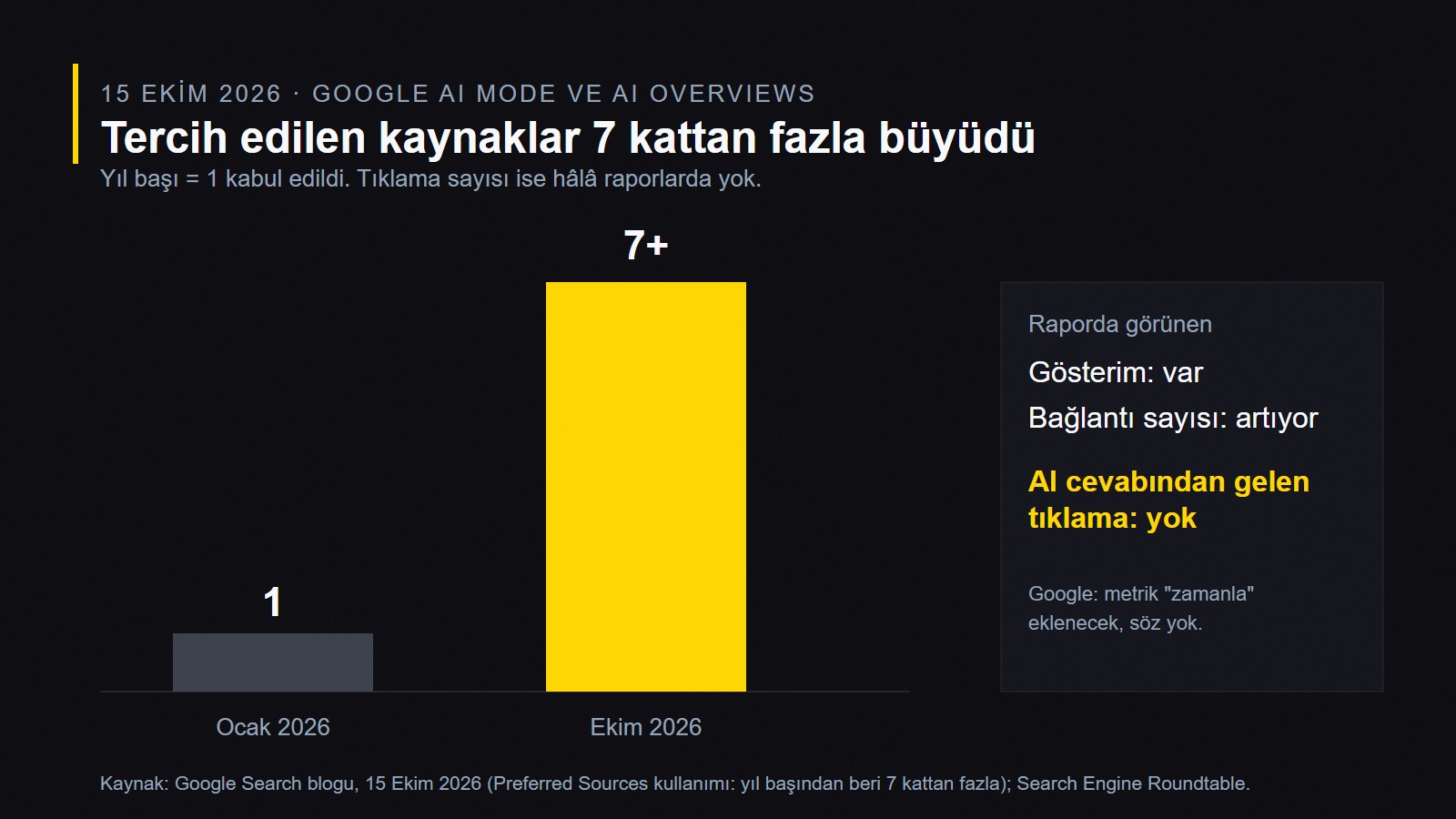
7x. On October 15, Google announced that the number of people using its "Preferred Sources" feature has grown that much since the start of the year. One thing is missing from the same announcement: a single number showing how many clicks those links have sent.
In other words, Google is putting more links into AI Mode and AI Overviews answers and moving them higher up, but it isn't telling you "this many people clicked." Its reply to Search Engine Roundtable points the same way: "We continue to work with website owners to understand which insights would be most useful."
Quick answer: Google increased inline links in AI Mode and AI Overviews answers, moved some of them above the answer, and started rolling out its news carousel to more regions. This matters to every site whose content gets cited. Google's reports don't show the clicks coming from these links; without setting up your own measurement, saying traffic "went up" or "went down" is a guess.
What happened?
On October 15, 2026, Google published an update on its Search blog; the post was written by Hema Budaraju, and Nick Fox announced it on X [A]. Roughly, here's what was announced:
Inline links in AI Mode and AI Overviews have seen "continued and substantial increases"; Google says it now shows them higher up within answers. There's no figure on how much they increased.
An "official links" section is in testing: at the very top of the answer, one or two links for queries from people who want to get a specific task done or find definitive information, each with a short note explaining why it's useful.
The carousel built for current news is starting to expand to "additional locations and languages globally," and it highlights Preferred Sources. Which countries and languages isn't specified, and whether Turkey is included isn't stated.
Related article links at the end of answers are getting visual thumbnails and becoming more clickable.
In one test, publisher and creator names on videos in AI Mode link to Google's Search profile pages rather than directly to the site [A][C].
Google also says more than 400 publications are in its news licensing pilot [A]. That's a topic for news sites; it doesn't have much to do with a small business's day-to-day work.
Why does it matter?
Because the most common complaint of the past year has been: "AI answers are taking readers away from my site." Google now seems to be responding by adding more links. Whether that increase turns into clicks to your site, though, nobody can verify from the outside.
In my view, it's important not to mix up two separate issues here. The first is visibility: does your page show up as a link in an answer? The second is traffic: does anyone actually click? Google's announcement talks about the first. For the second, it says "over time," without committing to anything. Search Engine Roundtable also emphasizes that there's no click metric in the AI performance reports [C].
There's also this: when the number of links goes up, your share doesn't automatically go up with it. Five links in the same answer doesn't mean all five get clicked equally. There's no data on this, and I won't guess.
There's one more uncertainty for Turkey. The features announced without a list of regions and languages are features whose timing and extent in Turkish-language searches aren't known. Checking your own queries once is worth more than my interpretation.
What changes for your brand?
If you publish content or a blog: Your page's chances of appearing as a link in an answer may have gone up, but you can't verify that in Search Console. You need to check your own queries by hand.
If you run a local business or a service site: The "official links" test targets queries from people who want to get a specific task done (booking an appointment, filling out a form, getting in touch, and so on). Having those pages clear and fast will pay off if the test expands. Whether it will expand isn't known.
If you produce news or timely content: Preferred Sources still means something: users can pick you as a source. The rules for appearing in the carousel aren't in the announcement. Still, review what Google said on October 3 about AI content and author transparency (in Turkish).
If you run e-commerce: More urgent than the increase in links are the Google and Meta shopping changes announced the same day (in the Radar below).
What do you do about "no click data"?
For the reporting side, I have a practical and boring answer: set up your own measurement.
Build a fixed list of 10-15 queries per month. Make them questions customers actually ask.
Once a month, ask these queries by hand in AI Mode and take screenshots. Note whether your page shows up as a link and in what position.
For the same period, line this up next to impressions in Search Console and organic sessions in GA4.
Add a "How did you hear about us?" question at the end of your forms.
None of these four steps is perfect. But it beats waiting for the number Google may or may not provide. If you remember, on October 15 the UTM tag also disappeared from ChatGPT links; the lesson is the same on both platforms: measuring AI-side traffic is in the platform's hands, not yours.
Comparison
Topic
What Google says
What's still unclear
Inline links
Increased, shown higher up
How much they increased, how many clicks they got
Official links section
Being tested
Which queries and which countries it will open to
News carousel
Coming to more regions and languages
Whether Turkey and Turkish are included
Click data
"We continue to work on it"
Whether a metric is coming, and when
The one thing to do today: Ask your site's most important service query once in AI Mode. Write down in a notes file, with the date, whether your page or your competitors' pages show up as links. Today's record of this 5-minute task may be the only comparison you have three months from now. You don't need to buy anything.
Today's Radar
News
Why people are talking about it
Who it affects
Meta will turn on "product browsing" by default in existing ads on October 28
Tapping an ad can open an in-app product page instead of the website; Meta claims 3% more conversions, without a definition. The countries aren't specified, and you have until October 28 to turn it off [C]
Google Search Console performance report has been delayed for several days
Rank tracking tools are also reporting problems; the cause hasn't been confirmed by Google [C]
Everyone who does reporting
Frequently asked questions
Will links in Google AI Mode increase my traffic?
There's no way to tell yet, and Google isn't sharing data on it. The number of links has gone up, but there's no click metric in the reports. Checking regularly with your own query list is currently the only way to measure it.
What is Preferred Sources, and does it help my site?
It's a way for users to mark the sources they prefer in Google's news results. Google talks about the growth in usage, but doesn't say how far it will extend to non-news sites. For a small business that doesn't produce news, it's not a priority for now.
Does this change apply in Turkey too?
The announcement says the news carousel is expanding to "additional locations and languages globally," but there's no list. No regional information was given at all for the other changes. You can't be sure without checking Turkish-language searches yourself.
Google gave the spam update it launched on September 24, 2026 up to two weeks to roll out; the first hard wave came over the September 25–27 weekend. Who's at risk, and what should you do this week?
Google announced that the September 2026 spam update finished on October 8; the rollout took 13 days and 17 hours. Here's what to look at, and what not to touch, if your traffic dropped.
October 3, 2026: Google updated two of its guides on October 1; all AI-generated content should be manually reviewed before publishing, and fabricated author profiles are now explicitly treated as deception.
SEO8 min
We use cookies to improve the site and measure advertising performance. Analytics and advertising cookies run only if you accept them. Details are in our Privacy Policy and Data Protection Notice.