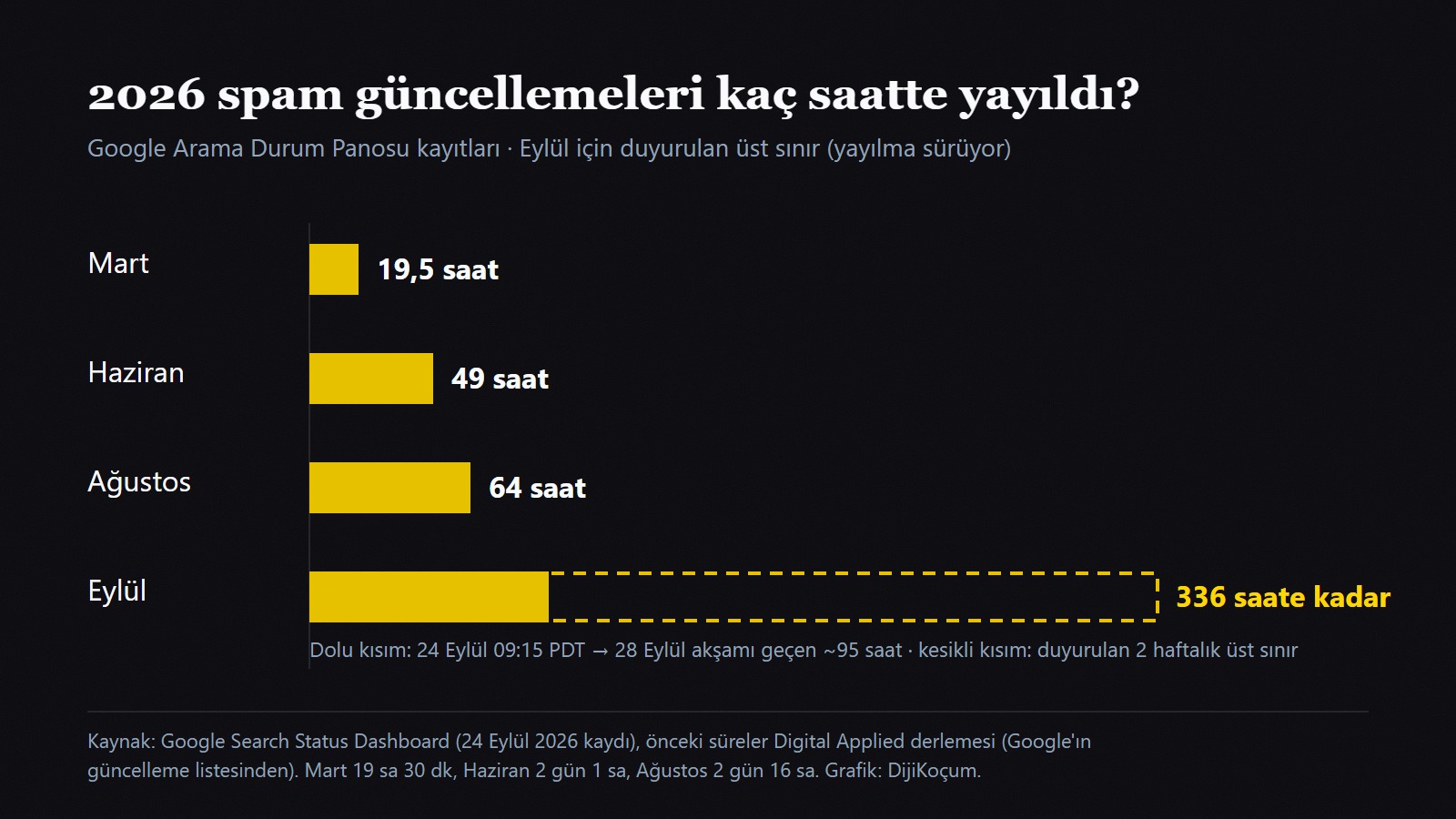
19 hours and 30 minutes. That's how long Google's first spam update of the year, in March, took to roll out and finish. June's took two days, and August's took two days and sixteen hours. For the fourth one, announced on Thursday, September 24, the timeframe Google gave is "up to two weeks."
Thursday evening was quiet. Then Friday started, Saturday got rough, and by Sunday evening almost every rank tracking tool had turned red. As I write this, the rollout is still going, so what we saw over the weekend may be only the first half of the story. If I were you, I wouldn't rush to touch anything on my site this week; I explain why below.
Quick answer: On September 24, 2026, Google launched the September spam update, which applies to all languages and countries; the rollout may last until around October 8, and the first big wave was seen over the September 25–27 weekend. It concerns sites engaged in scaled content production (especially unchecked AI pages), expired domain abuse and site reputation abuse. If your traffic dropped, first confirm in Search Console that there's no manual action and no technical error, and make your content decisions after the update finishes.
What happened?
A one-line entry dated September 24, 2026, 09:15 (Pacific time; 19:15 in Turkey) appeared on the Google Search Status Dashboard: "Released the September 2026 spam update, which applies globally and to all languages. The rollout may take up to two weeks to complete." [A] (Google Search Status Dashboard)
According to Barry Schwartz of Search Engine Roundtable, Google confirmed that the two-week wording wasn't a typo and was written that way on purpose. The update doesn't target link spam, and Google didn't share the share of affected queries. [A/C] (Search Engine Roundtable)
The weekend picture also comes from Roundtable: the first movement started on Friday (September 25), peaked on Saturday and continued into Sunday. Close to fifteen tracking tools, including Semrush, Mozcast, Sistrix, AccuRanker and Similarweb, all flag the same weekend. Consultant Glenn Gabe wrote that among the sites that dropped he saw examples of what he calls "Mt. AI" (sites churning out mountains of pages with AI) and "Mt. Programmatic." [C] (Search Engine Roundtable, September 28)
Why does it matter?
The first reason is the duration. This year's three spam updates finished in 64 hours at most [A]. Fourteen days suggests Google is doing something different this time. It isn't saying what, and I'm not going to make it up. But here's the context:
In the August update (August 18–21), one of the sites Glenn Gabe examined lost more than 200,000 queries entirely, and others lost around 14,000 and 25,000 [C] (GSQI, August 31). The common pattern: content produced at scale without editorial oversight.
A three-page Google Research paper dated late May describes a multi-agent system called "SAFE": a review mechanism that looks not at individual pages but at coordinated clusters of synthetic content. The paper is about YouTube channels; Google hasn't said whether it's used in Search [B] (Search Engine Journal). The link to this update is being drawn by the SEO community, not by Google.
Recovery isn't fast. Google's own documentation says a site that makes fixes may only improve "if our automated systems learn over a period of months that the site complies with our spam policies" [A] (Google, spam updates).
Let me also say this clearly: there's no published measurement showing how big the impact is on Turkish-language searches. Most tracking tools mainly read US and European data. If someone claims "this many sites dropped in Turkey," ask for their source.
What changes for your brand?
Frankly, for most small business sites, nothing. A spam update doesn't shuffle everyone's rankings the way a core update does; it hits the ones breaking the rules. The real risk is with those who think they're safe but did something like "let's scale our content" last year:
Those pumping out city × service pages. "Istanbul dental clinic," "Ankara dental clinic," "İzmir dental clinic"… Template copies opened for all 81 of Turkey's provinces, pages where only the city name changes, fit Google's definition of scaled content abuse exactly. It's the mistake I see most often among service businesses.
Those who handed their blog over to AI. Writing with AI isn't forbidden; Google's concern isn't the tool itself but "lots of pages that add nothing for the user." If 30 posts go out every week and no human touches any of them, that's where the risk is.
E-commerce sites copying the manufacturer's description and spreading it across thousands of products. On its own that isn't considered spam, but combined with programmatic pages the picture changes.
Those renting out a corner of their site to someone else. "Coupon" or "betting guide" subfolders on news sites are what Google calls site reputation abuse. Pages sold as "guest posts" on corporate sites can also slide into this category.
High chance of being hit by this update
Low chance of being hit
Content production
Unchecked, dozens of AI posts a day
Fewer but reviewed, sourced posts
Local pages
One template for 81 provinces, only the city name changes
A few cities you genuinely serve, with local information on each
Domain
An expired domain of an old organization bought and turned to another topic
A domain with the brand's own history
Third-party content
Subfolders rented out for authority
Guest content under editorial oversight, consistent with the site's topic
Links
Not targeted in this update
—
Let me add one caveat. It's easy to tell every site that saw a drop over the weekend "the spam update hit you," but that's not always true. A separate ranking fluctuation was also recorded on September 23–24, before the update was announced [C]. There's also seasonality. Before blaming the drop on a single cause, you need to look at the year-over-year comparison.
The one thing to do today
Open Search Console and, from the left menu, check the Security & Manual Actions → Manual actions page. If there's no entry there, compare dates in the Performance report as "last 28 days" versus "previous period," then run the same comparison against the same week last year. If the drop shows up only after September 25 and only in a specific group of pages (e.g., /blog/ or the city pages), write down that group's URL. Don't delete anything for now; run the same comparison again after October 8.
Why wait? Changes made while the rollout is ongoing both muddy your measurement and don't speed up an evaluation Google already says takes "months." This week's job is diagnosis, not treatment.
Today's Radar
News
Why people are talking about it
Who it concerns
Search Console got a "multimodal" search filter (September 24)
Lens, Circle to Search and image-based searches now show separately in the Performance report; no query text
Image-heavy e-commerce and catalog sites → SEO management
"Dive deeper" test in Google Discover (September 18)
Instead of clicking through to the story, an AI summary opens; publisher traffic concerns
Content sites that get traffic from Discover → GEO agency
YouTube announced "Shorts series" (September 23)
Shorts can be arranged into seasons and episodes; a response to TikTok's micro-series move
No, the tool on its own isn't a reason for a penalty. Google's spam policy targets producing large numbers of low-value pages to manipulate rankings; a human can do that, and so can AI. The question isn't "who wrote it" but "what did it add for the reader."
How do I know if my site was hit by this update?
First check whether there's a manual action in Search Console. If not, check whether the traffic drop lines up with September 25 and after, and whether it's concentrated in a specific group of pages. Make the final call after the update finishes, with a two-week before-and-after comparison.
If I was hit, how long until I recover?
Google doesn't give a timeframe; it only says "months." Consultants working with sites hit by the August update are also talking about at least a few months. Be cautious with anyone promising a quick comeback.
If you'd like to assess together where your content production falls in this picture, take a look at our SEO management page; if you'd rather see your site's overall state yourself first, take our short test.
Google increased the number of links in AI Mode and AI Overviews answers and moved them higher up, but there's still no metric showing the clicks those links send (October 15, 2026).
Since September 13, 2026, Google has been blocking rank tracking tools from collecting data, so the rankings in your dashboard may not reflect reality.
Google announced that the September 2026 spam update finished on October 8; the rollout took 13 days and 17 hours. Here's what to look at, and what not to touch, if your traffic dropped.
SEO6 min
We use cookies to improve the site and measure advertising performance. Analytics and advertising cookies run only if you accept them. Details are in our Privacy Policy and Data Protection Notice.