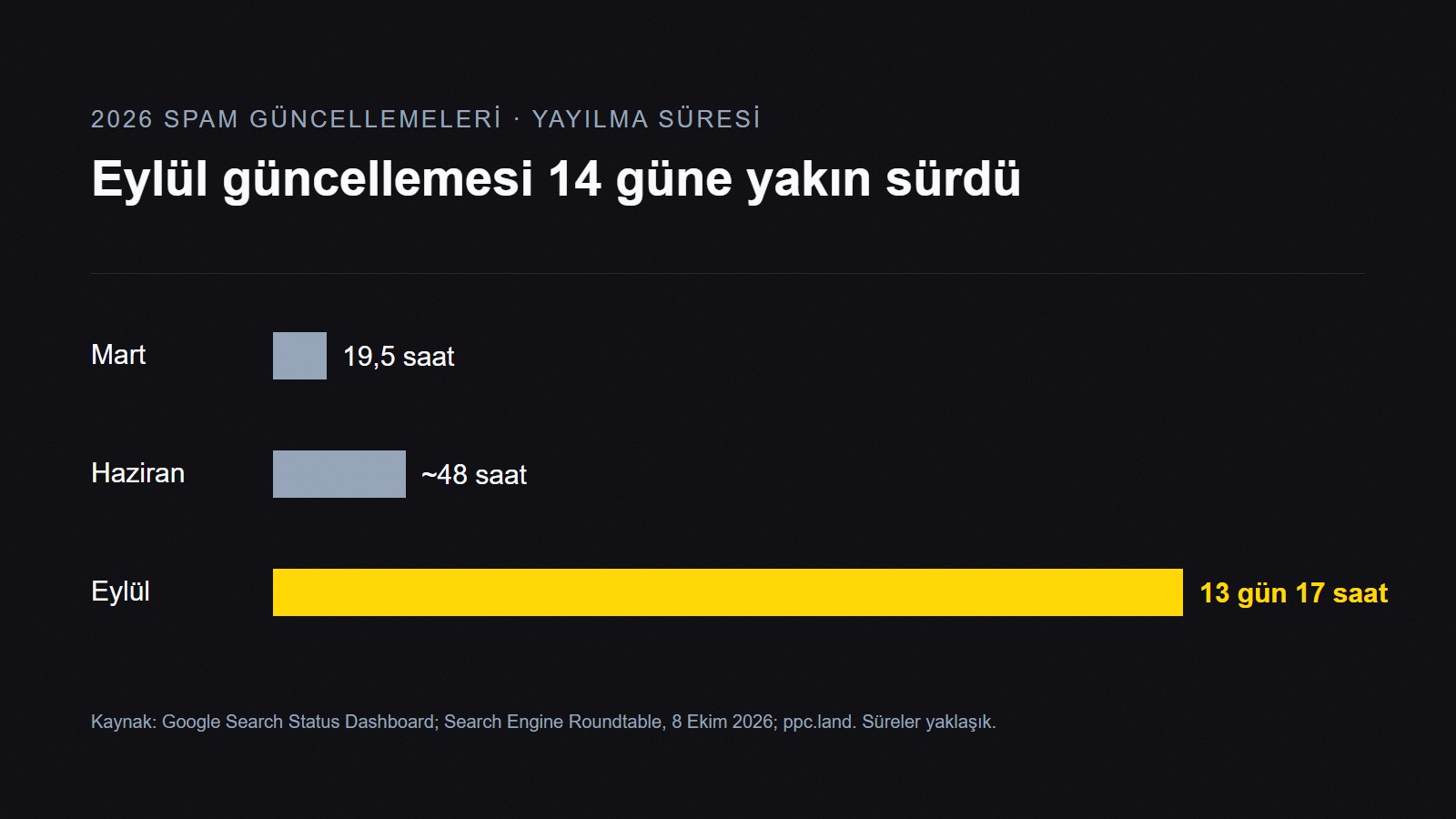
"Done" is a bit of a bold word for this update. Google announced that the rollout of the September 2026 spam update was completed on October 8; the process that started on September 24 took 13 days and 17 hours. This year's other spam updates had finished in one day, two days, three days. So this time, waiting patiently really was a strategy.
Last weekend I wrote about this update's first wave and said "make your content decisions once the update is over." The update is over. Now it's time to make good on that: what you should look at, and what you shouldn't.
Quick answer: Google announced that the September 2026 spam update was completed on October 8; the rollout took 13 days and 17 hours from September 24. It concerns sites that violate spam policies, such as scaled content abuse, expired domain abuse and site reputation abuse. If your traffic dropped between September 24 and October 8, first confirm in Search Console that there's no manual action, then review the pages that dropped one by one; don't do mass deletions.
What happened?
The Google Search Status Dashboard lists the update as starting on September 24, 2026, and the duration field says "13 days, 16 hours" [A] (Google Search Status Dashboard). By Search Engine Roundtable's count, it ended on October 8 at 04:37 Eastern time (11:37 in Turkey), for a duration of roughly 13 days and 17 hours [A/C] (Search Engine Roundtable). The one-hour difference is most likely due to rounding; I won't dwell on it.
Google Search Central announced the completion on X, and on LinkedIn wrote, "This is a normal spam update, and it will roll out for all languages and locations." [A] Barry Schwartz's objection to that sticks with you: calling something that took two weeks "normal" is a bit odd. I agree.
Once again, Google didn't explain what it was targeting. We know it didn't target link spam and that it didn't share the share of affected queries. That's it.
Why does it matter?
First, the duration. The March update finished in 19.5 hours, and the June update in about two days [B] (ppc.land). September's taking two weeks suggests Google did something different this time. I don't know what, and I won't speculate.
Second, the impact days are scattered. Schwartz writes that movement was seen on September 25–27, September 30 and October 4–6; but he himself can't confirm that all of those dates belong to the spam update, or that nothing else changed at the time [C]. So if you see a dip in your traffic chart on October 1, don't automatically pin it on the spam update.
Third, recovery. Google tells affected sites to review their compliance with spam policies, and says recovery can take months and that it will run periodic refreshes [A/C]. The word "months" is critical: if you fix something today, you won't see the result tomorrow.
There's also Schwartz's own take: some observers compare the impact to a core update, and he writes that he wouldn't be surprised to see a core update soon [C]. That's a guess, not information from Google.
On the policy side, ppc.land lists the existing rules the update enforces: expired domain abuse, scaled content abuse, site reputation abuse, doorway abuse, back button hijacking, and fake or hidden incentivized reviews. Enforcement isn't done through manual actions but through an algorithmic system called SpamBrain [B].
There's another signal from the same days, but I don't want to overstate it. Marie Haynes and Daniel Foley Carter wrote that requests for help with manual actions have risen in recent weeks; Schwartz also reviewed 12 threads from the Google Webmaster forum, most of them about "major spam issues," thin content and scaled content abuse [C]. But this is anecdotal. Google didn't confirm that it increased the number of manual actions, and ChatGPT and Gemini, which Schwartz had scan the forums, didn't find a dramatic jump either.
What changes for your brand?
If you haven't lost any traffic: don't do anything. I think the best response is to put your content quality control process in writing.
If there's a drop between September 24 and October 8: first check the Manual Actions section in Search Console. If there's a manual action, that's a separate path; you need a reconsideration request. If not, the issue is algorithmic and calls for calm analysis.
If you've mass-produced content with AI: look at which pages dropped, not all of them. More often than not, the common denominator is one template or one section.
If you have a small business blog: the update most likely didn't target you, but I can't know that. Clearly show each post's author, date and the real person responsible for it.
Situation
Where to look first
Should you rush?
Traffic didn't drop
Quality control checklist
No
There's a drop, and a manual action in Search Console
Manual Actions report, reconsideration
Yes, fix the problem first
There's a drop, no manual action
The common template of the pages that dropped
No, collect 1-2 weeks of data
Lots of mass-produced content
Page-by-page review
Moderate
The one thing to do today: Open the Performance report in Search Console, compare September 10–23 with September 25–October 8, and write down the URLs of the top 10 pages whose clicks dropped the most. Don't delete pages, don't change posts; just pull the list and note what those pages have in common (same template, same author, same production method). You don't need to buy anything.
Today's Radar
News
Why people are talking about it
Who it concerns
Conversion Lift in Google Ads can now be set up self-serve, with a minimum of 1,000 observed conversions and a $5,000 budget (SER)
Previously, Search and Performance Max required a Google rep
Large-budget Google Ads accounts; small accounts don't meet the threshold
Merchant Center may disapprove products whose price or stock changes too often instead of updating them (SER)
The help page was updated on September 27; no threshold number is given
The spam update is over, so why is my traffic still low?
Because the rollout ending doesn't mean the impact has ended. Google says recovery can take months and that there will be periodic refreshes. Reviewing the pages that dropped and fixing the real problem matters more than waiting.
How do I know which sites were affected?
You can't know for sure; Google didn't disclose its target. Look at page-level drops in Search Console between September 24 and October 8, and check whether there's a common template, production method or section. Because the impact days are scattered, it may be mixed up with another change.
Is the content I wrote with AI at risk?
Using AI isn't a violation on its own. The problem is pages produced at scale without editorial oversight that offer no added value. In my view, manual review before publishing is no longer up for negotiation.
Google gave the spam update it launched on September 24, 2026 up to two weeks to roll out; the first hard wave came over the September 25–27 weekend. Who's at risk, and what should you do this week?
October 3, 2026: Google updated two of its guides on October 1; all AI-generated content should be manually reviewed before publishing, and fabricated author profiles are now explicitly treated as deception.
Since September 13, 2026, Google has been blocking rank tracking tools from collecting data, so the rankings in your dashboard may not reflect reality.
SEO8 min
We use cookies to improve the site and measure advertising performance. Analytics and advertising cookies run only if you accept them. Details are in our Privacy Policy and Data Protection Notice.