1,000. Starting Thursday, that's the number of free-form replies each business phone number using the WhatsApp Business API can send for free per month. Since November 2024, there had been no limit. If a customer wrote to you, you could reply as much as you wanted within 24 hours, and Meta didn't charge a cent for it.
On October 1, 2026, that door closes. Articles out of Europe frame this as "WhatsApp is getting more expensive," and for Germany they're right. For businesses in Turkey, though, the picture is different. In my view, the real risk here isn't the bill, it's the message never being delivered at all. Below I separate the two.
Quick answer: Starting October 1, 2026, Meta will charge for free-form replies within the 24-hour window (service messages) on the WhatsApp Business API after 1,000 messages per number per month. Utility templates sent within the window, such as order confirmations, become paid from the very first message. Every business that replies to customers on WhatsApp, especially through a chatbot or a CRM, needs to check its payment method and its monthly reply count this week.
What happened?
Meta's WhatsApp Business Platform pricing documentation (last updated September 10, 2026) lists three changes for October 1. Frankly, the document is scattered; I went back to the top twice on my first read. Let me go through them in order:
Service messages become paid. Free-form text, images and similar replies you send within 24 hours after a customer writes to you had been free since November 1, 2024. From October 1, they're charged at each country's utility template rate [A].
There's a free quota of 1,000 messages a month. Each business phone number gets 1,000 free service messages per month. Any unused portion doesn't roll over to the next month. In group messages, each recipient counts separately [A]. This quota wasn't in the first announcement; Meta added it later with a "new" label.
Utility templates within the window are paid too. Since July 1, 2025, if you sent a template like "Your order has shipped" while the customer had already written to you, you didn't pay for it. That also ends on October 1, and the 1,000-message quota doesn't apply here [A][C].
There's also this sentence, buried a bit in the documentation: if no payment method is set up on your WhatsApp Business account, Meta delivers service messages until the 1,000 quota is used up, and after that, it doesn't [A]. So there's no error message and no bill. Your customer just doesn't get a reply, and that's it.
By the way, the 24-hour rule isn't changing. Incoming messages also stay free.
Why does it matter?
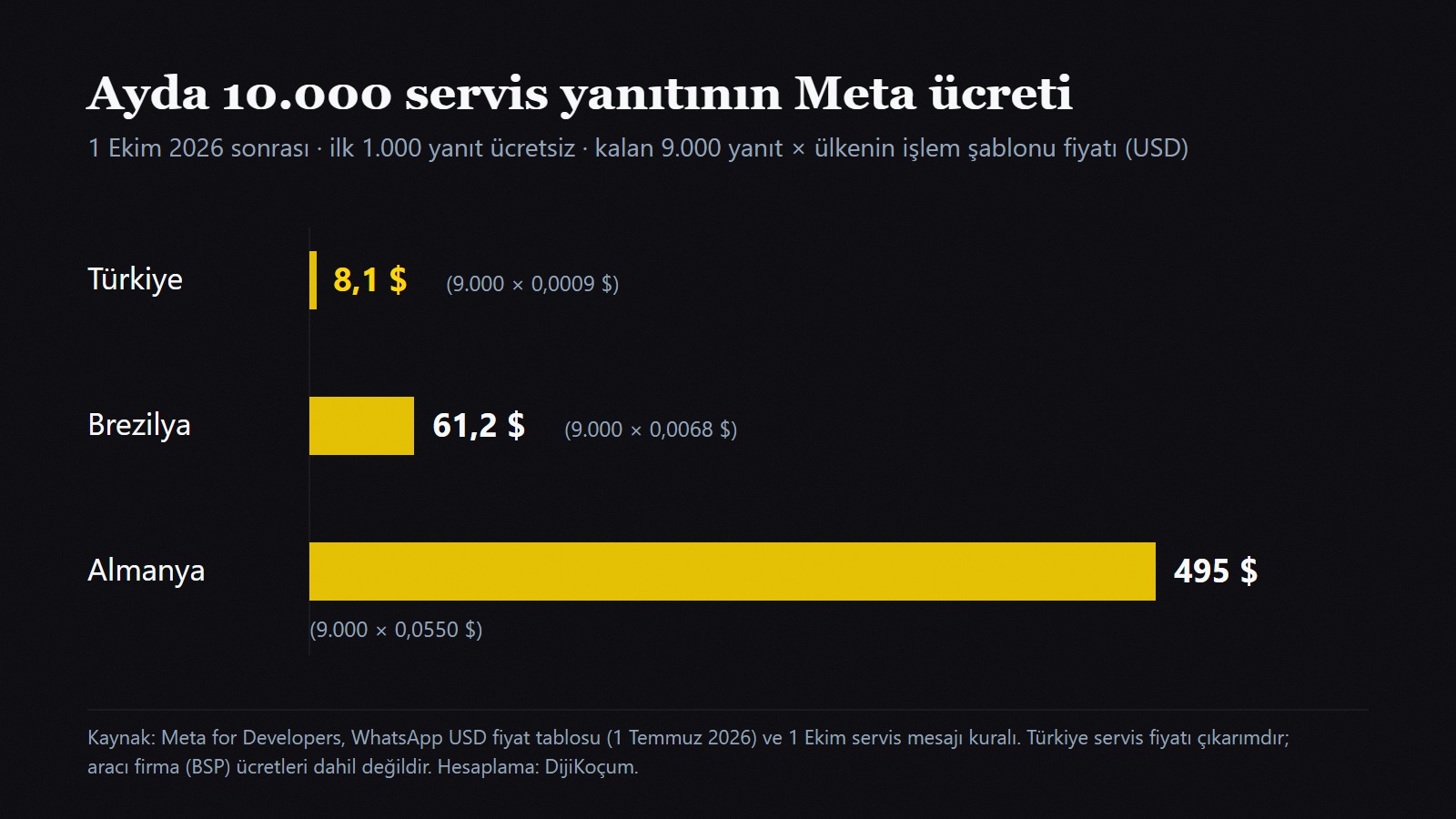
Let me reassure businesses in Turkey first. In Meta's USD rate table in effect since July 1, 2026, the utility template rate for Turkey is $0.0009 per message and the marketing template rate is $0.0109 [A]. Meta writes that the service message rate will be the same as the utility template rate in every country. Turkey also isn't on the list of countries whose rates change on October 1 [A]. The conclusion I draw from this is that a paid service reply in Turkey will cost about $0.0009. That's not a figure Meta states explicitly; it's an inference I made from two official pieces of information. If you see something different on your invoice, write to me and I'll correct it.
The math is simple. For a number that sends 10,000 replies a month, the first 1,000 replies are free, and the remaining 9,000 replies cost about $8.10. The same volume costs about $61 in Brazil and $495 in Germany (I calculated using the utility template rates in the July table) [A].
So the European articles that open with "WhatsApp is getting more expensive, let's move customer service to the phone" don't really apply to Turkey. If anything, I think they point you in completely the wrong direction.
So is it unimportant? No. There are three reasons:
There are no volume discounts on service messages [B]. Utility and authentication templates get cheaper as volume grows; service messages don't.
The fee is based on message count. In the Meta example NordFlux cites, the same conversation, made up of one marketing template, two AI replies, one agent reply and one order confirmation, counts as 1 paid message in July, 3 in August and 5 in October [B]. A bot that splits a single answer into four short bubbles now generates four lines on the invoice.
The intermediary (BSP) may add its own markup. Meta's rate is the same no matter which provider you're with. But many Turkish providers add their own per-message fee as well [C]. Even tripled, $0.0009 looks small; across hundreds of thousands of messages, it no longer does.
What changes for your brand?
If you run Click-to-WhatsApp ads: Conversations that come from a Meta ad pointing to WhatsApp, or from the WhatsApp button on a Facebook page, stay free for 72 hours. That includes template messages [A]. According to a note from Respond.io, for this window to open you need to reply to the customer's first message within 24 hours [C]. A team that gets back on Monday to a message that came in on Saturday misses out on this. The math on WhatsApp-focused campaigns in Meta ads tips a little more in your favor, but only if you reply quickly.
If you're an e-commerce business using a chatbot or AI assistant: You'll pass 1,000 replies a month within a few days. Rather than worrying about hitting the quota, check whether a payment method is set up. Meta's own AI agent (Meta Business Agent) has already been billed separately, on a token basis, since August 1. A bot you build yourself, with something like n8n, doesn't fall into that category; it counts as service messages [B]. We cover the setup on the AI assistant page and in the WhatsApp chatbot guide.
If you send order or appointment confirmations automatically: This is where the quietest change is. Starting October 1, every utility template sent within the window is paid from the first message [A]. In Turkey, the amount is small. But if your CRM flow sends the same customer a confirmation, a reminder and a "were you satisfied?" message separately, it may be time to combine two of them.
If you're a small business using the free WhatsApp Business app on your phone: Nothing changes for you. These rules only concern the API side.
| | Until September 30 | From October 1, 2026 |
|---|---|---|
| Free-form reply within 24 hours | Free, unlimited | 1,000 free per number per month, paid after that |
| Utility template within the window (order confirmation, etc.) | Free | Paid from the first message |
| 72-hour window from an ad or page button | Free | Free (unchanged) |
| Marketing template | Paid (Turkey ≈ $0.0109) | Paid (Turkey isn't on the change list) |
| Account with no payment method | Replies go out | After 1,000, replies aren't delivered |
| Incoming messages | Free | Free |
The one thing to do today
In Meta Business Suite, open the Billing & payments section (Billing Hub) and check whether a valid payment method is set up on your WhatsApp Business account. If there is one, note on the same screen how many service messages you sent last month. If there isn't one and you send more than 1,000 replies a month, at some point in the first week of October your customers will stop getting replies. If you use an intermediary, ask them this: "After October 1, will messages stop if our account is missing a balance or a card?"
Today's Radar
| News | Why people are talking about it | Who it affects |
|---|---|---|
| Google's September 2026 spam update started on September 24 and will take up to two weeks | The fourth spam update of the year. The previous three finished in two days, so a rollout this long stands out. | Any site whose traffic has been fluctuating lately. Wait two weeks before panicking: SEO management |
| Google Posts containing unverified phone numbers, emails and social media accounts may be removed (September 25) | Writing a phone number in a post used to be banned entirely. Now verified ones are allowed and unverified ones may be removed. | Local businesses that share promotions on their Business Profile: digital marketing |
| Search Console gets a "Multimodal" filter (September 24) | Lens, Circle to Search and image-based searches are reported separately for the first time. This data was never visible before. | E-commerce and fashion brands found through product images: GEO agency |
| Google adds creator/author support to video structured data (September 24) | Who a video belongs to can now be officially stated in the schema. | Brands that publish their own videos on their site: production |
| In Google Ads, target ROAS can't be edited while promotion mode is on (September 25) | Advertisers who want to change ROAS mid-campaign only see the tolerance setting. | E-commerce advertisers who adjust bids during campaign periods: Google Ads |
Frequently asked questions
Is the WhatsApp Business app becoming paid too?
No. The free WhatsApp Business app you download to your phone is outside this change. The rules only cover WhatsApp Business Platform accounts connected through an intermediary or the Cloud API.
Are the 1,000 free messages per account or per number?
Per number. According to Meta's documentation, each business phone number has its own monthly quota of 1,000, and the unused portion doesn't roll over. If you have two numbers, you get a total of 2,000 free service messages a month.
What is the exact price of a service message in Turkey?
Meta writes that the service message rate will be the same as the utility template rate in every country. In the July 2026 table, Turkey's utility template rate is $0.0009, and Turkey isn't among the countries whose rates change in the October update. So I expect about $0.0009. You'll see the exact amount on your October invoice. Any fee your intermediary adds isn't included in that.
If you'd like to work out together how much your WhatsApp-directed ads and your reply flow will cost after October 1, take a look at our Meta ads and AI assistant pages.
I walk through advertising on Instagram, from the Boost button to Ads Manager: what you need, how to calculate a budget, how long ad review takes, and what not to touch in the first two weeks.
At Advertising Week on October 6, 2026, Meta announced generative video, a wider Ads Creative Studio rollout, and in-chat checkout; here's what changes for advertisers, including those in Turkey.
Meta pushed the effective date of its new commercial terms from October 30 to November 20, 2026; as far as press reports show, the liability clause on AI features remains unchanged.
Advertising6 min
We use cookies to improve the site and measure advertising performance. Analytics and advertising cookies run only if you accept them. Details are in our Privacy Policy and Data Protection Notice.