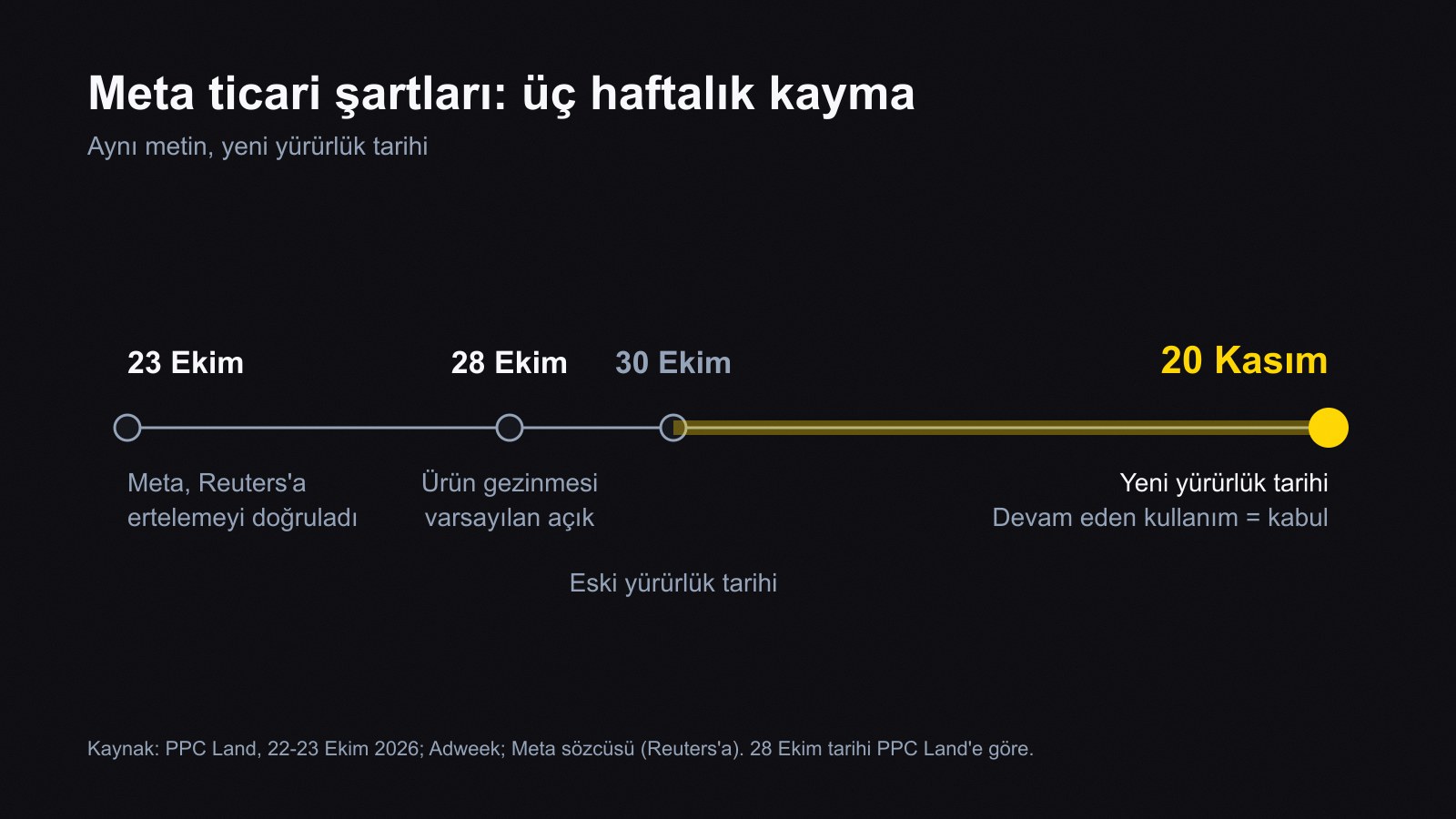
Meta's new commercial terms were supposed to take effect on October 30. Now they won't: on Friday, October 23, a Meta spokesperson told Reuters that the date had been pushed to November 20. No change to the text of the terms was announced, so this is only a calendar shift.
The reason I'm making the delay the headline isn't the date itself. The real issue is the "AI Features" section inside the terms, and the responsibility that section places on advertisers. You've gained three weeks, but what you need to do hasn't changed.
Quick answer: Meta pushed the effective date of its revised Commercial Terms and Self-Serve Ad Terms from October 30 to November 20, 2026; as far as press reports show, the text is the same. This affects everyone advertising on Meta, especially those who leave Advantage+ features turned on. What you need to do: use these three weeks to review the AI features in your account one by one.
What happened?
In an email to Reuters, the Meta spokesperson said the extra time was given "to explain to our partners and stakeholders what's changing and what's not." [C] According to PPC Land, the delay came after publishers filed complaints with EU and UK competition authorities. Publishers read the terms as a text granting Meta unlimited rights to use their content for AI services. Meta rejects that reading. [C]
For advertisers, though, the knot is in a different sentence. The new "AI Features" section, reported by Adweek on October 22, says AI features "may make mistakes" and may not produce accurate, complete or appropriate results, and it leaves the entire risk arising from the output to the business. [C] Previously, this responsibility arose only when you voluntarily used Meta's generative AI ad tools. In the new text, features Meta turns on by itself also appear to be in scope. [C]
Meta's response on this has two parts. First, advertisers can turn off individual Advantage+ features in Ads Manager at any time. Second, the update is a consolidation that folds the existing generative AI ad terms into the main terms. It did not directly answer whether you bear responsibility for a feature you haven't turned off. [C] I can't fill that gap either; I'm not the person to give a legal interpretation.
Why does it matter?
Because this isn't an abstract legal debate; it's something you can see on screen. According to Adweek, an agency called Exverus found added site links, translated copy, and images or carousels generated from the brand's own visuals even in campaigns where nobody had turned those features on, and pulled live ads. [C] Bookshop.org was enrolled in a generative feature through an account update; when it saw an AI illustration added to its human-made ad, it turned off all of Meta's AI ad features. [C]
The scale isn't small either. According to a figure reported by PPC Land, about 10 million advertisers used at least one of Meta's generative AI creative tools in the third quarter. [C] The same article also mentions that the average price per ad rose 23% and impressions rose 8% in the US and Canada. [C] I'm not linking those two numbers into cause and effect; they sit side by side, and that's all.
There's one more thing: PPC Land writes that the liability cap in the terms is the greater of $100 or the fees the advertiser paid in the previous twelve months, but it also states plainly that it could not verify the text on Meta's preview page. [C] The figure isn't clear on Meta's official page, so treat it as single-source.
Here's my contrarian view: everyone is saying "Meta is dumping all the risk on us." It's a valid alarm, but only half the story. The real risk isn't the contract language; it's an ad running under your brand's name that you haven't seen. Legal liability matters if you end up in court. A wrong price or a warped product photo that a customer sees matters today.
What changes for your brand?
Nothing today. The terms stay as they are until November 20. But on that day they'll be considered silently accepted: continuing to use the products means acceptance, and a business that objects has to stop using Meta products for commercial purposes. [C]
Small-budget, one-person accounts: If you manage the ads yourself, you can check what you see. The real problem is when there are multiple people or an agency on the account and you don't know who turned on which feature.
If you work with an agency: Ask your agency in writing which Advantage+ features are turned on. If the answer is "we don't know," that's an answer too.
E-commerce and industries that display prices: An image altered by AI or translated copy produces the most expensive mistakes here. Even a site link added automatically means traffic to the wrong page.
Cutting the budget in Q4: As Go Fish Digital put it, leaving Meta at this time of year isn't realistic for most brands. [C] The sensible move isn't to leave, but to turn off what can be turned off.
Now (until November 20)
After November 20
Terms in effect
Current generative AI ad terms
Consolidated Commercial Terms
Liability
Only the tools you chose
Reportedly includes the ones Meta turns on
What you can do
Review features one by one and turn them off
The same, but with the terms now accepted
What remains unclear
Liability for features you didn't turn on
The same question; Meta hasn't answered yet
The one thing to do today: In Ads Manager, open your biggest active campaign and look at the ad-level creative enhancements and Advantage+ settings. Next to every feature you see turned on, jot down "did I turn this on on purpose?" You don't need to buy anything; it takes ten minutes.
Today's Radar
News
Why people are talking about it
Who it affects
Google Ads is dropping the hashing requirement in Data Manager on November 16 and will process data in a trusted execution environment (PPC News Feed)
Data preparation changes for anyone uploading customer lists and enhanced conversions
Advertisers using Google Ads who upload offline conversions
Creative enhancements in ChatGPT Ads turn on by default October 29-30; opt out in Ads Manager
The same question exists on Meta: AI can rewrite ads without approval
When will Meta's new commercial terms take effect?
Meta pushed the effective date from October 30, 2026 to November 20, 2026. A Meta spokesperson confirmed this to Reuters on October 23. Even hours after the news, Meta's preview pages could still show the old date, so it's worth checking the date against Meta's own announcement too.
Can Meta's AI change my ad without my approval?
According to Adweek and agencies, this happened in some accounts: site links being added, copy being translated, images and carousels being generated. Meta says individual features can be turned off in Ads Manager. Some options were reported to sit in hidden or collapsed menus, so you need to check them all by hand.
Do these terms also apply to advertisers in Turkey?
The news reports don't say this clearly, and I'm not going to guess. Check which Meta company your account is tied to and the terms shown to you; for legal consequences, ask a lawyer. Turning off AI features that are on in your account, however, doesn't depend on any legal interpretation.
If you're not sure which AI features are turned on in your account, you can look at our Meta Ads service, or first see where you stand with START YOUR FREE ANALYSIS . Other developments are on the blog page, and all our services are here.
I walk through advertising on Instagram, from the Boost button to Ads Manager: what you need, how to calculate a budget, how long ad review takes, and what not to touch in the first two weeks.
At Advertising Week on October 6, 2026, Meta announced generative video, a wider Ads Creative Studio rollout, and in-chat checkout; here's what changes for advertisers, including those in Turkey.
September 27, 2026: Starting October 1, Meta charges for replies within the 24-hour window on the WhatsApp Business API after 1,000 messages per number per month. In Turkey the cost is small; the real risk is replies not being delivered on accounts with no payment method.
Advertising8 min
We use cookies to improve the site and measure advertising performance. Analytics and advertising cookies run only if you accept them. Details are in our Privacy Policy and Data Protection Notice.