
Visuals in Turkish · the full text is on this page
How-To Guide · GEO
How to Write Answer Blocks That AI Will Cite
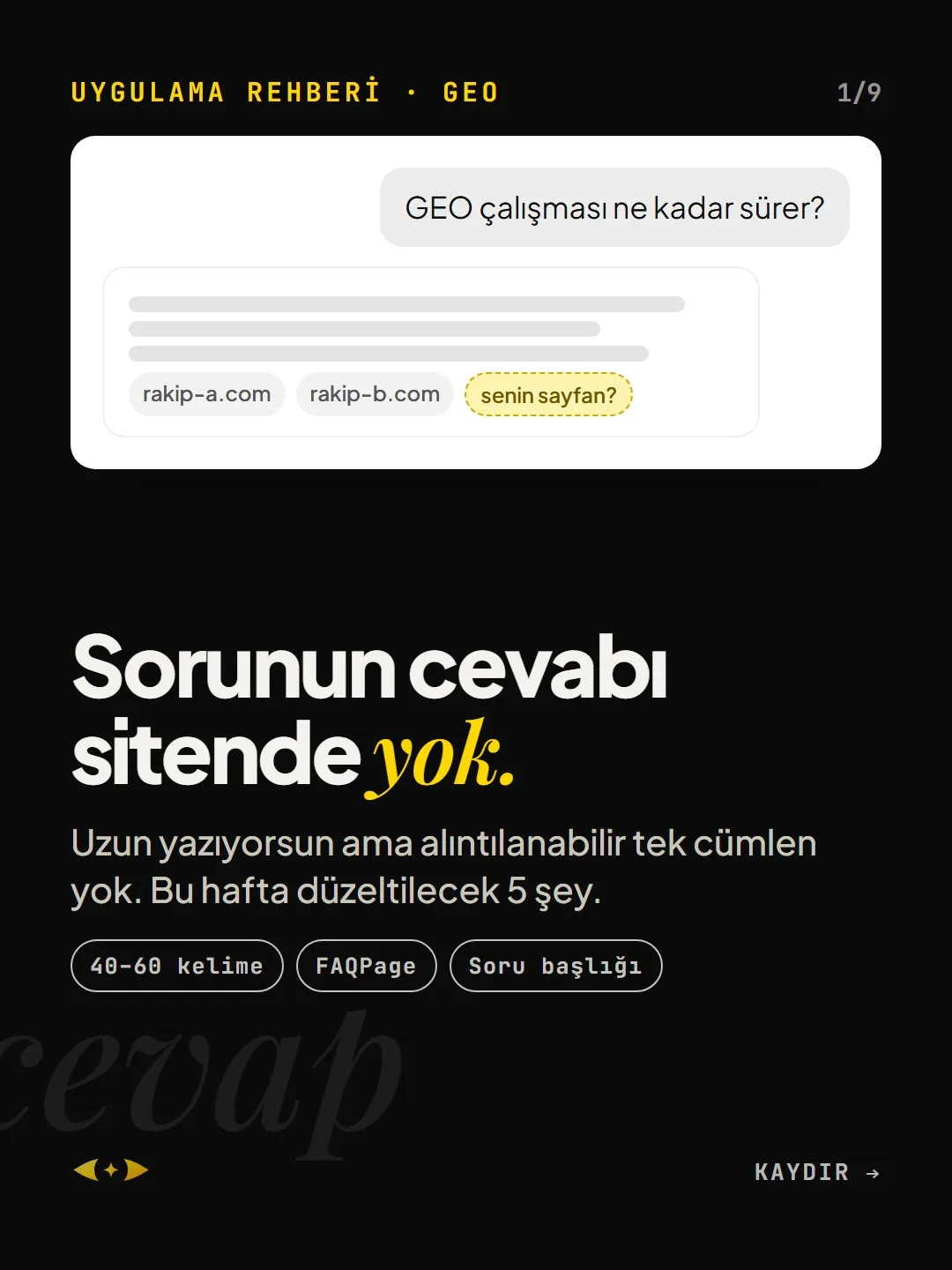
You write long posts, but you don't have a single quotable sentence. 5 things to fix this week.
Short answer
When AI builds an answer, it looks for the shortest complete passage it can lift from a page; if the clear answer is scattered across a long post, it cites another site. Turning the heading into the question the user asks and writing a direct 40–60 word answer right below it, with at least one number or condition, increases your chances of being cited.
5 steps · 2 min read · · Turan Yasin Salcı
Step by step · 5 steps
0/5 checked · saved in this browser only
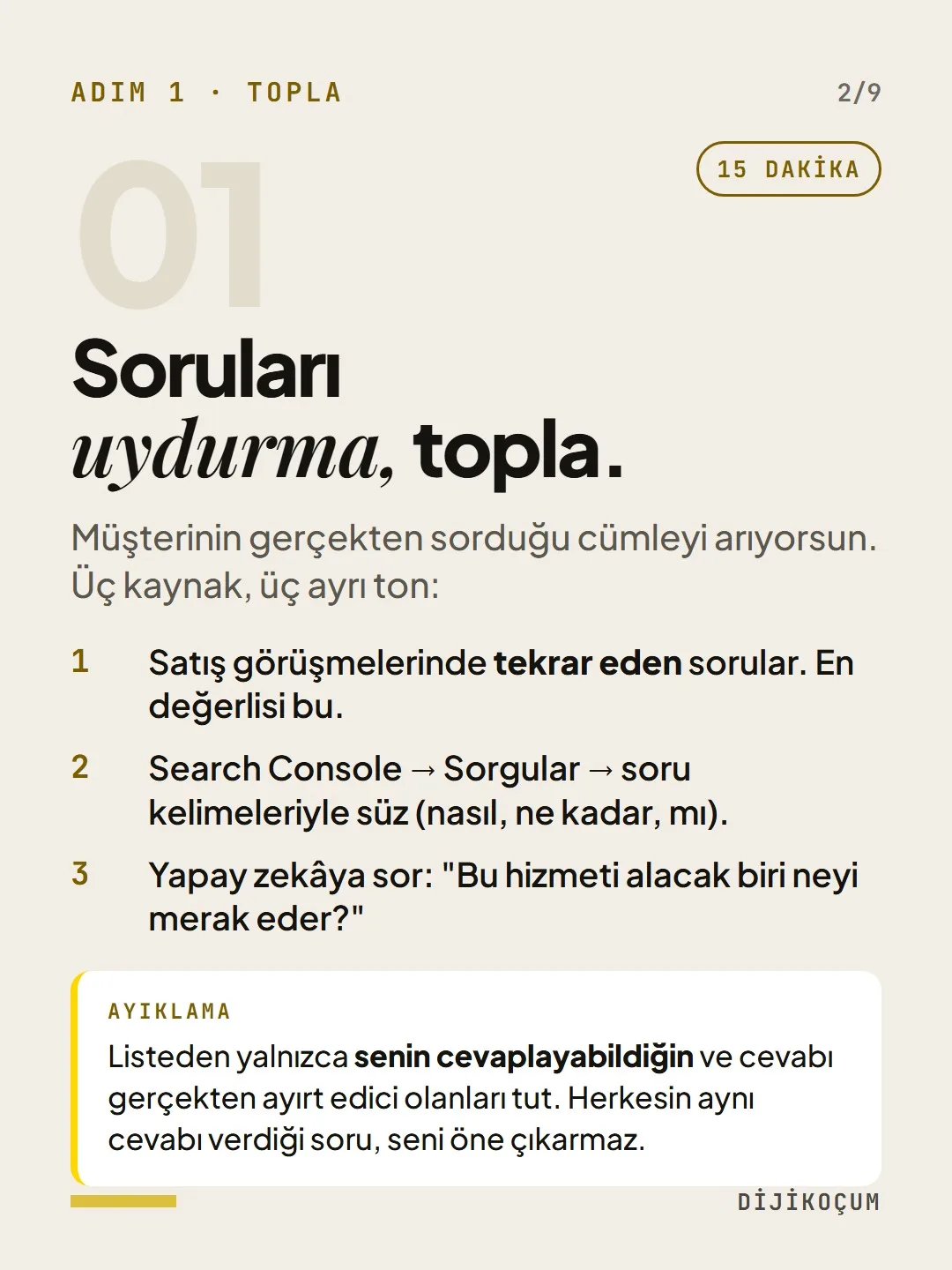
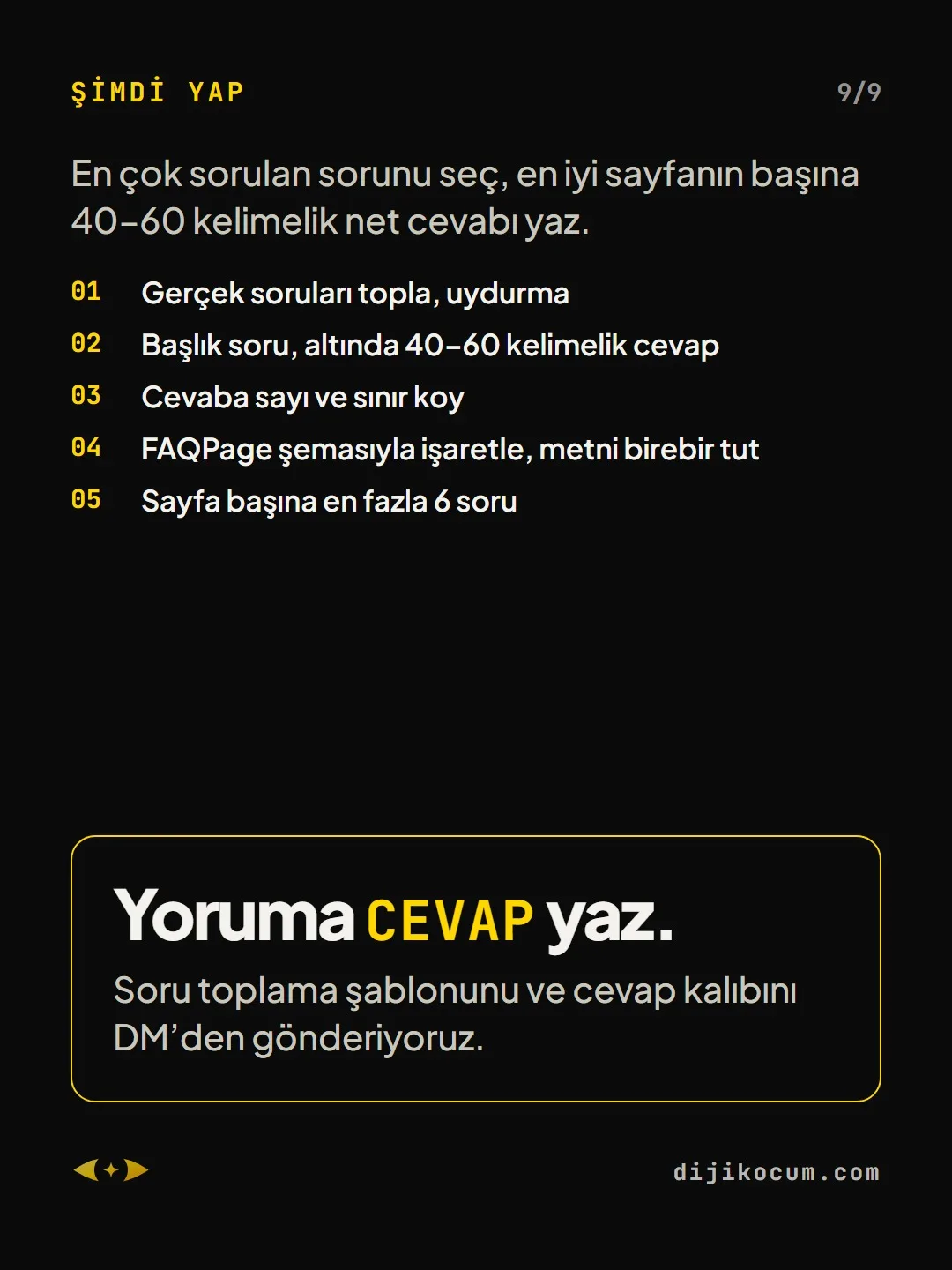
Don't make up questions; collect them.
15 MINUTESYou're looking for the exact sentence your customer actually asks. Three sources, three different tones:
- Questions that keep coming up in sales calls. This is the most valuable one.
- Search Console → Queries → filter by question words (how, how much, is/does).
- Ask AI: "What would someone buying this service want to know?"
Filtering: Keep only the questions you can answer and where your answer is truly distinctive. A question everyone answers the same way won't make you stand out.
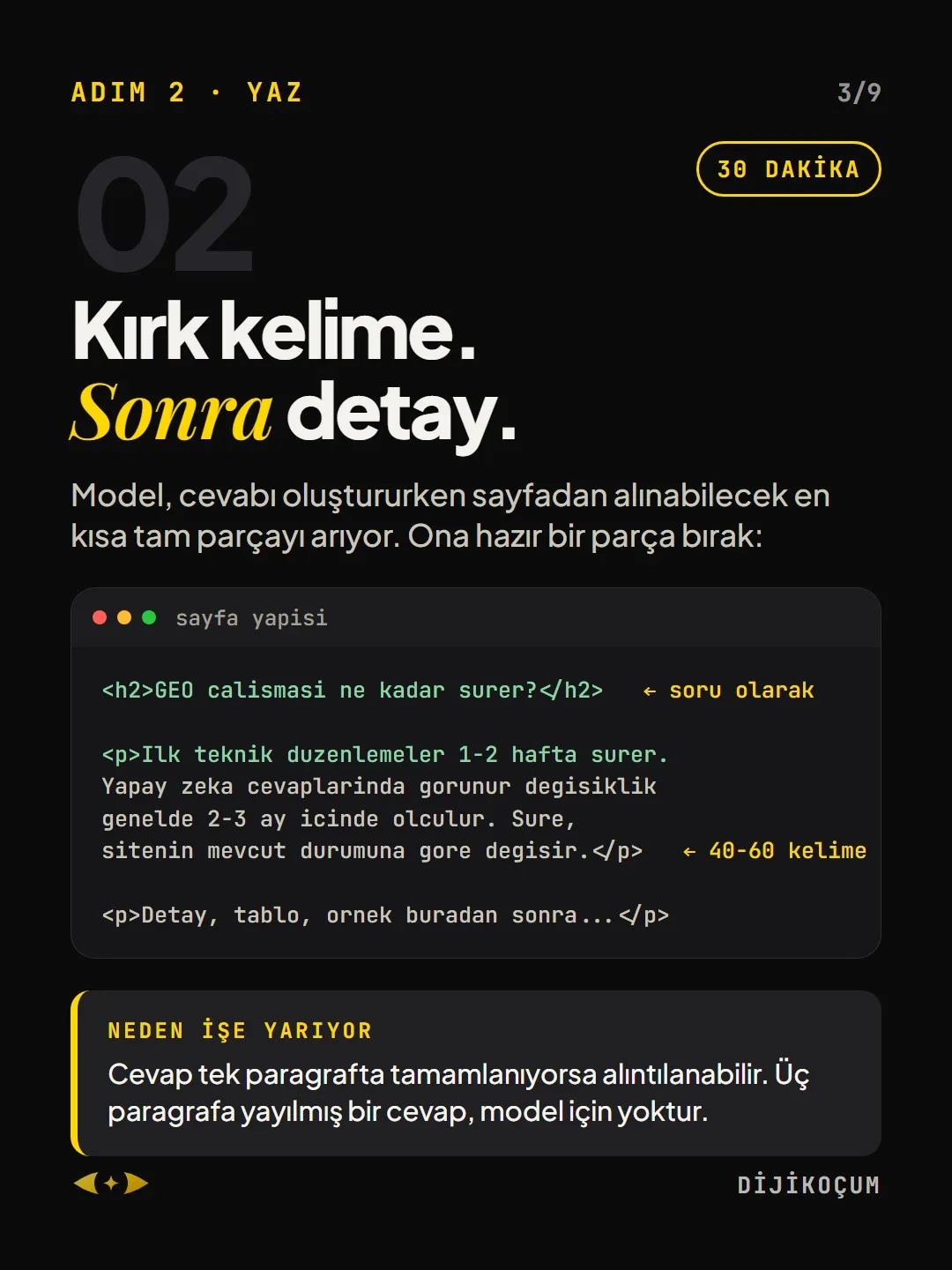
Forty words. Then the details.
30 MINUTESWhen the model builds an answer, it looks for the shortest complete passage it can lift from the page. Leave it a ready-made one:
Why it works: If the answer is complete in a single paragraph, it can be quoted. An answer spread across three paragraphs doesn't exist for the model.
<h2>How long does GEO work take?</h2> <p>The first technical fixes take 1-2 weeks. A visible change in AI answers is usually measured within 2-3 months. The timeline depends on the site's current state.</p> <p>Details, tables, examples go after this...</p>What does a quotable sentence look like?
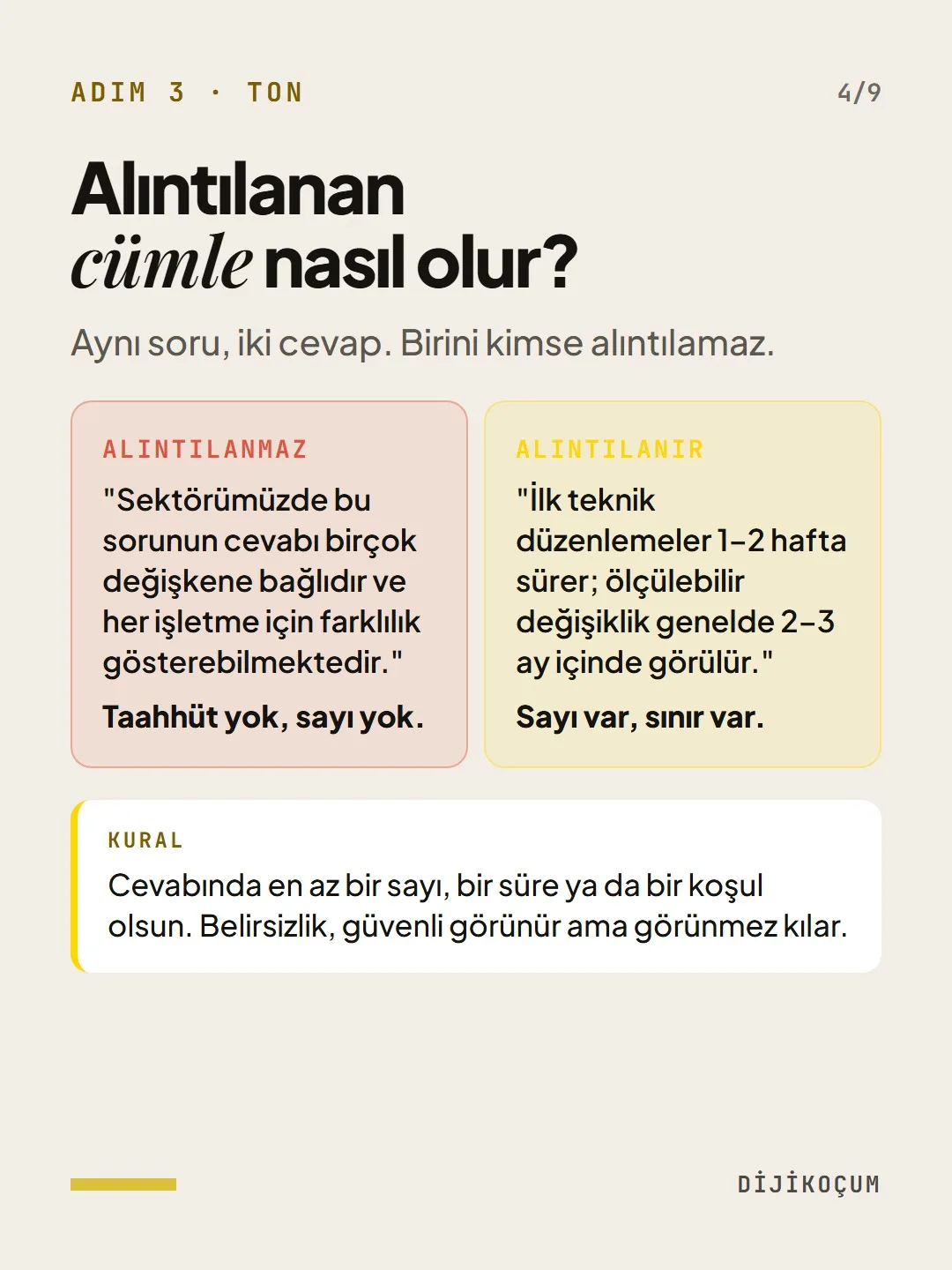
Same question, two answers. No one will quote one of them.
- Not quotable: "In our industry, the answer to this question depends on many variables and may vary for each business." No commitment, no number.
- Quotable: "The first technical fixes take 1–2 weeks; measurable change is usually seen within 2–3 months." There's a number, there's a limit.
The rule: Your answer should have at least one number, one time frame or one condition. Vagueness looks safe, but it makes you invisible.
Tell the machine too.
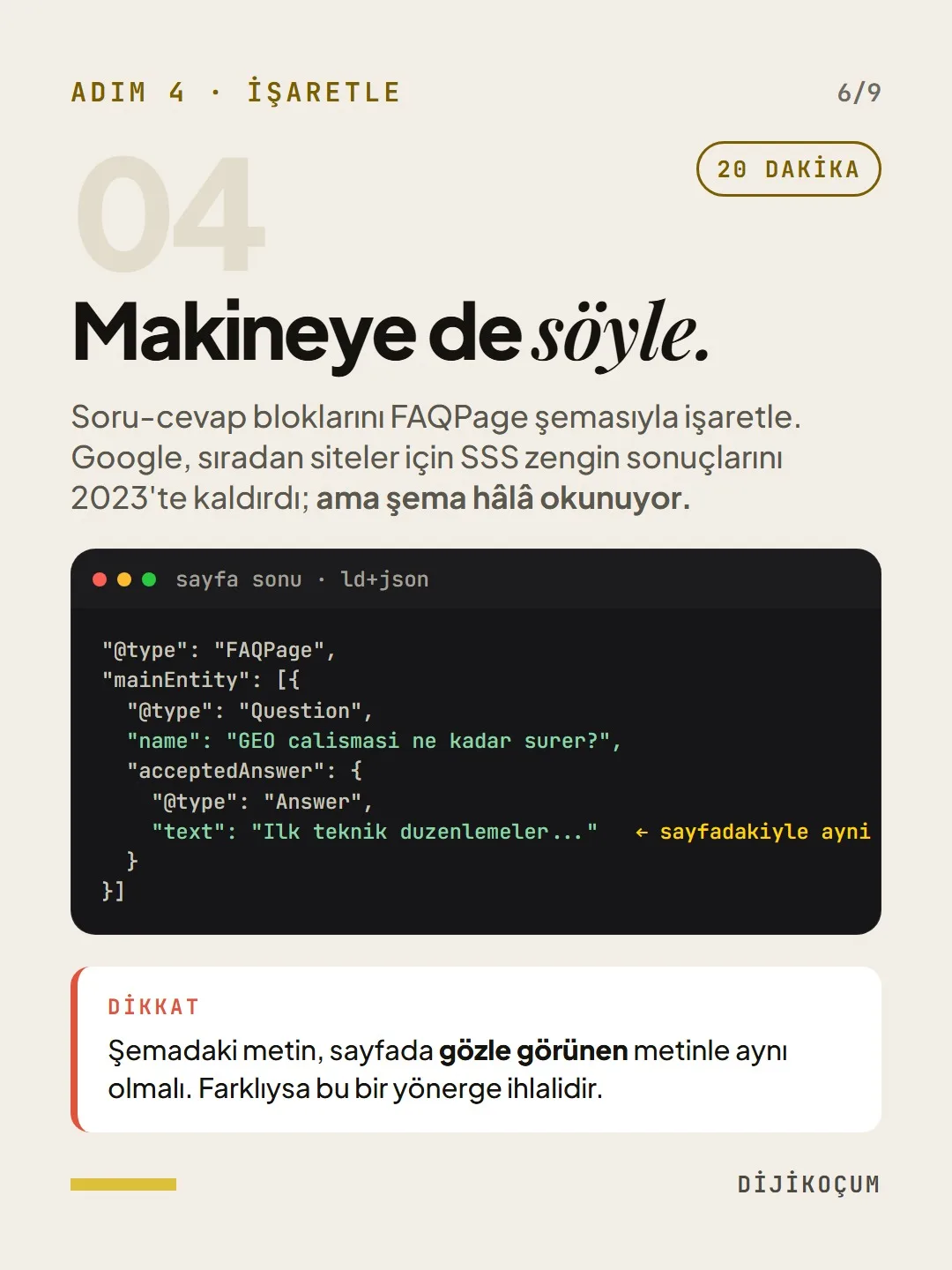
20 MINUTESMark up your question-and-answer blocks with FAQPage schema. Google removed FAQ rich results for ordinary sites in 2023; but the schema is still read.
Note: The text in the schema must match the text visible on the page. If it differs, that's a guidelines violation.
"@type": "FAQPage", "mainEntity": [{ "@type": "Question", "name": "How long does GEO work take?", "acceptedAnswer": { "@type": "Answer", "text": "The first technical fixes..." } }]Six questions per page.
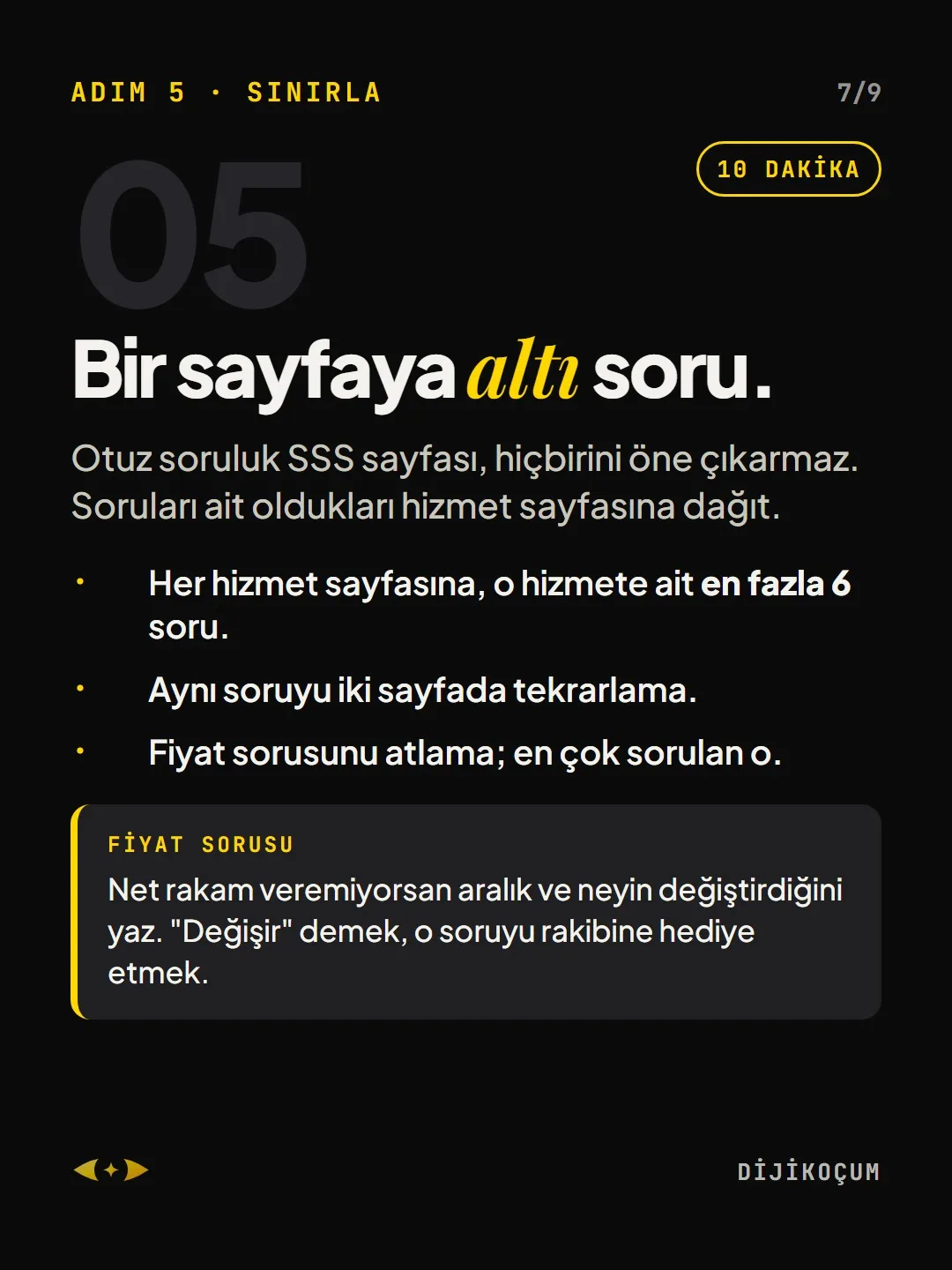
10 MINUTESA thirty-question FAQ page doesn't make any of them stand out. Spread the questions across the service pages they belong to.
- On each service page, at most 6 questions about that service.
- Don't repeat the same question on two pages.
- Don't skip the price question; it's the one asked most.
The price question: If you can't give an exact figure, write a range and what changes it. Saying "it depends" hands that question to your competitor.
How to measure it
Check whether you're being cited.
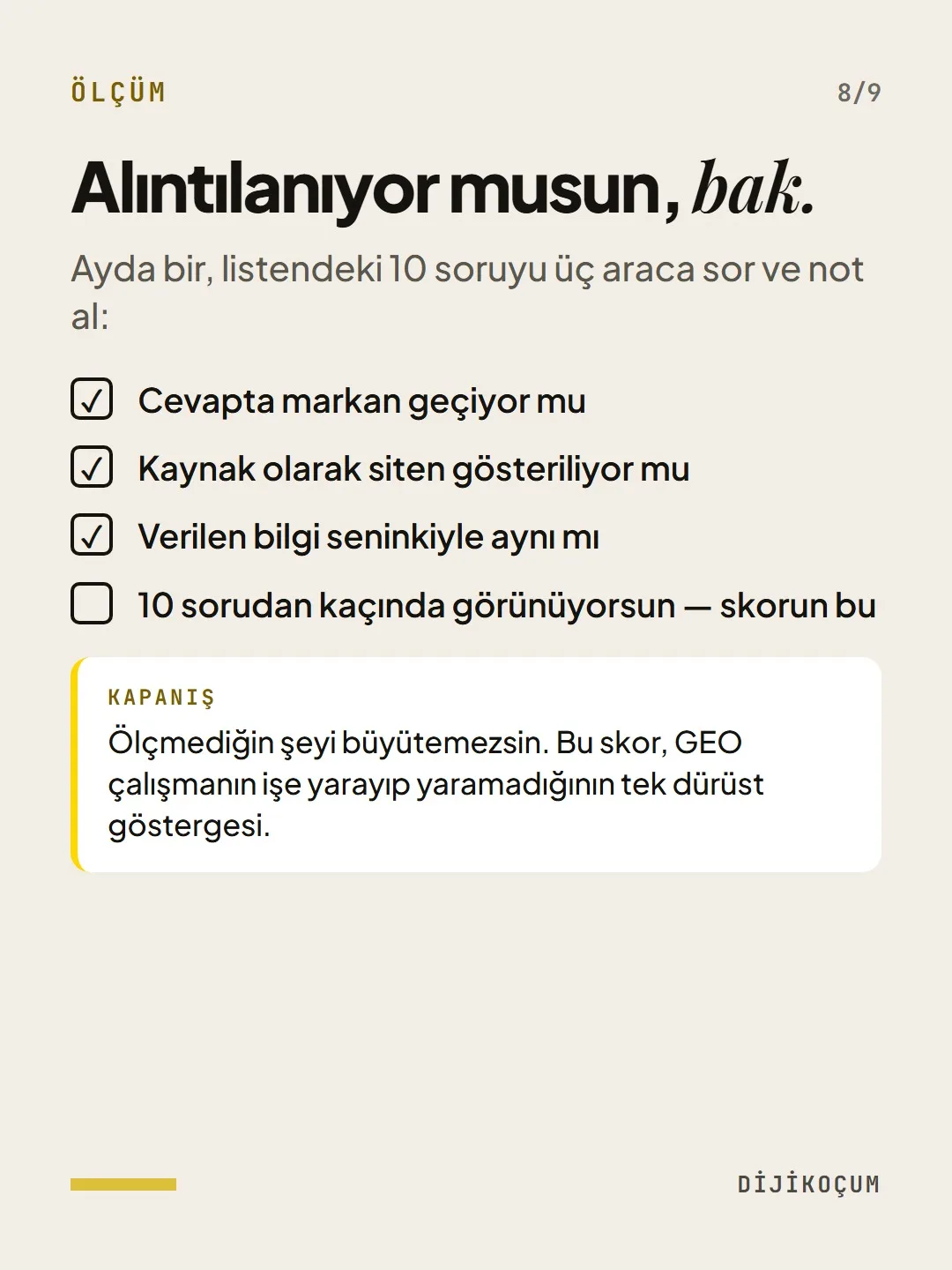
Once a month, ask three tools the 10 questions on your list and take notes:
- Is your brand mentioned in the answer
- Is your site shown as a source
- Does the information given match yours
- How many of the 10 questions you appear in — that's your score
Closing: You can't grow what you don't measure. This score is the only honest indicator of whether your GEO work is paying off.
Free · PDF
Download the ANSWER Checklist.
A printable checklist version of the steps on this page. The PDF is in Turkish; no sign-up needed.
Download the checklist (PDF in Turkish)Sources
- AGoogle Search Central: FAQ (FAQPage) structured dataPrimary source · checked: September 20, 2026
[A] primary source · [B] industry research · [C] practitioner · [D] our own data
This post is also on (in Turkish)
Frequently asked questions
How many words should an answer be for AI to cite it?
A direct 40–60 word answer right below the heading; the details come after. The answer should include at least one number, time frame or condition; saying “it depends” leaves the question to your competitor.
How many questions and answers should I add to a page?
At most six questions per page is enough; don't skip the price question. Questions aren't made up; they're collected from what keeps coming up in sales calls and from Search Console queries. The text in the FAQPage schema must match the page text exactly.
Next step
Let’s look at your site together.
Free Digital Checkup: a health score for your website, your ads and your visibility in AI search, plus what to fix first. 3 minutes.
More guides

How-To Guide
How to connect Instagram to Claude: two safe ways to set up comment-to-DM, a DM assistant and scheduled posting (step by step)
15 steps · 11 min
How-To Guide
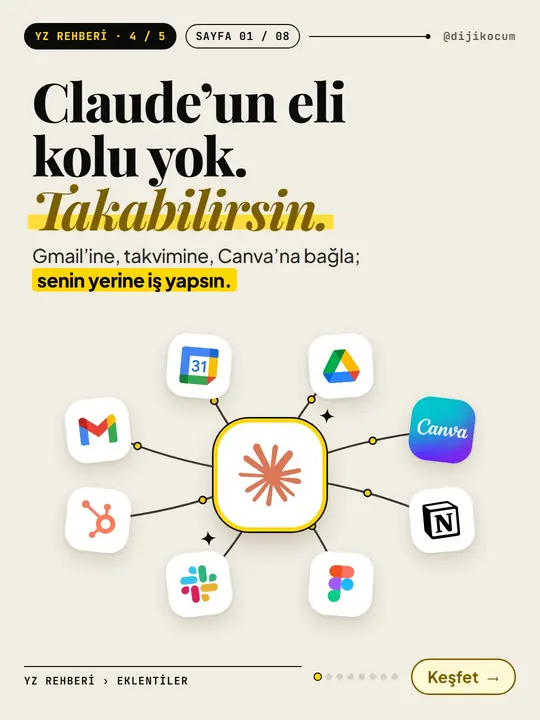
How to Connect Claude to Gmail, Google Calendar, Drive and Canva: Safe Connector Setup, Step by Step
12 steps · 7 min

How-To Guide
Make your restaurant's Instagram look like a menu: a 6-post feed template and shot list
9 steps · 6 min