
Visuals in Turkish · the full text is on this page
Tools · Social Media
Make videos with code using Claude: 8 GitHub repos with different styles, ready-made prompts and real examples (setup and usage)
Claude can now create animation, music and captions entirely by writing code. These 8 repos give you styles, prompts and ready-made code so your videos don't look like everyone else's.
Short answer
Claude Opus 5.5 doesn't produce a video file; it writes the code that draws each frame, the browser captures those frames one by one, and ffmpeg turns them into an MP4. If you don't steer it, most videos fall into the same mold. In this guide we walk you step by step through 8 GitHub repos that offer different styles, ready-made prompts and open-source examples: what each one is for, how to set it up and how to make your first attempt. Under each step is that repo's own video.
10 steps · 8 min read · · Turan Yasin Salcı
Step by step · 10 steps
0/10 checked · saved in this browser only
First, prepare your computer (done once).
All of these repos work the same way: Claude writes the code, Google Chrome captures the frames, and ffmpeg turns them into a video. So you'll need:
- Claude Code: the version of Claude that can write files and run commands on your computer. Setup: code.claude.com. Choose Opus as the model; for long, detailed jobs, set the thinking level (effort) to high.
- Node.js: download the LTS version from nodejs.org and install it like any other program.
- Google Chrome: if it's already installed, do nothing.
- ffmpeg: install it with
winget install ffmpegon Windows orbrew install ffmpegon Mac.
You don't need to know how to code; you can also have Claude Code run the commands by telling it "install this." To check whether the setup is correct, type the following into the terminal; both should print a version number.
node -v ffmpeg -versionAwesome Opus Videos: hundreds of viral videos and the prompts behind them.
What it's for: It collects hundreds of videos made with Opus 5.5 that spread on social media, each with the prompt that produced it (the README lists 703 prompts, 418 of them with live remakes). No setup; it's an archive.
How to use it:
1. Open github.com/yihui-dev/awesome-opus5-5-videos, or go to skillry.dev/ai-videos/opus-5-5 to see the videos side by side.
2. Click the Prompt link under the video you like and copy the prompt text.
3. Open Claude Code in an empty folder and paste the prompt. Change parts like the product name, colors and text to fit your business.
4. Ask Claude to build the result as a single HTML file and convert it to MP4.What to know: The same prompt doesn't give the same result; every run produces a different video. Some posts include only part of the prompt; the file itself notes this.
Lemo Opuscar: a skill installed in Claude Code, 66 film styles.
What it's for: 66 ready-made film styles (80s anime, toy bricks, ink painting, risograph, ukiyo-e…), each with a style prompt and a sample film. The videos are made entirely with code; no video model was used. You can also save your own style.
Setup (recommended): type the command below into the terminal. The command adds the skill to Claude Code.
How to use it:
1. Open Claude Code and type just/lemo-opuscar:lemo-opuscar.
2. It first asks for the language, then what you want to do: a film in a style from the library, adapting a style for yourself, or a film in a style you've saved.
3. If you want to see the styles first, you can watch a sample film of each at lemomo-ai.github.io/lemo-opuscar.If you'd rather not install the skill, you can also download the repo (
git clone https://github.com/lemomo-ai/lemo-opuscar.git) and work by typingclaudeinside the folder.claude plugin install lemo-opuscar@lemolabpdoom-video: the full source code of a word-by-word synced music video.
What it's for: A music video for the song "I'm Upping My P(doom)" with the lyrics landing on screen word by word. The idea, lyric timing, scenes and rendering were all made by talking to Claude Code. The code is open; it's the best example for having a lyric-synced video made for your own song.
How to explore / run it:
1. Download the repo from github.com/mexicat/pdoom-video.
2. What you need: bun (bun.sh), Google Chrome and ffmpeg.
3. Open the folder in Claude Code and say "start the preview according to the README"; it opens a live preview in the browser.
4.data/lyrics.jsonholds the lyric timings andapp/src/scenes/holds each scene. You can start by telling Claude "make a music video for my song with this structure."What to know: The song doesn't belong to the repo owner; use your own music in your own video.
PDoomVideo: someone else's take on the same song; compare it side by side with the 3rd repo.
What it's for: A hand-drawn-looking cartoon music video JohnHeibel made for the same song. Open it side by side with the repo in step 4 to see how a completely different video comes out of the same idea. Opus's scene plan (
STORYBOARD.md) and the style guide it wrote for its own subagents (ANIMATION_GUIDE.md) are also in the repo.How to run it: Node.js, Chrome and ffmpeg are enough. Download the repo and run the commands below in the folder: the first draws the frames, the second converts them to MP4.
git clone https://github.com/JohnHeibel/PDoomVideo.git cd PDoomVideo npm install node render.mjs --frames=0:156.6 --workers=4 node render.mjs --encode --out=out/pdoom.mp4MG Styles: 15 motion graphics styles, with film, prompt and code all open.
What it's for: 15 motion graphics styles such as frame-by-frame drawing, isometric, 3D, synthwave, pixel and cyberpunk HUD. Each is a 10-second film; the full prompt and source code are open.
How to use it:
1. Watch the films at vincentwei1021.github.io/mg-styles-15 and pick the one you like.
2. Open that style's file in the repo'sprompts/folder and copy the entire prompt block.
3. Paste it into Claude Code in an empty folder.
4. To adapt it to yourself, change only the story, brand name, text and colors in the Creative seed section; if you want a vertical video, set the Output section to 1080×1920. Don't touch the Signature features section; that's what makes the style recognizable.To save time, you can tell Claude to use the repo's
harness/render.mjs(rendering) andlib/audio(music) files. The 3D style also requires Blender.Claude Animation Base: a hand-painted cartoon character with 31 emotional expressions.
What it's for: A ready-made starter pack for Clawd, Claude's mascot: a hand-painted look with p5.js and p5.brush, 31 emotional expressions and an animation guide for the model to follow (
ANIMATION_GUIDE.md).How to use it:
1. Download the repo and open the folder in Claude Code (commands below).
2. Write to Claude what you want. Example: "Read ANIMATION_GUIDE.md, then make a 15-second video of Clawd trying to catch a butterfly."
3. The model first produces a scene plan, then builds it scene by scene and writes theout/video.mp4file.What to know: On computers without a graphics card, the watercolor fills render slowly; you can ask Claude to replace those fills with something lighter. You can also provide your own reference image to change the character or add new emotions or costumes.
git clone https://github.com/JohnHeibel/ClaudeAnimationBase.git cd ClaudeAnimationBase npm install node render.mjs --clip --out=out/video.mp4Awesome Claude Videos: an archive of hundreds of videos with their sources.
What it's for: It collects videos made with Claude 5.5, linked to their original posts (424 source posts; by model: Opus 301, Sonnet 54, Haiku 21, Fable 68). A good starting point to see which model and which production route were used for which job.
How to use it:
1. Open github.com/athemeroy/awesome-claude-5-5-videos.
2. Click a model in the Browse by model table and find a video in the list similar to what you want to make.
3. Check how it was made via the original link in each row; the Make your own section tells you which example to start from based on your job.No setup needed; it's an archive.
Opus Video Prompts: ready-made prompts you can copy and use directly.
What it's for: 54 sample videos made with code using Opus 5.5, and ready-made prompts you can copy and use directly. The repo is in Chinese; it reads easily with your browser's translation feature, and most of the prompts are already in English.
How to use it:
1. Open github.com/joeseesun/opus-video-prompts and scroll down to the "精选提示词" (featured prompts) section.
2. Copy a prompt. Even this one-sentence prompt produces a promo video: it's in the box below.
3. Paste it into Claude Code in an empty folder and replace the "for a modern startup" part with your own business.
4. Claude writes the code, renders the frames, checks its own work and gives you an MP4.The video below is an example made with this one-sentence prompt.
make a modern slick and punchy video for a modern startup that works on inferenceMake it look like your own video: don't copy the style as is.
If you copy the styles in these repos one-to-one, your video will still look like everyone else's. Tell Claude your own brand's colors, typeface, transition style and pacing. Example: "Use this style, but make the colors dark navy and yellow, the typeface Inter, the transitions hard cuts, the video vertical 1080×1920 and 20 seconds long."
Don't expect a perfect result on the first try: watch the video, describe what you don't like ("the second scene is too slow," "the text is small") and have it redone. Every run produces a different result; that's normal.
How to measure it
For a week, try a single 10–15 second video every day in a different style from these repos. Note which one suited your business and audience best and which one needed the fewest fixes. Then lock in the best two styles with your own colors and typeface and turn them into a series.
Sources
- Ayihui-dev/awesome-opus5-5-videos (GitHub)Primary source · checked: October 31, 2026
- Alemomo-ai/lemo-opuscar (GitHub)Primary source · checked: October 31, 2026
- Amexicat/pdoom-video (GitHub)Primary source · checked: October 31, 2026
- AJohnHeibel/PDoomVideo (GitHub)Primary source · checked: October 31, 2026
- AVincentwei1021/mg-styles-15 (GitHub)Primary source · checked: October 31, 2026
- AJohnHeibel/ClaudeAnimationBase (GitHub)Primary source · checked: October 31, 2026
- Aathemeroy/awesome-claude-5-5-videos (GitHub)Primary source · checked: October 31, 2026
- Ajoeseesun/opus-video-prompts (GitHub)Primary source · checked: October 31, 2026
- AClaude Code setup (Anthropic)Primary source · checked: October 31, 2026
[A] primary source · [B] industry research · [C] practitioner · [D] our own data
Frequently asked questions
Do I need to know how to code?
No. Claude Code writes and runs the code itself. Your job is to explain clearly what you want, watch the resulting video and ask for fixes. You can have Claude run the setup commands too.
Is it paid?
All the repos are open and free. Claude Code, however, runs on Claude's paid plans or on API usage; long, detailed videos use more.
Can I use the resulting video on Reels/TikTok?
You can use the video you produce yourself. The sample videos and songs in the repos belong to their owners; don't publish them as they are. The P(doom) song in particular doesn't belong to the repo owners either.
Why didn't the video come out the same for me?
Claude rewrites the code on every run; the same prompt gives a different but similar result. Once you get a result you like, save the code and the prompt and use them as the base for your next videos.
Can I have it make a vertical (9:16) video?
Yes. Just write "make the output 1080×1920 vertical" in the prompt; MG Styles prompts have a separate Output section for this.
Next step
Let’s look at your site together.
Free Digital Checkup: a health score for your website, your ads and your visibility in AI search, plus what to fix first. 3 minutes.
More guides

Tools
How to transform product photos with ChatGPT Images 2.5: 20 ready-made image prompts (step by step)
26 steps · 14 min
Tools
5 Free Animation Skills for Claude Code: How to Install Three.js, GSAP, design-dna, LottieFiles and Genjutsu (Step by Step)
16 steps · 9 min
Tools
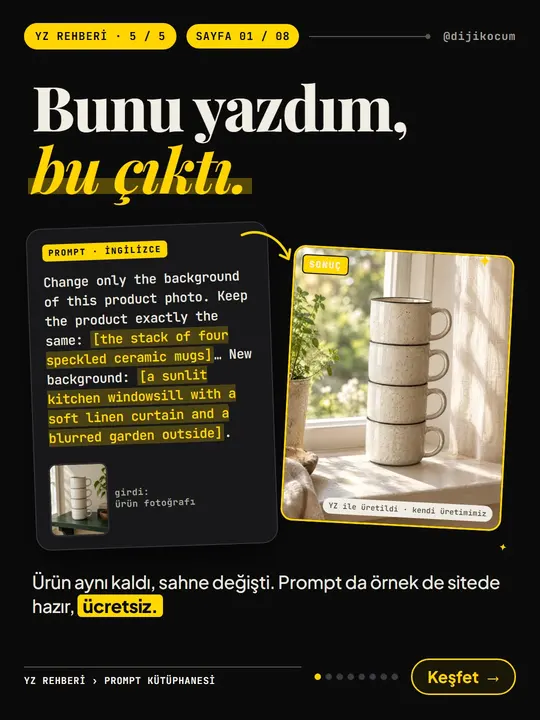
How to Use the Prompt Library and Prompt Builder: Copy a Ready-Made Prompt, Fill In the Blanks
9 steps · 7 min