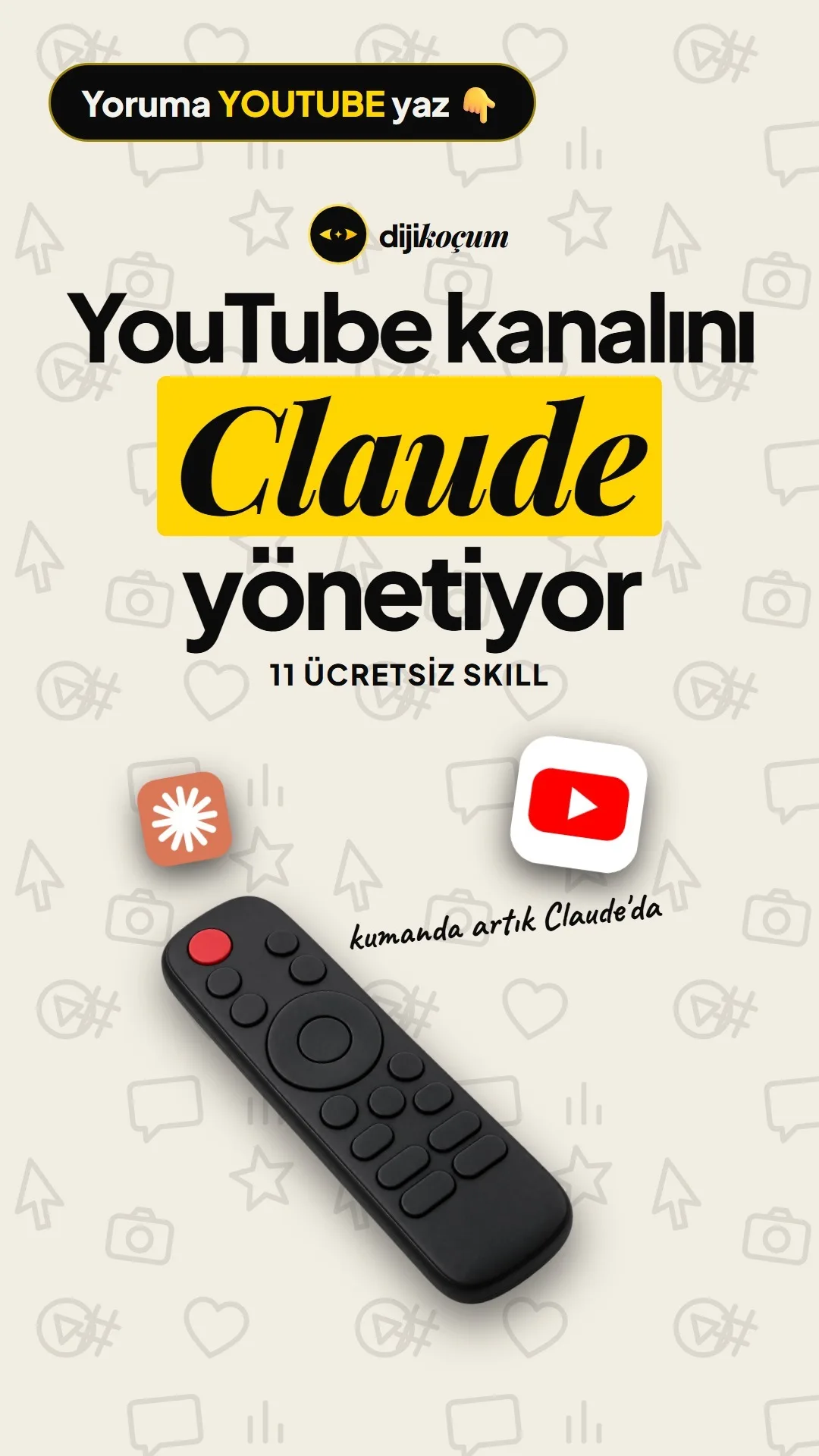
Visuals in Turkish · the full text is on this page
How-To Guide · Social Media
An 11-Person Team for Your YouTube Channel: Which Claude Skill Does Which Job, and How to Install It
Scriptwriter, thumbnail designer, editor, community manager, planner, trend analyst… In Claude, each one is a free skill. The decisions and the uploading are still yours.
Short answer
The work it takes to grow a YouTube channel adds up to a whole team: scripting, titles and thumbnails, editing, comment management, planning, trend tracking. The free, open-source YouTube Agent Skill package turns each of these jobs into a Claude skill; there are 11 commands in total. This guide looks at the package as a "team": which role maps to which command, what you give each one and what you get back, and where it fits in a weekly workflow. The installation steps are here too; the tool doesn't post anything on its own and doesn't connect to your channel. The outputs are a little different every time, and the final read is yours.
14 steps · 5 min read · · Turan Yasin Salcı
Step by step · 14 steps
0/14 checked · saved in this browser only
Know what you're installing.
YouTube Agent Skill is a free, open-source (MIT license) package of 11 Claude skills written for a YouTube channel. A skill is a ready-made instruction package that has Claude do a specific job in a specific way; it's called with a command like
/yt-script. It doesn't ask for sign-up, an API key or a channel connection. It doesn't publish anything for you: it writes and checks; you do the uploading.Choose which Claude to use.
The smoothest path is Claude Code (Claude running on your computer; it requires a paid Claude subscription or a Console account). If it's not installed, paste
irm https://claude.ai/install.ps1 | iexinto PowerShell on Windows orcurl -fsSL https://claude.ai/install.sh | bashinto Terminal on Mac, then typeclaudein the terminal and sign in with your Claude account. Details are on the official installation page. The six Python tools in the package (hook score, title check, cut list, etc.) only work fully in an environment that can run files, like Claude Code.Install the package: the easiest way.
Open Claude Code; you'll see an empty chat. Copy the two lines below exactly as they are, paste them and send. Claude downloads the repository and installs the skills; if it asks for permission, read and approve. Replies come in the language you ask in, so you can ask in English (or Turkish, for example).
https://github.com/Jakeschincariol/youtube-agent-skill Install this skill, then confirm /yt-script works.Or install it manually.
If you want to install it yourself, run these two commands in the terminal (Git must be installed). The skills are copied into the
~/.claude/skills/folder and show up in all your projects. If you only want to use them in one project, copy the same folders into that project's.claude/skills/folder. If you want to install it as a plugin, type/plugin marketplace add Jakeschincariol/youtube-agent-skillinside Claude Code, followed by/plugin install youtube-agent.git clone https://github.com/Jakeschincariol/youtube-agent-skill.git cp -r youtube-agent-skill/skills/yt-* ~/.claude/skills/Check that it works.
Close and reopen Claude Code and type
/: if commands like/yt-scriptand/yt-packageappear in the list, the install is complete. To try it, type/yt-scriptand describe a video idea in one sentence (e.g., "A video showing cafe owners how to shoot menu photos in 3 minutes"). You can also send the command empty; Claude will ask you for the missing information.Set aside 10 minutes for voice.md.
Every skill in the package reads the
voice.mdfile, which describes the way you talk; this file shapes the result more than anything else. The file lives at~/.claude/youtube/voice.md. The easiest way: send Claude the scripts of your own 3 best videos (the captions/transcript in YouTube Studio) and say "write my voice.md from these." The template has these headings: who you're talking to, how you talk, words you never use, phrases you use often, things you won't claim, and your video format.Scriptwriter: /yt-script.
Give it a one-sentence video idea. It first suggests 5 opening lines from 21 hook formulas and scores them; once you pick one, it writes a marked-up voiceover script. Read the hook out loud; the score is an estimate, and the final call is yours.
Title and thumbnail designer: /yt-package.
Give it the title and the text that will go on the thumbnail together. It checks the two as a single package: does the title get cut off, does the thumbnail text repeat the title, is it vague. It doesn't draw the thumbnail image; it fixes the text and how the two match.
Editor: /yt-edit (+ /yt-shorts, /yt-chapters).
Give it the caption file (.srt) of your footage. It lists dead air, filler words and retakes down to the second; you make the cuts in your own editing program by following the list. With the same transcript,
/yt-shortspulls Shorts candidates out of the long video, and/yt-chaptersproduces chapter titles that follow YouTube's rules.Community manager: /yt-comment.
Copy and paste the comments into it. It sorts the comments into four piles, writes reply drafts in your tone and tells you which one you should pin. You read the replies and send them yourself.
Planner: /yt-plan.
Tell it how many hours a week you can spare. It lays out a realistic week: 1 main video, 1 light video and 3 Shorts.
Trend analyst: /yt-viral.
Tell it a few channels in your niche. It ranks videos not by raw views but by how many times they beat each channel's own average, and names the pattern in the title. It only reads public lists and doesn't log into your account; it needs at least 4 videos per channel.
Analyst and auditor: /yt-retention, /yt-seo, /yt-audit.
Give
/yt-retentionthe audience retention data you downloaded from YouTube Studio; it shows at which second, and while you were saying what, viewers left./yt-seowrites the description, the tags that actually help, and the 3 searches the video should win./yt-auditreviews the whole channel and ends with a single fix.Fit the team into your week.
- Start of the week: /yt-plan → pick an idea from /yt-viral.
- Prep: /yt-script → /yt-package.
- After filming: /yt-edit → /yt-shorts → /yt-chapters → /yt-seo.
- After publishing: /yt-comment; a few days later, /yt-retention.
- Once a month: /yt-audit.
No step publishes for you; each one ends with text for you to copy.
How to measure it
Use the team in this order for a month and note two numbers for every video: the time you spent on prep, and the first-30-second audience retention rate in YouTube Studio. If prep time is getting shorter but retention is dropping, have the script written closer to your voice.md.
Sources
- AYouTube Agent Skill (GitHub, MIT license, README)Primary source · checked: October 31, 2026
- Avoice.md template (GitHub)Primary source · checked: October 31, 2026
- AClaude Code quickstart (official documentation)Primary source · checked: October 31, 2026
[A] primary source · [B] industry research · [C] practitioner · [D] our own data
This post is also on (in Turkish)
Frequently asked questions
Does it really do the work of 11 people?
No, it doesn't replace people; it prepares the first draft and checklist for each role. Filming, editing, the thumbnail image and uploading stay with you.
Does it ask for access to my channel?
No. There's no login, API key or channel connection. You provide the data (idea, transcript, comments, retention file).
Is there a fee?
The package is free and open source (MIT). Claude Code requires a paid Claude subscription or a Console account.
Is this page the same as the "YouTube Agent Skill installation" page?
Same package. The installation steps are shared; this page explains the package role by role, as a workflow, while the other one summarizes the commands and their limits.
Next step
Let’s look at your site together.
Free Digital Checkup: a health score for your website, your ads and your visibility in AI search, plus what to fix first. 3 minutes.
More guides

How-To Guide
How to connect Instagram to Claude: two safe ways to set up comment-to-DM, a DM assistant and scheduled posting (step by step)
15 steps · 11 min
How-To Guide
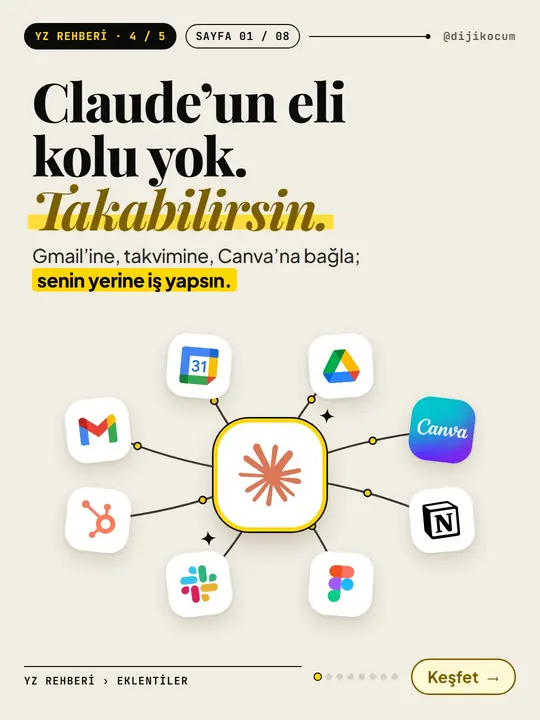
How to Connect Claude to Gmail, Google Calendar, Drive and Canva: Safe Connector Setup, Step by Step
12 steps · 7 min

How-To Guide
Make your restaurant's Instagram look like a menu: a 6-post feed template and shot list
9 steps · 6 min