"A cheap model? It'll give a customer some nonsense answer, and then I'm the one writing the apology." That's the objection I hear most often when small models come up. And it's not unfair: a year ago, most small models went off the rails now and then even on a narrow task like classification.
Anthropic released Claude Haiku 5.5 on October 7, and it's trying to answer that objection not with price but with a setting. For the first time, Haiku gets an "effort" setting; the same model can think less and answer fast, or think more and work more carefully at a higher cost. Its price, meanwhile, is a tenth of the previous Haiku's. The real question is: which jobs is that enough for?
What changed?
There are four changes: two stand out, and one barely gets talked about.
Price. On Haiku 4.5, a million input tokens cost $1 and output cost $5. On Haiku 5.5 that's $0.10 and $0.50 [A]. With one condition: if the input part of a request exceeds 100,000 tokens, the whole request is billed at the higher rate, $0.50 and $2.50 [A]. If you're going to have it read a long contract or a hundred-page PDF in one go, do your math with that second line. Anthropic says it's about 75% cheaper than Haiku 4.5 on average; on short requests the difference is 90% [A].
Effort setting. A first for the Haiku class: low, medium, high, xhigh, max [A]. In the API the default is medium [A]. There's a detail that didn't get much attention in the announcement: the part where the model thinks is also billed as output tokens. According to Artificial Analysis, which runs independent measurements, Haiku 5.5 at its highest setting spends around 162,000 output tokens per task on average; that's roughly three times GPT-6 Luna, the model they compared it with [C]. So the "cheapest Claude" label doesn't stay all that cheap once you turn the setting all the way up.
Then there's the meter. Haiku 5.5 uses the new tokenizer, and according to Anthropic's pricing page this tokenizer produces about 30% more tokens from the same text [A]. The price dropped to a tenth, and the meter runs a bit faster. Still, the difference is big.
Sonnet 5.5 caching. The same day, Sonnet 5.5's cache read price dropped from $0.20 to $0.10 per million tokens [A]. Anthropic says this cuts Sonnet costs by about 20% for most agent workloads [A]. I think this is the overlooked news of the week. Plenty of people are talking about Haiku, but a bot that already runs on Sonnet gets a smaller bill from this discount without switching models.
Where the model is available: the Claude Platform API, Amazon Web Services, Google Cloud and Microsoft Foundry [A]. The context window is 1 million tokens, with up to 128,000 output tokens in a single response [A].
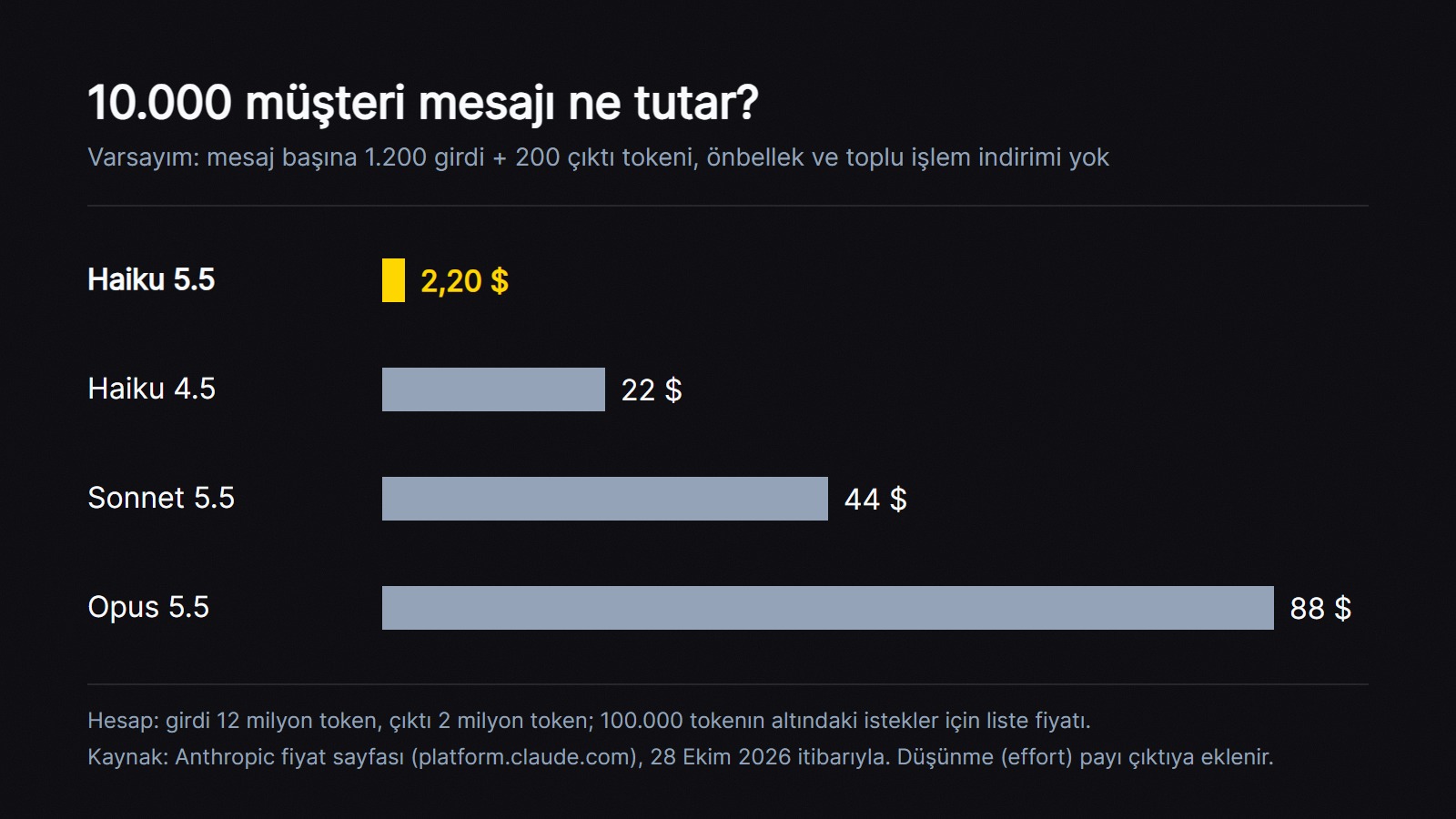
Source: Anthropic pricing page, as of October 28, 2026. The calculation is DijiKoçum's assumption, not a measurement.
What do 10,000 customer messages cost?
I'm writing the math out so you can swap in your own numbers. Assumption: in each message, the bot's instructions and product information are 1,000 tokens, the customer's message is 200 tokens, and the bot's reply is 200 tokens. Thinking overhead is ignored (a scenario close to the low setting).
Over 10,000 messages, that comes to 12 million input tokens and 2 million output tokens. On Haiku 5.5: 12 × 0.10 + 2 × 0.50 = $2.20. The same calculation is $44 on Sonnet 5.5 and $88 on Opus 5.5 [A].
Since the instruction part is identical in every message, caching it makes things even cheaper: 10 million tokens are read from cache at $0.01, and the remaining 2 million at the normal price. That's about $1.30 in total, plus a few cents of cache write fees. Batch processing (the Batch API) halves the price [A], but it's asynchronous; it's not for a WhatsApp customer waiting for an instant reply, it's for an email classification job that runs overnight.
One more thing: the number of tokens Turkish text takes differs from English, and the official source gives no ratio for Turkish. WhatsApp's own message fees are also outside this calculation. Don't write a budget until you've had the console count a few hundred of your own real messages. By the way, how many messages land in your inbox each month? Answer from last month's records, not from a guess.
Which jobs is Haiku good enough for?
Haiku 5.5 is enough
Tagging incoming emails by topic (returns, invoices, complaints)
Boiling a long email thread down to three lines
The first draft of a product description
Greeting and routing in a WhatsApp bot
Single-step questions like price, stock and shipping
Leave it to Sonnet or Opus
Agents that work step by step across several systems
Complex code and software work
Legal, financial or health-related answers
Final copy that has to carry the brand's voice
Long conversations with an angry customer
Compiled from Anthropic's recommended use cases and independent measurements
The first two items in the right column aren't my guess. In the announcement, Anthropic itself writes that Sonnet 5.5 and Opus 5.5 are still better at complex agentic coding; on Terminal-Bench 4.0, Haiku 5.5 scores 39.2% and Sonnet 5.5 scores 70.6% [A]. In Artificial Analysis's automation test, Haiku 5.5 also stopped at 35%, while rival small models sit in the 53-60% band [C]. Artificial Analysis attributes part of this to the model refusing unnecessarily, and says it will rerun the test after a fix [C]. That result may change, but for today, handing automation to Haiku on its own looks premature to me.
There's data pointing the other way too: in the same measurement, Haiku 5.5's hallucination rate is 40%, versus 77% for GPT-6 Luna [C]. It's more inclined to say "I don't know" when it doesn't know. For a customer bot, that's good news.
I have a contrarian take. Instead of having Haiku run your whole WhatsApp bot, put Haiku at the door. Let it read the incoming message, answer the simple questions itself, and hand off anything that smells like a return or a complaint to Sonnet or to a person. With a workflow tool like n8n or Make, you can set up that split with a few nodes. The cheap model carries most of the bill, and the expensive model handles the risky part.
Who is it useful for?
E-commerce: Product description drafts and "where's my package?" questions. Have a person read them before they go live.
Service businesses (clinics, agencies, education): Sorting incoming forms and emails into categories.
Teams with software: As a helper agent running subtasks alongside a larger model. Anthropic specifically mentions this use in the announcement [A].
A small business that gets a few dozen messages a month: You can skip it. At that volume, the difference between Sonnet and Haiku is coffee money; go for quality.
Is it available for free on claude.ai? How does it handle Turkish?
It is. According to Anthropic's Haiku page, Free, Pro, Max, Team and Enterprise users can select Haiku 5.5 on claude.ai, on the web, iOS and Android [A]. It says "can select"; it doesn't say it's the default model on the free plan. You may need to pick it yourself from the model menu. Turkey is on Anthropic's list of supported countries [A]. Free chat access doesn't mean an API key; to connect your own bot, you need an API account and credits.
On the Turkish side, let me be straight: Turkish isn't in Anthropic's multilingual performance table, and the table stops at Haiku 4.5 [A]. Haiku 5.5's Turkish quality isn't clear from the official source. The documentation only says it works well beyond the languages in the table too and that you should test it in your own language; it recommends stating the response language explicitly in the system prompt [A].
This week I'm testing Haiku 5.5 on my own work
0/6
As you check items off, it becomes clear which jobs you can give to Haiku.
Mask emails containing personal data before you test them; removing names and phone numbers is enough.
On claude.ai, you can select it for chat on the free plan too [A]. The API is pay-as-you-go: for requests under 100,000 tokens, $0.10 per million input tokens and $0.50 per million output tokens (as of October 28, 2026). The monthly API credits given to Max and Team subscribers also count toward this usage [A].
Should I switch from Haiku 4.5?
On price, yes, but don't just swap it in. The new tokenizer counts more tokens for the same text, and the effort setting can lengthen the output. First run the two models side by side on a few hundred real requests, and compare the bill and the errors together.
If I build my customer bot on Haiku 5.5, will its Turkish be solid?
The official source has no Turkish measurement for Haiku 5.5, so I can't guarantee it. What to do is clear: write "always reply in Turkish" in the system prompt, test with your real customer messages, and count the suffix and proper-name errors. Hand off the type that produces errors to a larger model.
If you want to build the bot and split messages properly between the cheap and the expensive model, take a look at the AI chatbot page. For automating email and form workflows, the AI automations page is a better fit. If you don't know where to start: START YOUR FREE ANALYSIS .
Beyond GPT-6, ChatGPT got five new features in October 2026. Audio uploads are on paid plans, Slides on Pro and business plans, locked chats for everyone; Finances is US-only.
OpenAI released GPT-6.1 Terra on October 26, 2026: on the API, one million input tokens cost $1 and output tokens $5, half the price of its predecessor. It's available in ChatGPT Work and Codex on Plus and higher plans.
Google has deprecated Gemini 2.5 Pro and Flash; starting December 1, Gemini API requests are quietly redirected to 3.8 Flash and 3.5 Flash-Lite. What happens to price and quality, and which automations are affected?
+2
We use cookies to improve the site and measure advertising performance. Analytics and advertising cookies run only if you accept them. Details are in our Privacy Policy and Data Protection Notice.






 +2