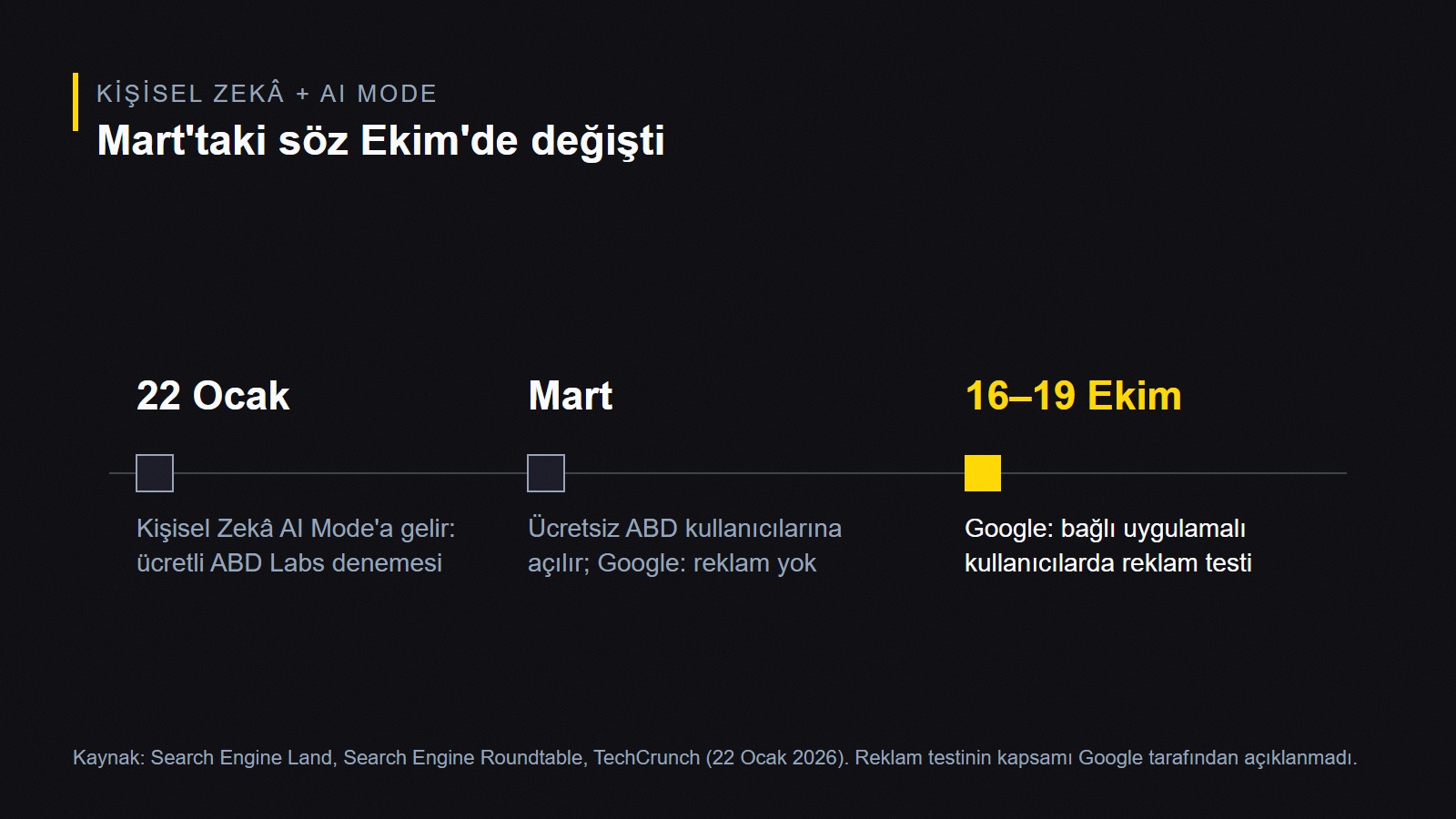
Back in March, Google was asked: will users who connect Gmail and Photos to AI Mode be shown ads? The answer was "no," and Google even said "That isn't changing right now." Seven months have passed since then. On October 16, Google confirmed to Search Engine Land that it has started testing ads for these users; on October 19, Search Engine Roundtable carried the same story.
The crux of the story isn't the ad itself; it's the second half of the sentence. According to Google's help page, ads won't be based "directly" on your Gmail inbox or Photos library, but summaries, excerpts and inferences drawn from connected apps can also be used to show ads. The distance between "not directly" and "not at all" is unclear for now, and I don't think that distance is going to shrink on its own.
Quick answer: Google has started testing ads for users who connect apps like Gmail/Photos to AI Mode through Personal Intelligence; the scope, advertiser controls and expansion timeline have not been announced. This matters to people who manage Google Ads and to brands chasing visibility in AI search. For now, the move isn't to shift budget, but to put the ad surface in AI Mode on your watch list.
What happened?
Personal Intelligence came to AI Mode on January 22, 2026, as a paid Labs experiment for AI Pro and Ultra subscribers in the US [C]. In March, it opened up to free US users with personal Google accounts. At the time, Google told Search Engine Land there were no ads for users with connected apps, and that ads were expected to work similarly in the future [C].
On October 16 that changed: Google confirmed to Search Engine Land that it has started testing ads in AI Mode for users who connect their apps through Personal Intelligence [C]. The updated help document says three things:
Ads are not directly based on your Gmail inbox or Photos library.
Summaries, excerpts and inferences from connected apps can be used in Search, and the same information can also be used to show ads.
There's no personalized advertising in sensitive categories like race, religion, sexual orientation and health.
Advertisers have no access to Gmail or Photos [C]. Connected apps are available to users aged 18 and over in 188 countries and territories; the Calendar connection, however, is only available in the US and in English [C].
So when will this show up in Turkey? The sources give no date or country list. I'm not going to guess.
Why does it matter?
Because the ad-free side of AI Mode was a trust argument. Users had been told, in effect, "connect your inbox, I'll give you personalized answers, and I won't put ads on top." Now the same user may see ads next to the answer, without being able to see which inference the ad was chosen by.
Three things are unclear, and all three matter to advertisers:
Will advertisers get targeting or reporting controls? Not announced [C].
Will connected-app signals be used only in AI Mode, or on other search surfaces like Discover, Maps and Shopping too? Google's help page covers all "Search services," but doesn't draw a distinction [C].
Some connected data can be used to train Google's generative AI models, and a subset processed in AI Mode and Ask Maps is seen by human reviewers. Google recommends not connecting apps that hold confidential information [C].
In my view, the third item is where the real damage to user trust could happen, even if the test looks small on paper. Users connect their inbox and then learn from a help page that ad inferences can also be fed from that inbox. So the problem isn't the ads; it's the surprise.
What was said in March
What was confirmed October 16-19
Ads for users with connected apps
None, "isn't changing right now"
Test started
Gmail/Photos content in ads
Not discussed
Not used "directly"; summaries and inferences can be
Advertiser controls
Not discussed
Not announced
Scope / countries
Not discussed
Not disclosed
What changes for your brand?
A small business running Google Ads: Nothing changes today. The test is small, the scope is unclear, and there's no new setting or report on the advertiser side. There's no point in shifting budget in a panic.
If you're after organic visibility (GEO): In AI Mode, the answer and the ad space compete on the same screen. Getting cited as a source in the answer and showing up through an ad are two separate jobs; keep an eye on both.
A local business: The same day, Google appeared to be moving the Google Posts section higher up in the local panel (see the radar below). Publishing fresh posts is a cheap move this week.
If you're watching ChatGPT ads: The same week, OpenAI also added new visual formats and measurement partners to ChatGPT Ads. Ads in AI chats are no longer a single company's experiment.
The one thing to do today
In your Google Ads account, check whether you can see impressions and conversions from AI answer surfaces separately for your AI Max, Performance Max or Search campaigns. You don't need to buy anything. If you can't see them, you already know you won't be able to measure this test's impact on you.
Today's Radar
Story
Why people are talking about it
Who it affects
ChatGPT Ads: new visual formats, a revamped conversions page, a weekly performance email; Northbeam, DV Rockerbox, INCRMNTAL and Kochava, Tenjin, Airbridge added as measurement partners (OpenAI, evening of October 16)
No action needed on existing campaigns, the formats are being tested; which markets are covered was not specified
Is Google going to read my emails and show me ads?
According to Google's help page, ads are not directly based on your Gmail inbox or Photos library. But summaries and inferences from connected apps can be used in Search and in ads. Connecting is optional, and you can disconnect at any time.
Is this test running in Turkey too?
The sources contain no information about Turkey. Which countries the ad test is running in has not been disclosed. Connected apps are available in 188 countries, but the Calendar connection is only available in the US and in English.
As an advertiser, can I control ads in AI Mode?
There's no clear control for now: Google hasn't announced targeting options, reporting or an expansion timeline.
Our services and the next step
Inside AI answers, ads and visibility compete separately. If you want to measure both, take a look at our GEO service and our ChatGPT ads service; on the paid side, there's our Google Ads page. To see how ready your account is for AI surfaces:
OpenAI, October 5, 2026: an image ad test on ChatGPT's image generation screen (US) and independent measurement partners like AppsFlyer, Adjust and LiveRamp. What changes for advertisers, including in Turkey?
I explain where ChatGPT ads appear and who sees them, where account availability stands for businesses in Turkey today, and how to set up your first campaign step by step. I checked every point against OpenAI's own help pages.
ChatGPT ads opened in 52 countries on September 2, and Turkey isn't on the list. But shopping results are now open only to brands with a connected product feed, and that's where the real action is for businesses in Turkey.
Advertising6 min
We use cookies to improve the site and measure advertising performance. Analytics and advertising cookies run only if you accept them. Details are in our Privacy Policy and Data Protection Notice.