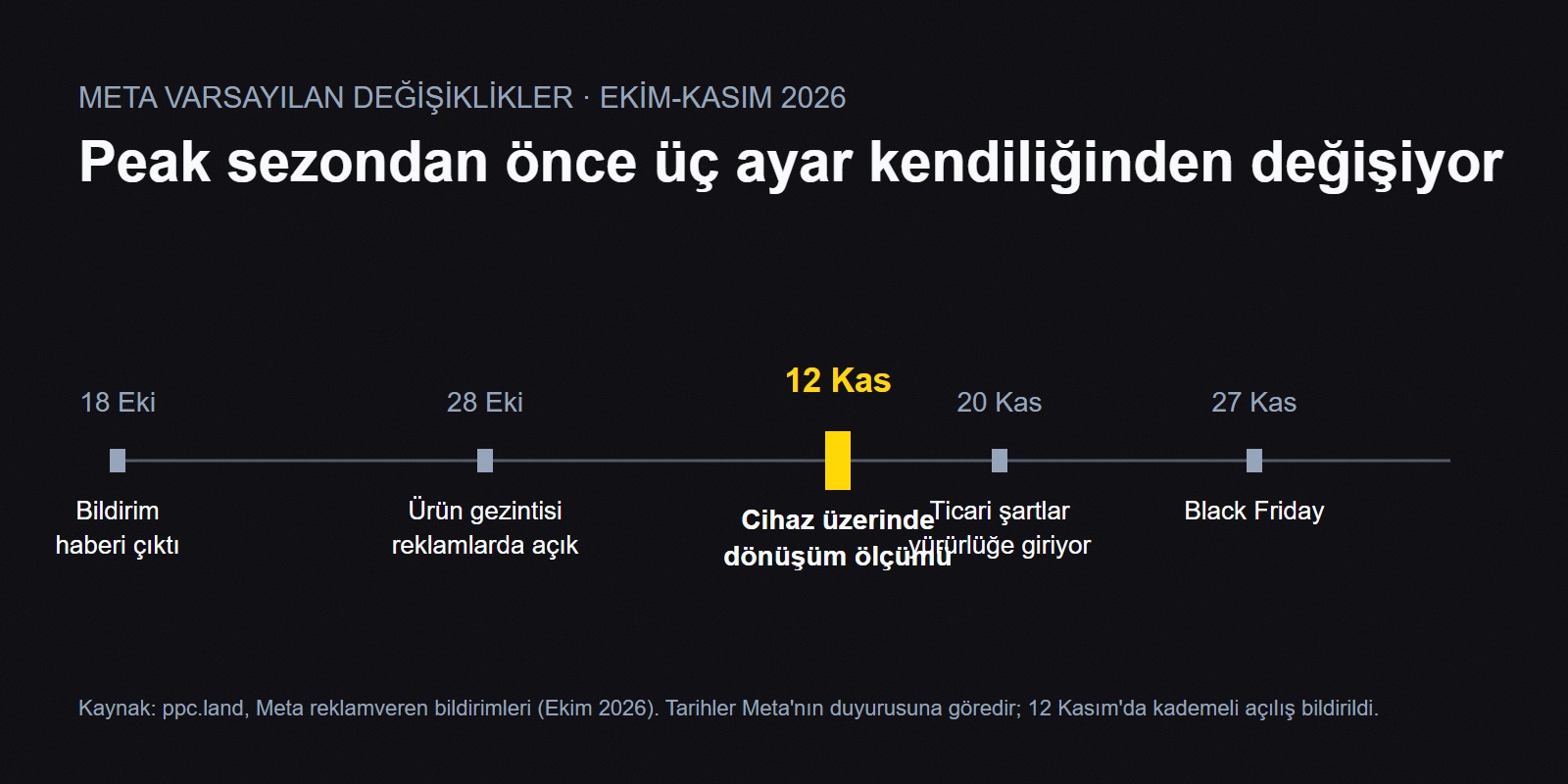
If the number of sales in your ad report went up on its own one morning, would you celebrate? I'd ask why first. Starting November 12, exactly that could happen in Meta Pixel: a setting called "Measure conversions on customer devices" will be on for advertisers who do nothing. The number of sales won't change, but the number of sales Meta reports might.
The news itself isn't new. Meta sent the notice to advertisers in mid-October, and the first reports came out on October 18. But the topic came back on October 26: Yiqi Wu, CEO of Aimerce, which sells Pixel tracking tools to Shopify merchants, wrote on X that the setting comes at "the worst possible time," and the debate started up again. The measurement logic is changing two weeks before Black Friday (November 27). In my view, that timing is the real issue.
Quick answer: Starting November 12, 2026, Meta is turning on the "Measure conversions on customer devices" setting by default for datasets connected to Pixel and the Conversions API; the goal is to match purchases that never reach Meta on the device and add them to reports. This affects everyone running e-commerce ads with Meta. The move isn't to switch the setting off blindly: before November 12, build a baseline comparing the sales Meta reports with your actual orders, then decide.
What happened?
The setting sits in Events Manager, inside the Pixel settings, right below the older AI toggle for automatically adding page and product information. According to the panel text, measurement starts on November 12, 2026, applies to datasets that already send events via Pixel or the Conversions API, and requires no code changes. There's no step to turn it on; if you want it off, you turn it off yourself. [A: Meta's advertiser notice, as reported by ppc.land and Wortfilter/ASTIG]
Here's the logic Meta describes: some purchases never make it into the campaign report because no information reaches the server. The new method does the matching on the customer's device; it uses information the business already has (an email address, for example) and temporary, non-identifying device data. All Meta learns is that a purchase happened and which campaign should get credit for it. The panel says measurement will happen on the device and not "only" on servers; so it reads as adding a path alongside the existing one, not replacing it.
Information on where it won't work isn't in Meta's panel; it's in the conditions MetricMaven cites from the Meta Business Help Center: it's not active in the EU and the UK, the Pixel must be installed directly on the page (not in an iframe or as an image-only pixel), and the site needs an email or phone login. [C: a single third-party report, not in the panel text] If the login requirement is accurate, most stores that allow guest checkout fall outside the scope. Exactly which condition covers which case isn't clear from the available sources.
Why does it matter?
Because a "recovered conversion" doesn't mean the ad brought in that sale. It means Meta attributed a purchase to the ad. The difference looks small, but not when it comes to budget decisions.
There's also the threshold issue. On October 21, Meta said an ad set needs roughly 50 conversions a week to exit the learning phase. [A] If the conversions added to reports are counted, some ad sets could cross that line without a single extra sale. Meta hasn't said whether this affects bidding or delivery; ppc.land listed it as an open question too. I'm not going to speculate.
The legal and privacy side isn't quiet either. Captain Compliance writes that the notice doesn't explain how Meta handles visitors who haven't given consent or who send an opt-out signal, and recommends treating the setting as off until Meta provides documentation. [C] In Turkey, the same question applies under KVKK (Turkey's Personal Data Protection Law); there's no answer yet.
None of this is happening in isolation. Meta turning on in-app product browsing for existing ads on October 28 (advertisers can opt out in advance or switch it off per ad) and the commercial terms being pushed back to November 20 fall in the same window. Three default changes, 30 days before peak season.
What changes for your brand?
If your store runs on a platform like Shopify or WooCommerce and customer accounts are required: Your reported sales count may shift upward. Before you celebrate a better-looking ROAS, look at your orders.
If most of your customers check out as guests: You most likely won't be affected. But don't count on that until you confirm the scope conditions in Meta's own documentation.
If you work with a small budget and fewer than 50 conversions a week: Learning phase behavior may change. Comparing the status of the same ad set a week before and a week after is enough.
If you work with an agency: Ask for an explanation of any spike that shows up in the report after November 12. "It's the result of optimization" isn't a good enough answer.
If the setting is left on
If the setting is turned off
Reported conversions
May increase
Stay at today's level
Actual order count
Doesn't change
Doesn't change
Comparison
Can't be compared one-to-one with before November 12
Continuity is preserved
Risk
Increasing budget based on inflated ROAS
Continuing to miss sales Meta can't see
Privacy uncertainty
Open until consent handling is documented
None
In my view, both "turn it off now" and "don't touch it" are hasty answers. Aimerce's CEO says he himself won't turn it off by default, but that company sells Pixel tracking; it has a stake. It's not a neutral source. Still, the method he suggests makes sense, because it doesn't sell anyone anything: measure first.
The one thing to do today: In Events Manager, pull the daily number Meta has called "purchases" over the last 30 days, put your store's actual order count for the same day next to it, and write the ratio into a table. If that ratio drifts after November 12, you'll make the call on turning the setting off with real data in hand. You don't need to buy anything.
What is the "Measure conversions on customer devices" setting in Meta Pixel?
It's the setting that lets Meta match purchases that never reach its servers on the customer's device and add them to the campaign report. It starts on November 12, 2026, and is on by default.
How do I turn the setting off?
In Events Manager, go to Data sources, select the relevant Pixel, then Settings. The setting is separate for each Pixel, so businesses with more than one site need to check all of them. Turning it off doesn't require any code changes.
If I leave the setting on, will my sales go up?
No. What may go up is the number of conversions Meta reports, not actual sales. That's why you need to build a baseline first.
If you want to check whether the numbers reported in your Meta ads match your actual orders, take a look at our Meta Ads service, and to see your overall picture, START YOUR FREE ANALYSIS .
I explain digital marketing not as a list of channels but as the path a customer walks from an ad to a sale: which channel to start with, what performance marketing means and where the money leaks, plus a checklist you can fill in for your own business.
Out of thirty-plus announcements in August 2026, five real developments remain: the forced AI Max migration timeline, the spam update, generative UI in AI Mode, Reddit vanishing from ChatGPT, and shrinking Meta reporting.
October 2026 roundup for businesses in Turkey: the under-15 social media ban, on-device Meta Pixel measurement, Google Ads defaults, ChatGPT's UTM and ad changes, and PHP2Shell. Plus what was overhyped.
Marketing strategy12 min
We use cookies to improve the site and measure advertising performance. Analytics and advertising cookies run only if you accept them. Details are in our Privacy Policy and Data Protection Notice.