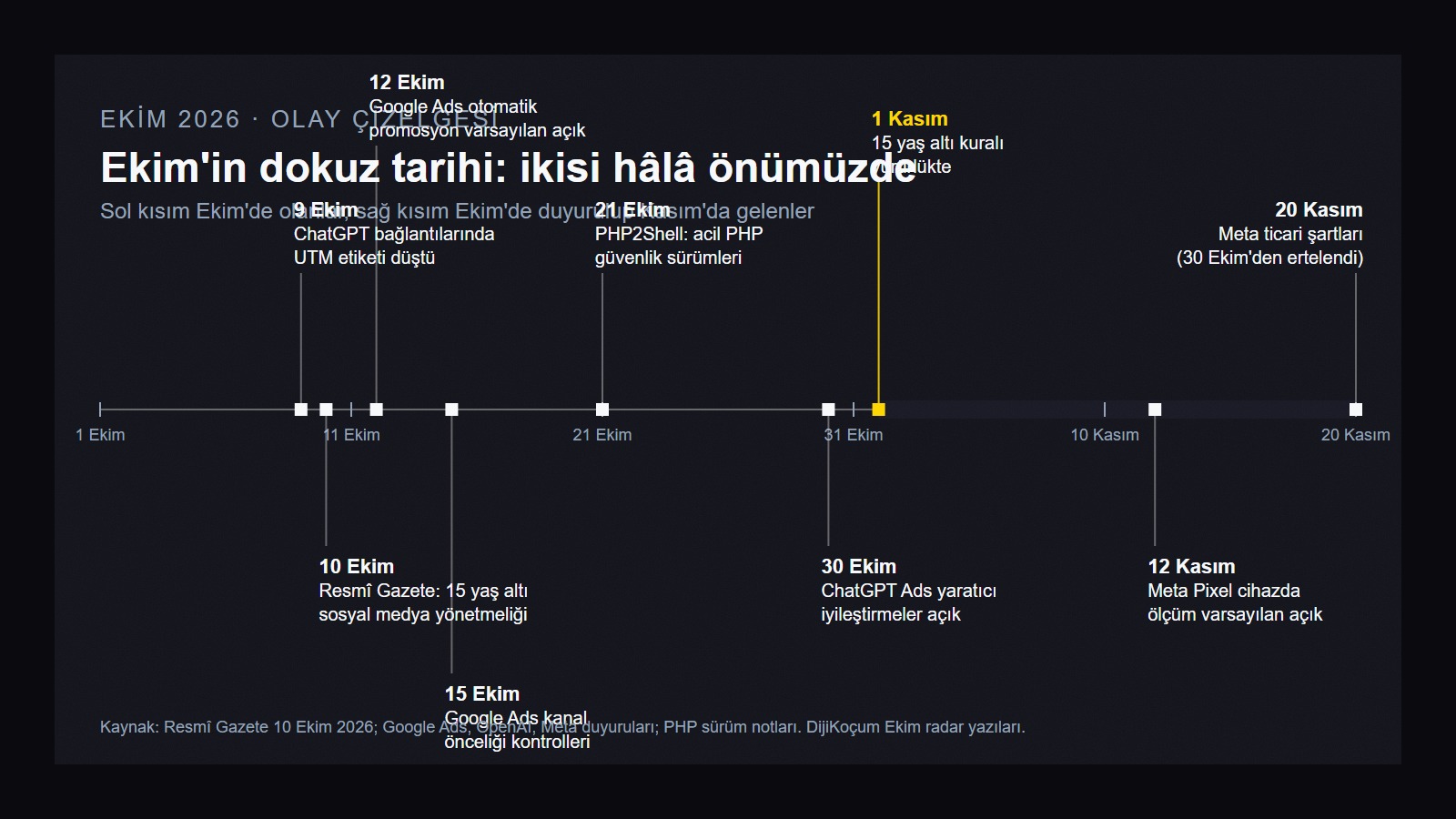
In October, this blog published 21 Daily Radar posts. Each one also ended with a four-to-six-line "Today's Radar" table, and announcements I never covered in the daily posts stayed there. At the end of the month I put them all side by side. I had dozens of headlines. I asked the same question I ask every month: after reading this news, does a business operating in Turkey have to change a setting, a budget or a routine?
I was left with five. The rest, no matter how interesting, goes into the "What was overhyped" section below.
The odd thing about this month: for three of the five, the finish line isn't in October but in November. So this post is less a look back and more a to-do list for November. One of the five took effect on November 1.
Quick answer: The five useful developments of October 2026: Turkey's ban on social media accounts for under-15s took effect on November 1; Meta Pixel's on-device conversion measurement turns on by default on November 12; since October 12, Google Ads can add the discounts on your website to your ads automatically, and the February 2027 timeline for Display has started; ChatGPT dropped the UTM tag from its links and, from October 30, can rewrite ads without approval; and on October 21, PHP shipped emergency releases for two critical vulnerabilities.
1. Turkey's under-15 social media ban started on November 1
I'm ranking this first because it took effect on November 1 and it's specific to Turkey.
The regulation published in issue 33396 of the Official Gazette of Turkey on October 10 prohibits every social network provider accessible from Turkey from serving users who haven't turned 15. It took effect on November 1, 2026. The deadline for verifying every existing account at least once is March 31, 2027. [A] Verification uses a token obtained from e-Devlet (Turkey's e-government portal) that carries only one piece of information: whether the user is over 15 and whether they're over 18. [B]
The 15–17 age group isn't shut out completely; it moves to a "segregated" version: accounts are private by default, there's no live streaming, and there's no behavior-based personalized advertising or profiling. [B][C] For anyone selling ads, the last line is the most important one.
Some things are still unclear. The regulation's technical guidelines hadn't been published as of November 1, 2026, and how the platforms are implementing it in practice isn't stated in any official source. The status of contextual ads isn't clear in the text. Whether corporate accounts fall under a separate provision isn't stated either. Before it took effect, some said "the date may slip"; I saw this as an asymmetric risk: if it had slipped, you'd have lost two weeks; if it didn't, you'd lose all of November.
What to do: From the Instagram, TikTok and YouTube dashboards, export the last 90 days of follower and reach data with the age breakdown, and write the 13–17 share into a single cell. At the end of November, that will be the only honest answer to "how much audience did we lose?" If your brand sells to teenagers or families, review your campaign plan with this in mind as well. Details are in the October 11 post, and the related services are on the social media management and influencer marketing pages.
2. Two default changes at Meta, both in November
The first is November 12. On datasets connected to Meta Pixel or the Conversions API, the "Measure conversions on customer devices" setting comes on for anyone who does nothing. The goal is to match purchases that never reach Meta's servers on the device itself and add them to the report. [B][C] Your actual number of orders doesn't change. What may change is the sales figure Meta reports.
The second is the commercial terms. The effective date was October 30; on October 23, a Meta spokesperson told Reuters it had been postponed to November 20. The text, including the AI Features liability clause, is the same. [C] What was postponed is the date, not the content.
My own view here: "turn it off right away" and "don't touch it" are both hasty answers. If you turn the setting off blindly, you keep missing real sales that Meta can't see; if you leave it on, your ROAS may inflate and stop being directly comparable with the period before November 12. And November 12 is just two weeks before Black Friday (November 27). The scope conditions (such as a login requirement) come from a single third-party report and aren't in Meta's own dashboard text. [C] In Turkey, there's also no clear answer, as of November 1, 2026, on how consent management will work under KVKK (Turkey's Personal Data Protection Law).
What to do: In Events Manager, put the daily "purchase" count for the last 30 days next to your store's actual order count for the same days, and write down the ratio. If the ratio drifts after November 12, you'll be making the decision to turn it off with real data in hand. If you work with an agency, ask for an explanation of any jump that appears in the report; "optimization" isn't a sufficient answer. Details are in the October 27 and October 24 posts, and the service side is on the Meta ads page.
3. Two things in Google Ads that change without you touching your account
This month, in two separate places in Google Ads, a decision was made for you, or will be.
Automated promotions. Starting October 12, in Search and Performance Max campaigns with a location asset attached, Google began finding coupon and discount phrases on your website and adding them to your ads as "promotions"; the setting is on by default. If you've added a promotion manually, it doesn't overwrite it. [A] The date comes from two secondary reports; the help page doesn't mention October 12. [C] A forgotten "15% off your first order" banner on your site is an active campaign in Google's eyes. For businesses with multiple locations, conditions such as "valid for online orders only" can get lost in the ad.
Channel prioritization. With the controls announced on October 14, you can set channels in Search, Shopping, Performance Max and Demand Gen to "High" or "Low" priority and put a budget percentage cap on the low-priority channel; the gradual rollout started on October 15. [A] The real date is February 2027: the current spend distribution for Search campaigns with the Display Network turned on goes away, and those campaigns move to the new system. To keep your current setup, Google recommends the "GDN low priority + 50%" setting. [A][C] The documentation doesn't explain exactly how current Display spend will be split under the new system; I'm not going to guess.
What to do: Check the account-level automatically created assets settings and leave the promotions option on or off deliberately, then review all the campaign copy on your website. If the Display box is checked in your Search campaigns, open the network breakdown report; if you set your own priority before February, the new setting takes effect immediately. Details are in the October 5 and October 18 posts, and the service page is Google Ads.
4. ChatGPT: measurement broke, and ads get rewritten without approval
Two separate stories, the same root problem: we've been relying on ChatGPT's defaults.
The traffic didn't disappear; it was recorded differently. OpenAI opened GPT-6 to paid plans on October 7 and to Free and Go on October 8. From October 9, the utm_source=chatgpt.com tag and referrer information dropped from ChatGPT links; visits shifted to "Direct" in GA4. Across roughly 500 pages that Adobe's Cedric Huesler looked at, ChatGPT-tagged visits fell by about 31,000 a day, while Direct rose by about 26,000. [C] This data comes from Adobe's own pages; there's no basis for saying a small business website in Turkey will see the same ratio. As of November 1, 2026, OpenAI hasn't commented, so whether it's intentional or a side effect is unclear.
Ad copy can change without your approval. In an October 20 email, OpenAI announced that from October 30, "creative enhancements" in ChatGPT Ads would be on by default for new and existing self-serve campaigns. The headline, description, image size, translation and destination URL can run in versions you haven't seen; the advertiser is responsible. [A][B] You can turn it off in Ads Manager at the account or campaign level. If you didn't turn it off before October 30, you can still turn the setting off now, but you won't be able to see what ran until then.
What to do: In GA4, compare October 9–13 with the previous week and look for the "ChatGPT down, Direct up" signature; if you see it, don't throw out your AI visibility work. If you run ChatGPT ads, check the creative enhancements setting right away, and if you're in a regulated industry such as healthcare, finance or law, turn it off. Details are in the October 15 and October 21 posts, and the service pages are ChatGPT SEO and GEO and ChatGPT ads.
5. PHP2Shell: this month's only "do it now" item
On October 21, the PHP team set aside its release schedule and shipped emergency releases for two vulnerabilities, CVE-2026-109618 and CVE-2026-109619: 8.5.12, 8.4.27, 8.3.36 and 8.2.35. Both have a CVSS v4.0 score of 9.2 and allow remote code execution without authentication. [C]
Here's why it made the list: updating WordPress or its plugins is not the same as updating PHP. [C] If you're on shared hosting, the patch has to be applied by your provider, not by you. Forgotten sites, like a campaign page set up three years ago and never opened again or a demo site left behind by a former agency, are the quiet side of this. One detail, the claim that attackers were probing the flaws four days before the announcement, comes from a single source and isn't confirmed elsewhere, so I'm leaving it out here.
What to do: Ask your hosting provider in writing, "Has my PHP version been upgraded to one of the patched versions above?" and keep the answer. Version 8.1 and earlier are no longer officially supported; if you're on one of those, the problem isn't the patch, it's the version. Details are in the October 22 post and on the website design page.
What was overhyped
The ones that got cut. Some of them are my own daily posts, so I'm cutting myself too.
The "clicks are exploding in AI search" narrative. On October 15, Google wrote that it had increased inline links in AI Mode and AI Overviews; no click data was shared. More links don't mean more traffic. Nothing here calls for a change in behavior.
The ad test for Personal Intelligence users in AI Mode. In March, the line was "no ads"; in October, the test began. Sensitive categories are excluded, and no advertiser controls have been announced. It's in the testing phase; there's nothing for you to do this month.
Meta Muse's shopping agent "favors well-known stores." Profound's 50-prompt test is interesting, but the scale is small, and the Muse package for small businesses is in the US and Canada. There's nothing for a small business in Turkey to change in November.
The Gemini agent's own email address. It's on the Workspace side, and its price and general availability aren't known. When it will open is unclear, and I'm not going to guess.
A WhatsApp button on Google's local business card. With WhatsApp this widespread in Turkey, it sounds exciting, I know. But the news is a Search Engine Roundtable report, not Google's own announcement, and there's no date. If the button arrives, keeping your WhatsApp line ready is enough.
AI model pricing news. On GPT-6.1 Terra, the output price dropped from $12 to $5; Claude Haiku 5.5 is cheaper; Gemini 4 Argon is new. All of these are developer costs. For a business that uses ChatGPT through the app, the bill doesn't change. I covered the details in the AI News section.
The spam update and the "AI content should be reviewed manually" guidance. The September spam update finished on October 8, after 13 days and 17 hours. Separately, on October 1, Google added manual review before publishing to its AI content guidance. This isn't a new rule; content that goes live without anyone checking it was already a problem.
October 2026 by the numbers
Development
Date
Size
Confidence
Under-15 account ban takes effect
November 1
Deadline for existing accounts: March 31, 2027
[A]
Meta Pixel on-device measurement
November 12
On by default
[B]
Effective date of Meta's commercial terms
October 30 → November 20
Postponed 3 weeks
[C]
Google Ads automated promotions
October 12
On by default (campaigns with location assets)
[A]
Migration of Search campaigns with Display turned on
February 2027
Recommended setting: GDN low + 50%
[A]
ChatGPT-tagged visits (Adobe, ~500 pages)
October 9–13
-31,000/day; Direct +26,000
[C]
ChatGPT Ads creative enhancements
October 30
On by default
[A]
PHP2Shell CVSS v4.0 score
October 21
9.2 (two vulnerabilities)
[C]
Duration of the September spam update
September 24 – October 8
13 days 17 hours
[C]
What I'm watching in November
Not predictions; a watch list:
How the platforms implement age verification. Whether the technical guidelines get published, and what Instagram, TikTok and YouTube show on new accounts from November 1 on. I won't have anyone scrap a campaign plan before seeing which platform turns on which rule, and when.
Drift in Meta's reporting after November 12. Whether the ratio between the purchase count and actual orders changes. If it doesn't, it means I made this section bigger than it needed to be, and I'll correct it.
Meta's commercial terms on November 20. Whether the AI Features clause in the postponed text stays the same. When it will become final is unclear, and I'm not going to guess.
Frequently asked questions
Does the under-15 ban also affect a brand's corporate account?
Verification is described for individual users. The published text doesn't include a separate provision for corporate accounts; it wouldn't be right to speak definitively before the technical guidelines are out.
Do I need to turn off the new Meta Pixel setting?
It's not mandatory, but the decision should be a deliberate one. First, work out the ratio between the purchase count Meta reports and your actual orders; if it drifts after November 12, consider turning the setting off. The setting is separate for each Pixel.
My traffic from ChatGPT dropped. Was my visibility work wasted?
Most likely not. Since October 9, untagged visits have been landing in Direct in GA4. First, look at the increase in Direct from that date on.
Am I the one who has to update PHP?
If you're on shared hosting, no, the provider does it; but ask in writing whether it's been done. If you have your own server, you also need to restart PHP-FPM or Apache after the update.
I explain digital marketing not as a list of channels but as the path a customer walks from an ad to a sale: which channel to start with, what performance marketing means and where the money leaks, plus a checklist you can fill in for your own business.
Starting November 12, 2026, Meta is turning on the "Measure conversions on customer devices" setting in Pixel by default; reported sales may go up, but actual orders won't change.
Out of thirty-plus announcements in August 2026, five real developments remain: the forced AI Max migration timeline, the spam update, generative UI in AI Mode, Reddit vanishing from ChatGPT, and shrinking Meta reporting.
Marketing strategy9 min
We use cookies to improve the site and measure advertising performance. Analytics and advertising cookies run only if you accept them. Details are in our Privacy Policy and Data Protection Notice.