Let's set up a scene, entirely imaginary: a small e-commerce site selling towels in Bursa, Turkey, one o'clock at night. The owner is trying to get the words "Şimdi %30 İNDİRİMLİ" ("Now 30% OFF") onto a campaign image. The image tool adds the text, but the "Ş" has turned into an "S," and the dot on the "İ" is missing. After the third try, the owner gives up and adds the text by hand in Canva.
Here's why I set up this scene: the first promise of Nano Banana 2.1, released on October 6, is exactly this pain point. Google is introducing the model with "improved text rendering in images." The question I actually want answered isn't in the announcement: does it write Turkish characters correctly?
What changed?
According to Google's Gemini API changelog, gemini-nano-banana-2.1 was released as a stable version on October 6 [A]. Google describes it as an update to Nano Banana 2 (technical name Gemini 3.1 Flash Image): in the same speed and cost class, with better image quality, results more faithful to the prompt, characters that stay the same across several rounds of editing, and better text [A].
These are the changes I think will be useful; they don't all carry the same weight.
Text. The model page says text rendering and infographic layout have improved [A]. In how many languages, and how accurately? It doesn't say. The image generation guide doesn't give a list of languages either; the examples include a Spanish translation, and Turkish doesn't appear [A]. An independent comparison had found that Nano Banana Pro, from the previous generation, sometimes dropped diacritical marks or put them in the wrong place [C]. That test was for the older version; where things stand in 2.1 isn't clear from the official sources.
Character consistency. You can provide up to 14 reference images in a single request; according to the model page, up to four of them can be characters and up to ten can be objects [A]. For anyone producing five different campaign images with the same mascot or the same model, I think this is the real news, more important than the text, even.
Wide aspect ratios. The 1:4, 4:1, 1:8 and 8:1 ratios were added; output is 1K, 2K and 4K [A]. 8:1 is handy for a website banner strip or a storefront banner. It also says the tiling artifacts seen at 2K and 4K in wide ratios in the previous version have been fixed [A]. One note: the small 512-pixel output isn't available in 2.1 [A].
What happens to the old model? gemini-3.1-flash-image went onto the deprecation list the same day, but Google's deprecation page has no shutdown date: "No shutdown date announced" [A]. An October 29 date is circulating on some sites; you won't find any such date on the official page, so there's no need to panic this week.
Who is it useful for?
E-commerce owners who make product images and campaign posters. Placing the same product in different scenes, adding a short campaign line on top. But check Turkish text letter by letter, every time.
Small agencies or freelancers producing social media content. Producing a series of posts with the same character may now take less effort; on the social media management side, this is the kind of improvement that speeds up the weekly plan.
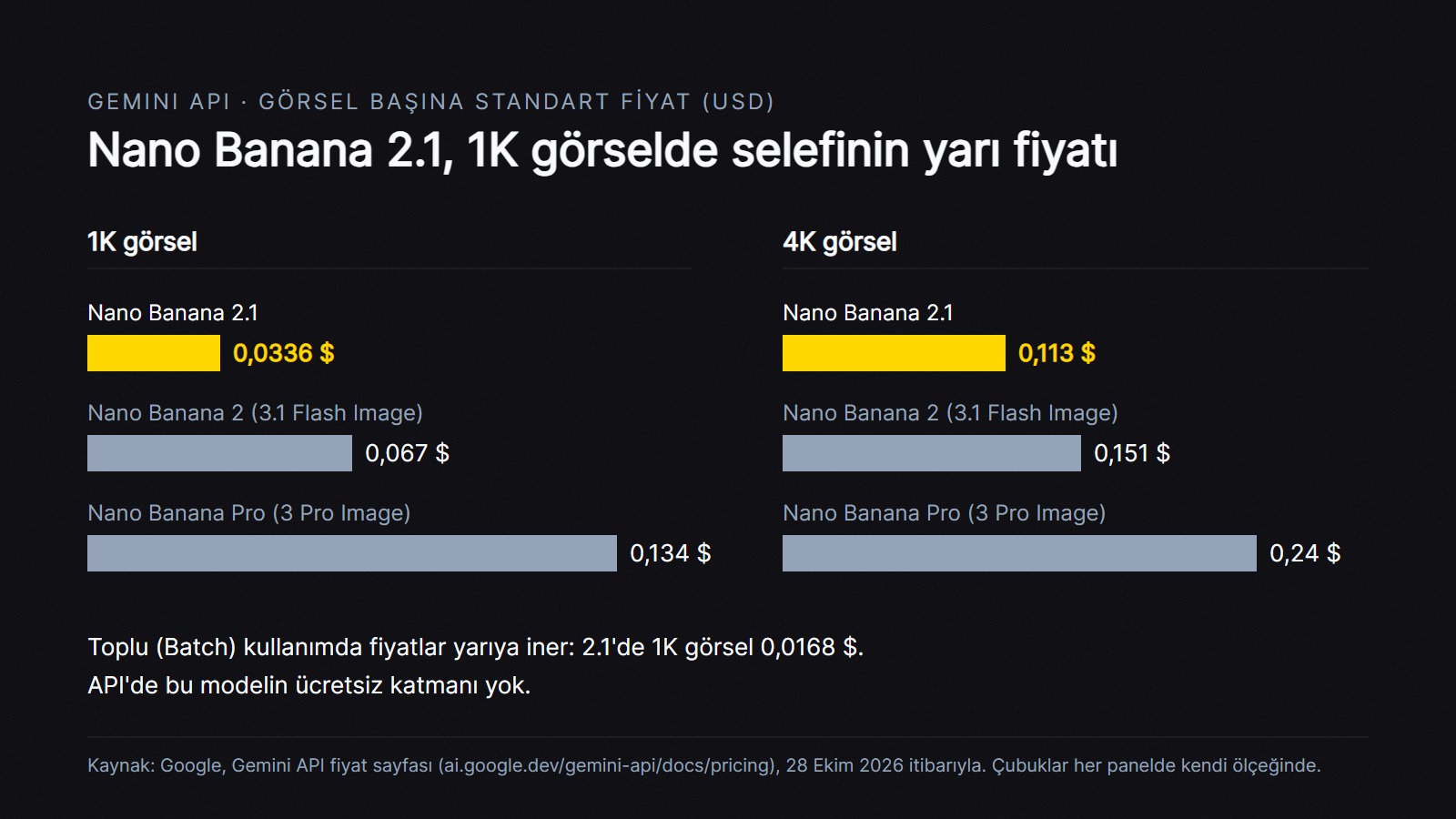
Developers connecting image generation to their own app. When the price is cut in half, the math on bulk generation changes; in Batch mode, a 1K image costs $0.0168 [A].
If you're looking for a logo or a corporate identity, honestly, this model isn't for you. A logo is a design decision, not a randomly generated image.
Source: Google, Gemini API pricing page, as of October 28, 2026.
Can I try it for free?
That's everyone's first question, so I gave it its own section. The answer is different in the app and in the API, and there's some uncertainty on the app side too.
In the Gemini app, free accounts can generate images and edit photos, with a daily quota; the size of the quota isn't stated. The press reported that 2.1 also came to the Gemini app [C], but Gemini's own release notes have no separate entry for 2.1, and exactly which version runs behind free accounts isn't clear from the official sources. If you're curious about the model change on the free plan, see the post where we covered the October 9 switch to a single model.
On the Google AI Studio side, the pricing page says AI Studio usage is free in all regions where it's offered [A]; Turkey is on the list of supported regions [A]. The same page shows 2.1's free API tier as "Not available" [A]. So if you're going to write code and call it from the API, you'll need to turn on billing.
Here's the before-and-after comparison:
Nano Banana 2 (3.1 Flash Image)
Nano Banana 2.1
1K image (standard)
$0.067
$0.0336
2K image
$0.101
$0.0504
4K image
$0.151
$0.113
Smallest output
0.5K (512 px)
1K
1:4, 4:1, 1:8, 8:1 ratios
No
Added
Status
Being deprecated, no shutdown date
Stable version
Prices from the Gemini API pricing page, as of October 28, 2026 [A]. Some third-party lists show a lower figure for 4K; the figure on the official page is $0.113.
Why bother with this when Midjourney or ChatGPT exist?
Let me be honest: there's no independent test comparing quality; all we have are Google's own claims. The tangible difference is in price and access.
Midjourney has no free plan, Basic starts at $10 a month, and its interface is in English and Korean. Its aesthetics are strong, but it has no official API, so you can't connect it to a store system. ChatGPT offers image generation on the free plan too, with limits. What sets Nano Banana 2.1 apart is that you can find the same model both in a free app and in an API at a little over 3 cents per image.
For a small business, I don't think the right question is "Which one is prettier?" It's "Which one places my product, with my text, without breaking it?" And you can only see that with your own product photo.
If cleaning up the background is your only concern, single-purpose tools like Photoroom still bring fewer surprises. And if you'd rather add the text by hand, Canva is right where it's always been; my contrarian view is that for most campaign images, having the model write the text is still an unnecessary risk.
Watermarks and commercial use
According to Google's guide, every image generated with this model carries a SynthID watermark [A]. It's invisible to the eye, but Google's verification tool can detect that the image was generated with AI. Keep this in mind if you're thinking of presenting a product photo as a "real shot."
The Gemini API terms say Google won't claim ownership of the generated content; they add that it may generate the same or similar content for others and that you're responsible for how it's used [A]. On free services, the content you send may be used for product development and may be read by human reviewers; the terms say not to send sensitive or personal information to these services [A]. Think twice before uploading a photo with a customer's face. This isn't legal advice, just a reading of the terms.
The one thing you can try today: a Turkish text test
0/5
A five-minute test; you'll see the result with your own product.
Does Nano Banana 2.1 write Turkish text correctly?
Google says text rendering has improved but doesn't list the supported languages; accuracy with Turkish characters isn't clear from the official sources. In every image you're going to publish, check the letters ç, ş, ğ, ı and İ one by one.
Is Nano Banana 2.1 free?
In the Gemini app, free accounts can generate images with a daily quota. In the API, this model has no free tier; as of October 28, 2026, a 1K image costs $0.0336 and a 4K image costs $0.113.
Can I use the images I generate in ads?
Under the Gemini API terms, Google doesn't claim ownership of generated content, and you're responsible for how it's used. The image carries a SynthID watermark. Be especially careful with real people's faces and other brands' products.
If you need support with product shoots or short videos, see the production services page; if you want to connect image generation to an automation, see the AI automation page. To see where you stand first: START YOUR FREE ANALYSIS .
Beyond GPT-6, ChatGPT got five new features in October 2026. Audio uploads are on paid plans, Slides on Pro and business plans, locked chats for everyone; Finances is US-only.
OpenAI released GPT-6.1 Terra on October 26, 2026: on the API, one million input tokens cost $1 and output tokens $5, half the price of its predecessor. It's available in ChatGPT Work and Codex on Plus and higher plans.
Google has deprecated Gemini 2.5 Pro and Flash; starting December 1, Gemini API requests are quietly redirected to 3.8 Flash and 3.5 Flash-Lite. What happens to price and quality, and which automations are affected?
+2
We use cookies to improve the site and measure advertising performance. Analytics and advertising cookies run only if you accept them. Details are in our Privacy Policy and Data Protection Notice.




 +2