Google your own brand name. Then type [Apple] and see what happens. Before November 2, the AI Overview on that search sat in the middle of the page, among the organic results. As of November 2, on desktop it sits in the right column, where the knowledge panel used to be.
Barry Schwartz wrote about the change on Search Engine Roundtable on November 2. There are examples for Zillow, Coca-Cola, and Google's own name as well. As of November 3, Google has made no statement. I don't read this as a minor layout tweak, because on a brand search people are already looking for you. What that screen says affects everything, from your ads to your organic result.
Quick answer: On November 2, 2026, without an announcement, Google moved the AI Overview on many brand searches out of the main results and into the right column on desktop. It concerns anyone whose brand name gets searched, especially businesses that spend ad budget on their brand keyword. The first thing to do: search your own name on desktop and on your phone, and check what the overview says about your brand.
What happened?
According to Schwartz, Chris Long and David McSweeney were the first to spot the change on X. On October 31, McSweeney wrote that the overviews were generally showing up in the right panel, sometimes further down. Long said Google had replaced the knowledge panel with the AI Overview on brand searches. All of Schwartz's example screenshots are US results. [A/C]
PPC Land covered the same story, stressing that Google made no announcement. The only sentence from a Google spokesperson was that the overviews create "new opportunities" for brands. Nothing was said about the placement. [C]
In Turkey: no verified example of the same layout in Turkish-language results had surfaced as of November 3. None of the sources include an example from Turkey. When it will arrive, or whether it will at all, is unknown, and I'm not going to guess.
Why does it matter?
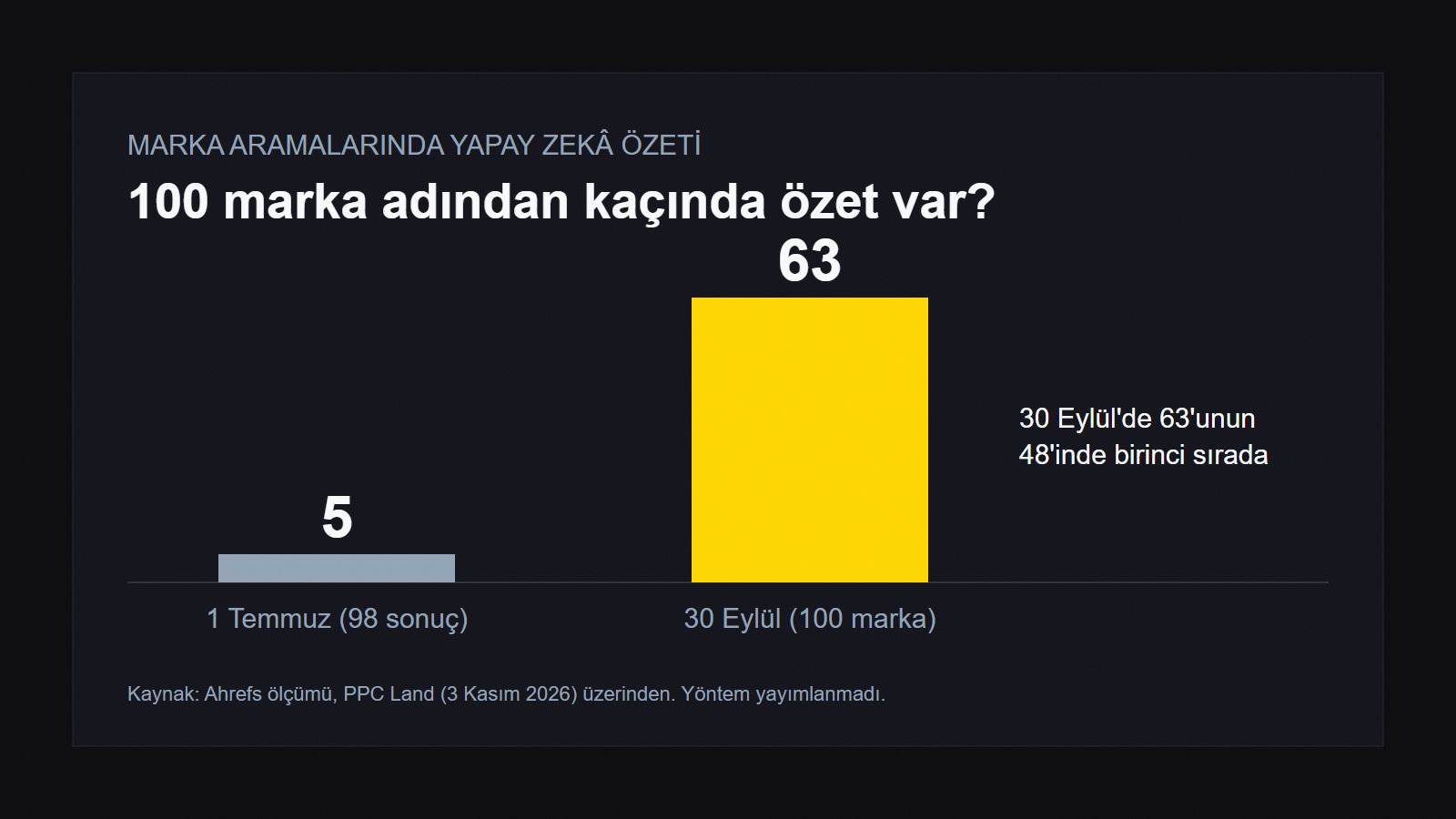
AI Overviews on brand searches aren't new; how common they've become is. According to Ahrefs' measurement across 100 brand names, on July 1 an overview appeared in 5 of 98 usable results; on September 30 it showed up for 63 of the 100 brands, and in 48 of them it was in the first position. A separate Ahrefs measurement says it saw an overview on 82.91% of brand keywords on September 29. The methodology behind neither figure has been published, so don't add them together. [B]
The second issue is accuracy. In the Zillow example PPC Land cites, the overview text gives the founding year as 2006, while the fact line in the same panel says 2004. For a brand, that's a small inconsistency, but it sits where everyone can see it. [C]
The third is money. According to Digiday's conversations with 18 media buyers, some agencies are putting 10–20% of their Google search budgets up for discussion; one said that could rise to 20–30% around Black Friday. These are individual estimates, not audited data. The same article also notes that Alphabet's search ad revenue grew 12% in the third quarter, the slowest growth of the year. [C]
If you ask me, the real news here isn't the placement. It's now clear that Google treats brand searches as "a place where answers get generated" too.
Everyone is breathing a sigh of relief: "it moved to the right column, it's less intrusive." Schwartz finds it better too. I'm not so sure. For years, the right column was where brand information lived, in other words, where the eye already goes. Putting the overview there doesn't make it invisible; if anything, it presents it as if it were an authoritative source. A wrong year, a wrong address, a missing service. All of it looks "official."
There's one more thing, and nobody is measuring it: how this placement affects clicks on brand searches. Neither Google nor anyone independent has published a figure on it. That's why I'm skeptical of anyone saying "clicks will drop" or "clicks will rise."
What changes for your brand?
The knowledge panel and the overview are blending together. In the right column, the customer is reading not from your site but from a text the model has compiled. If that text is wrong, the way to fix it is to keep clear information on your own site and on trusted third-party sources.
Small, single-location business. If your brand name doesn't get searched much, an overview is less likely to appear. But if your name overlaps with a generic word (a neighborhood, a profession), another business's information could be written in place of yours. You can't know without checking.
If you run ads on your brand keyword, also read the sentence on Google's Performance Max help page: Performance Max campaigns "may filter out navigational and brand-specific searches in favor of dedicated brand Search campaigns." Half of the budget debate comes from here.
Lower your click expectations, but don't overdo it either. In Cyrus Shepard's small single-site study, the click-through rate of AI surfaces came out at about 0.9%; he himself says the data is small and estimated. One site's result is not your site's result. [C]
Before
Since November 2 (US examples)
Where the overview sits
In the middle of the main results
Right column on desktop, sometimes further down
Knowledge panel
Owns the right column
In most examples, the overview is in that spot
Proven impact
None
The effect on clicks has not been measured
The one thing to do: Search your own brand name in an incognito window, on both desktop and phone, and if an overview appears, compare every sentence in it with your site. If you find a wrong piece of information (founding year, address, list of services), take a screenshot and state that information in a clear sentence on your own site. You don't need to spend any money.
Today's Radar
News
Why people are talking about it
Who it concerns
A shared robots.txt signal from Google and Bing, __usage_ai-training (October 30)
Opting out of AI training will take a single line; Google's support is targeted for 2027, and as of October 30 the draft is at the IETF
As of November 3, there is no verified Turkish example. All the screenshots in the sources are US results, and Google has made no statement. Checking your own search result is more reliable than guessing.
Can I stop an AI Overview from appearing on my brand search?
The official documentation doesn't list a switch just for brand searches. There are page-level restrictions such as nosnippet, but they affect how your whole site appears in search. Rather than trying to turn the overview off, it makes more sense to focus on making sure the information in it is correct.
Should I stop running ads on my brand keyword?
None of the data in this post says "yes" to that. The budget debate rests on agency estimates, not on an audited measurement. Look at the conversion and cost data for branded searches in your own account; the decision comes from there.
Google gave the spam update it launched on September 24, 2026 up to two weeks to roll out; the first hard wave came over the September 25–27 weekend. Who's at risk, and what should you do this week?
Google announced that the September 2026 spam update finished on October 8; the rollout took 13 days and 17 hours. Here's what to look at, and what not to touch, if your traffic dropped.
October 3, 2026: Google updated two of its guides on October 1; all AI-generated content should be manually reviewed before publishing, and fabricated author profiles are now explicitly treated as deception.
SEO8 min
We use cookies to improve the site and measure advertising performance. Analytics and advertising cookies run only if you accept them. Details are in our Privacy Policy and Data Protection Notice.