I opened GitHub's weekly trending list this morning: the vast majority of the 14 projects are either coding agents, tools that help agents, or infrastructure for running a model. This week, the projects collecting stars are mostly the ones that answer the question "how do I run an agent reliably?"
Some of them are for developers, and there's nothing for a small business owner to do with them at their desk tomorrow. Still, the list is worth a look, because what developers use today shows up inside agencies and automation setups a few months later. For each tool I answered the same questions: what it does, what number measured its rise, who it's useful for, whether it's free, and whether it supports Turkish.
Rising this week
Cloudflare security-audit-skill: a package that has an agent run your security audit
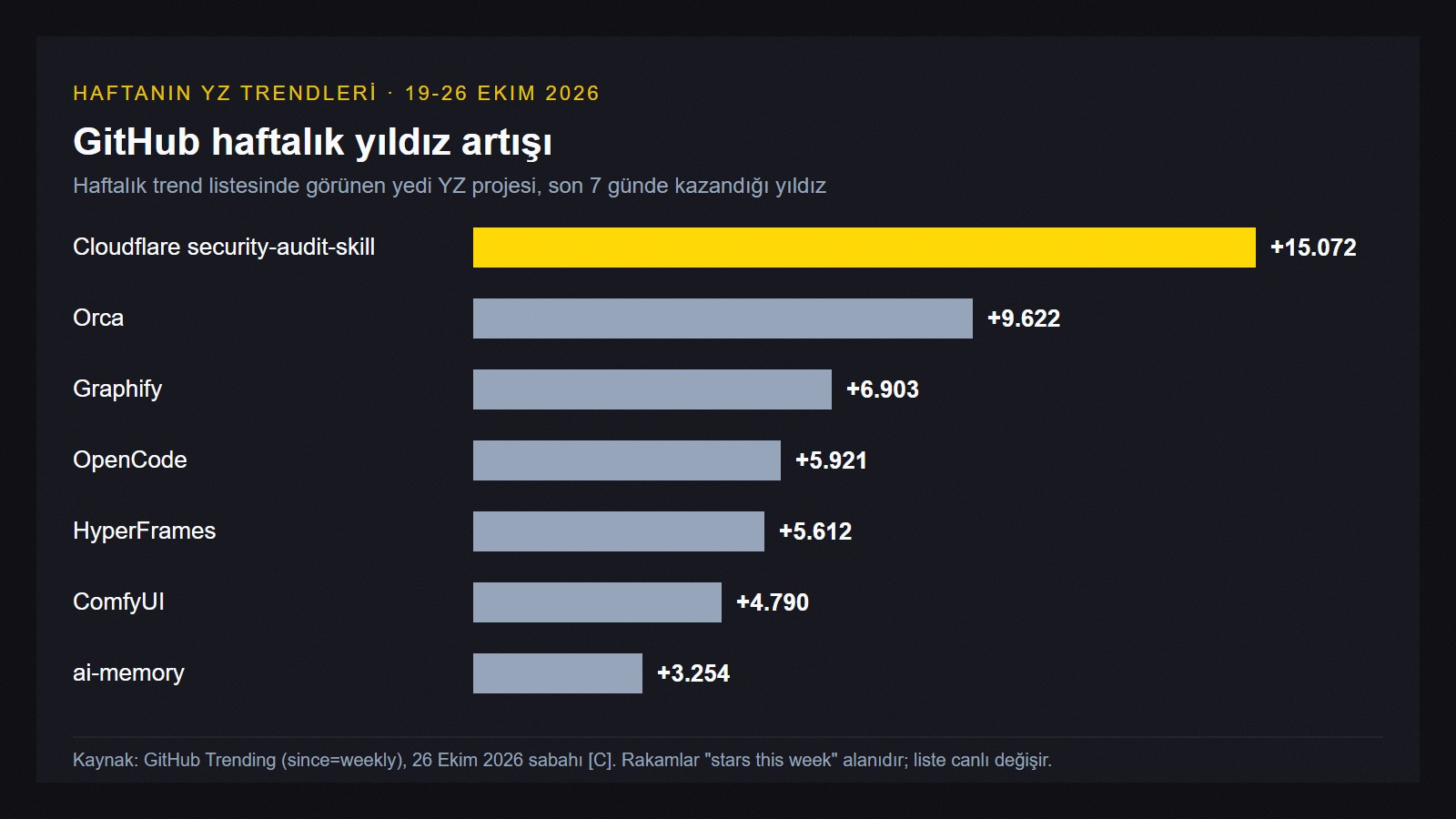
Number one on GitHub's weekly list: +15,072 stars, 46,860 in total [C]. The repository is MIT-licensed. It has a coding agent audit a software project in six stages: mapping, vulnerability hunting, a separate agent trying to refute the candidates, a structured report, independent verification and a final report [A].
Here's the interesting part: the repository isn't new. Cloudflare published it on June 18, 2026, along with its own blog post, so a four-month-old repository blew up this week. Why it happened this week is not clear in the official source. The figures Cloudflare gives on its blog for its own internal system are striking too (about 20,000 raw candidates, close to 12,000 of which passed verification), but the company also writes that these were found in its own test environment and that there were no unpatched vulnerabilities in production [A]. It wouldn't be right to carry those numbers over to your site and say "it will find this many vulnerabilities."
Who it's useful for: Businesses that had a developer build their website or app and have access to its source code; the real user is their developer.
Is it free: The skill is MIT-licensed and free. The usage cost of the model the agent runs on is separate, and a multi-agent audit burns a lot of tokens; the amount isn't in the official source.
Turkish support: The documentation is in English; the language of the report is not clear in the official source.
Orca: several coding agents at once, each in its own working folder
+9,622 stars, 105,808 in total [C]. It's a desktop app (macOS, Windows, Linux); it runs each agent in a separate git worktree and lets you monitor the results from one place. There's a phone app too: you get a notification when an agent finishes its task, and you can give new instructions from there [A]. It's MIT-licensed; you connect the agents with your own subscription, so the agents' costs are separate.
Who it's useful for: Software teams. Someone who wants to give the same task to five agents and pick the best result.
Turkish support: Turkish isn't among the README translations; the interface language is not clear in the official source.
Graphify: turns a codebase into a queryable knowledge map
It's already in our atlas: Graphify. +6,903 stars, 135,242 in total [C]. It takes a code folder, its documentation, SQL schemas and PDFs and maps the connections between them into a graph; according to the developer, it runs locally with deterministic (non-AI) parsing and doesn't need a vector database [A]. It's Apache-2.0 licensed and free. Four releases came out during the week (0.9.92 through 0.9.95, October 16-23); according to the release notes, the last two include security hardening around installation and importing [A].
Who it's useful for: Teams inheriting old software that nobody fully understands.
Turkish support: It's a command-line tool; there's no Turkish interface, and whether it works with Turkish documents is not clear in the official source.
ai-memory: keep your memory even when you switch agents
+3,254 stars, 13,517 in total [C]. Written in Rust, MIT-licensed. The idea: when you move from one coding agent to another, you don't have to re-explain the architecture and the approaches that were tried and failed; more than twenty agent tools write to a single shared memory. The memory lives in plain Markdown files and you run it on your own server [A]. Basic Memory in our atlas also addresses the need to keep memory in plain Markdown notes; ai-memory adds handoff between agents and a shared server.
Who it's useful for: Small software teams using more than one coding agent.
Turkish support: Not clear in the official source.
DeepSeek V4.1 Flash 1017: a cheap model, number one on Hugging Face this week
Released on October 17, the model was number 1 on Hugging Face's "trending" ranking on the morning of October 26: 2,982 likes, 85,275 downloads [C]. It's MIT-licensed and has a 1 million token context window. According to DeepSeek's own table, compared with the previous Flash release it went from 31.2 to 42.3 on Terminal-Bench 4.0; that's the company's own measurement, not an independent result [A].
Pricing in the DeepSeek API, per the official page as of October 26, 2026: per million input tokens, $0.30 during peak hours and $0.15 off-peak; for output, $1.20 and $0.60. Peak hours are 01:00-04:00 and 06:00-10:00 (UTC) on weekdays. The old deepseek-v4-flash name still works but now routes to this model [A].
Who it's useful for: People building automations that process large numbers of short texts (classification, summarization). If you'll be sending customer data, read the privacy terms first.
Turkish support: Turkish performance is not clear in the official source.
Claude Duet: an assistant that works without being asked, but US-only for now
Anthropic introduced Duet as a research preview on October 21; it's number 5 on Product Hunt's weekly list, with 343 votes [C]. It prepares a morning briefing from your connected apps, checks in every few hours and lets you know if something needs attention; it asks for confirmation before actions like sending messages, making payments or deleting files [C]. For now there's a waitlist for Pro and Max subscribers in the US, and background checks count toward your existing plan limit [C]. Claude is already in our atlas.
Who it's useful for: Nobody yet; there's no information that access has opened in Turkey.
Turkish support: Not clear in the official source.
Labels are taken from each tool's official release notes or announcement; release dates as of October 26, 2026.
Overhyped
FAQ
Does a star count show that a tool is good?
No, it shows interest. Cloudflare's skill is a four-month-old repository that picked up 15,000 stars in a single week; that tells you a lot of people saw it that week, not that it works. Test a tool with a small sample of your own data before you bring it into your business.
Which tools on this list are useful for a small business?
Concretely, two this week: Voxtral, which turns audio recordings into text, and DeepSeek Flash, which processes large numbers of short texts cheaply. The rest are for software teams; your developer or agency can use them, and you don't have to set them up yourself.
How do you pick the week's trends?
GitHub's weekly trending list, Hugging Face's trending ranking and Product Hunt's weekly list. A tool only makes it into the post if it has a measurable rise and a source for it; price and Turkish support are taken from the official page, and if the page doesn't say, it's marked "not clear."
If you want to pin down how to fit an AI tool into your business, check the AI consulting page; if you want to automate your repetitive tasks, check the AI automation page. To see where you stand first: START YOUR FREE ANALYSIS .
Beyond GPT-6, ChatGPT got five new features in October 2026. Audio uploads are on paid plans, Slides on Pro and business plans, locked chats for everyone; Finances is US-only.
OpenAI released GPT-6.1 Terra on October 26, 2026: on the API, one million input tokens cost $1 and output tokens $5, half the price of its predecessor. It's available in ChatGPT Work and Codex on Plus and higher plans.
Google has deprecated Gemini 2.5 Pro and Flash; starting December 1, Gemini API requests are quietly redirected to 3.8 Flash and 3.5 Flash-Lite. What happens to price and quality, and which automations are affected?
+2
We use cookies to improve the site and measure advertising performance. Analytics and advertising cookies run only if you accept them. Details are in our Privacy Policy and Data Protection Notice.






 +2